 Safekipedia
Tshangla language
Adapted from Wikipedia · Discoverer experience
The Tshangla language is a special kind of language that belongs to a big group called Sino-Tibetan. It is part of something called the Bodish branch, which is closely related to the Tibetic languages.
People mainly speak Tshangla in the eastern part of Bhutan. Because it is easy for many people there to understand, it is used as a common language for everyone to talk to each other.
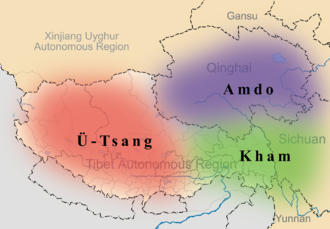
Besides Bhutan, Tshangla is also spoken in a nearby area called Tawang in the Indian state of Arunachal Pradesh, as well as in the Pemako region of Tibet. In Bhutan, Tshangla is the main language that was spoken before Tibetan became more common.
Classification
Tshangla is often thought to be close to the Tibetic languages. Some experts say it belongs to the East Bodish languages, while others are not sure where it fits within the bigger Sino-Tibetan language family and want more study.
Another expert says Tshangla is a Bodish language but points out that it is related to, but not directly from, Classical Tibetan. Recent research suggests Tshangla might not be very close to Bodish at all and could be placed in its own special group of languages.
Varieties
Tshangla has several different ways of speaking that people find hard to understand across each other. These include Trashigang, Dungsam, Dirang, and Bjokapakha. The way people speak in Trashigang town is used to help everyone communicate together. Dungsam keeps older features, while Dirang and Bjokapakha are quite different.
Number of speakers and status of the language
Tshangla is mainly spoken in the east and southeast parts of Bhutan, especially in the Trashigang district. People there call it “Sharchopkha,” which means “the people in the east” in Dzongkha, Bhutan’s national language.
The language is also spoken in the Indian state of Arunachal Pradesh and in southeast Tibet. There are about 170,000 people who speak Tshangla. Most of them live in Bhutan, with smaller groups in India and Tibet. Many children still learn Tshangla as their first language, so it is not in danger of disappearing. In eastern Bhutan, Tshangla is very common and helps people communicate with each other.
Even though Tshangla is widely used, it is not officially recognized as a written language in any country. This means it is not taught in schools or used in official documents. However, some people can read and write it using the Tibetan Uchen script. Tshangla is used on radio and television, even though it is not clear exactly how it is written for these broadcasts. The official language of Bhutan is Dzongkha, but Tshangla is one of the country’s many native languages and the most spoken among the native Sino-Tibetan languages.
Writing system
Tshangla is usually a spoken language and does not have an official status in any country. When people write it, they most often use the Tibetan script. However, experts have created a romanized transcription system to write it using regular letters.
Phonology
The Tshangla language has special sounds, called phonemes, that help people talk. Some sounds that are not usually used in Tshangla can change a little when people speak them. For example, the sound /ɬ/ often turns into /l/, and /dz/ becomes /z/.
Tshangla has certain sounds at the start of words and some special combinations of sounds. At the end of words, only a few sounds are used, like /p/, /t/, /k/, /s/, /m/, /n/, and /ŋ/.
Tshangla also has different vowel sounds. Some vowels come from other languages like Tibetan, Dzongkha, and Chöke. There are special combinations of vowels in Tshangla words, such as /ai/ and /au/, and sometimes /oi/ and /ui/ appear in certain situations.
| Labial | Alveolar | Retroflex | Palatal | Velar | Glottal | ||
|---|---|---|---|---|---|---|---|
| Approximant | w ⟨w ཝ⟩ | j ⟨y ཡ⟩ | h ⟨h ཧ⟩ | ||||
| Nasal | m ⟨m མ⟩ | n ⟨n ན⟩ | ɲ ⟨ny ཉ⟩ | ŋ ⟨ng ང⟩ | |||
| Plosive | voiceless | p ⟨p པ⟩ | t ⟨t ཏ⟩ | ʈ ⟨tr ཏྲ⟩ | k ⟨k ཀ⟩ | ||
| aspirated | pʰ ⟨ph ཕ⟩ | tʰ ⟨th ཐ⟩ | ʈʰ ⟨thr ཐྲ⟩ | kʰ ⟨kh ཁ⟩ | |||
| voiced | b ⟨b བ⟩ | d ⟨d ད⟩ | ɖ ⟨dr དྲ⟩ | ɡ ⟨g ག⟩ | |||
| Affricate | voiceless | ts ⟨ts ཅ⟩ | tɕ ⟨tsh ཆ⟩ | ||||
| voiced | (dz ⟨dz ཛ⟩) | dʑ ⟨j ཇ⟩ | |||||
| Fricative | voiceless | s ⟨s ས⟩ | ɕ ⟨sh ཤ⟩ | ||||
| voiced | z ⟨z ཟ⟩ | (ʑ ⟨zh ཞ⟩) | |||||
| Lateral | voiceless | (ɬ ⟨lh ལྷ⟩) | |||||
| voiced | l ⟨l ལ⟩ | ||||||
| Flap | r ⟨r ར⟩ | ||||||
| Romanized | |
|---|---|
| Hello | Kuzu zangpo |
| Goodbye | Lassola |
| House | Phai |
| Boy | Za |
| Girl | Zamin |
| Friend | Charo (Bhutan)/Tosang |
| Younger brother | Bonying |
| Younger sister | Usa (Bhutan)/Zi |
| Older brother | Ata |
| Older sister | Ana |
| Romanized | |
|---|---|
| How are you? | Hang ten cha ya |
| What is your name? | Na ga mingsho hang ya? |
| My name is Galey | Ja ga ming Galey gila |
| I live in Bhutan | Jang druk ga choncha |
| I know Tshangla | Ji tshangla sencha |
| Number | Tshangla | Number | Tshangla |
|---|---|---|---|
| 1 | Thur | 11 | Songthur |
| 2 | Niktsing | 12 | Songniktsing |
| 3 | Sum | 13 | Songsum |
| 4 | Phi | 14 | Songphi |
| 5 | Nga | 15 | Songnga |
| 6 | Khung | 16 | Songkhung |
| 7 | Zuum | 17 | Songzuum |
| 8 | Yen | 18 | Songyen |
| 9 | Guu | 19 | Songguu |
| 10 | Say | 20 | Songsay |
Tone
Most dialects of the Tshangla language do not change words based on how they are said, but the language as a whole might be starting to develop this feature. Some specific dialects, like those spoken in Central Monpa and Padma-bkod, have started using high and low tones instead of differences in voiced and voiceless sounds.
Grammar
Tshangla grammar includes nouns, adjectives, adverbs, and verbs. The usual word order is subject–object–verb. The language adds meaning to words by sticking smaller parts together, but most everyday words have just one or two sounds.
Nouns can be grouped in different ways. Words that describe how or which noun come before the noun, while words that tell about the noun’s role or number come after it.
Tshangla often leaves out words that are understood from the talk or situation. When talking about two people, you don’t need to say “they,” just the number, like ro nyiktsing, meaning “the two of them.”
Verbs can show if something is done to something else or just happening on its own. For example, yekpa means “to speak” when someone is doing the speaking, but “to be called” when it’s happening without someone doing it on purpose.
| Singular | Dual | Plural | |
|---|---|---|---|
| 1p | jang | a-ching | ai |
| 2p | nan | na-ching | nai |
| 3p | ro | da-ching | rokte |
Dialects
Tshangla dialects form a group centered around the town of Trashigang, which is considered the main dialect by speakers. People can still understand each other even with these differences, and many words come from Classical Tibetan (Chöke).
In Arunachal Pradesh, the Monpa tribe speaks Tshangla in the Kalaktang and Dirang area of West Kameng. Around 6,000 people speak this "Central Monpa" dialect. More Tshangla speakers live in Kathmandu, Darjeeling, and Assam.
In Bhutan, Tshangla sounds very similar to the Tshangla (Chinese: 仓洛; pinyin: Cāngluò) spoken in southeastern Tibet, also called "Mêdog (Bomê) Monpa". The Bomê County region of Tibet, formerly known as Padma-bkod or Pemako, still has some of these Tshangla-speaking communities.
Related articles



This article is a child-friendly adaptation of the Wikipedia article on Tshangla language, available under CC BY-SA 4.0.