Universities and research institutions in Berlin
The Berlin-Brandenburg capital region is one of the most productive centers of higher education and research in the world. It has the largest number of universities and colleges in Germany. The city has four public research universities and 27 private, professional, and technical colleges (Hochschulen), which offer a wide range of subjects. Studying at public universities in the German system is free of tuition.
In the winter term of 2014/15, 175,000 students were enrolled. About 20% of them have an international background. Student numbers have grown by 50% over the last 15 years. The Humboldt Universität zu Berlin (HU Berlin) has 34,000 students, and the Freie Universität Berlin (Free University of Berlin, FU Berlin) also has 34,000. The Technische Universität Berlin (TU Berlin) has around 30,000 students. The Universität der Künste (UdK) has about 4,000 students, and the Berlin School of Economics and Law has about 10,000.
Forty Nobel Prize winners are connected to the universities based in Berlin.
History
The Prussian Academy of Arts was an art school set up in Berlin, Brandenburg, in 1694/1696 by prince-elector Frederick III. He was also Duke Frederick I of Prussia and later became king in Prussia. The academy had a strong influence on art in the German-speaking world throughout its existence. In 1945 it dropped "Prussian" from its name. After two separate academies of art were founded in 1954, one for East Berlin and one for West Berlin, the old academy was finally closed in 1955. The two separate academies merged in 1993 to form Berlin's present-day Academy of Arts.
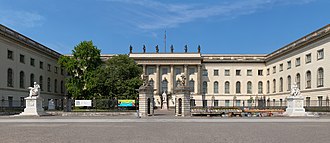
The Humboldt University of Berlin is one of Berlin's oldest universities. It was founded in 1810 as the University of Berlin by the liberal Prussian educational reformer and linguist Wilhelm von Humboldt. His model for universities has strongly influenced other universities in Europe and the Western world.
Universities
Berlin has six large, internationally known research universities in the Berlin-Brandenburg capital region. The Free University of Berlin (FU Berlin), the Humboldt University of Berlin (HU Berlin), the Charité, and the Technische Universität Berlin (TU Berlin) are each a German University of Excellence and part of the Berlin University Alliance. The Charité is a medical school and one of the largest university hospitals in Europe. The Berlin University of the Arts (UdK) is the largest art and design school in Europe, and the University of Potsdam is in the southwestern part of the Berlin urban region.
Berlin also has seven recognized private universities, including ESCP Europe Wirtschaftshochschule Berlin, the Hertie School, the MSB Medical School Berlin, the Steinbeis-Hochschule Berlin, the ESMT European School of Management and Technology, and the International Psychoanalytic University Berlin. The city has several public or private universities of applied sciences, such as Alice Salomon Hochschule Berlin, Bard College Berlin, Berlin School of Economics and Law, and Berlin University of Applied Sciences and Technology.
Research institutions
Berlin has many research institutions, including the Fraunhofer Society, the Leibniz Association, the Helmholtz Association, and the Max Planck Society. Many of these are independent of the city's universities or only loosely connected to them. In 2012, around 65,000 scientists were working in research and development. The city is also one of the centers of knowledge and innovation communities of the European Institute of Innovation and Technology (EIT).
Nobel Prize winners
Berlin's universities have 43 Nobel Prize winners connected to them:
1901 Jacobus Henricus van 't Hoff (Chemistry) 1901 Emil Adolf von Behring (Physiology or Medicine) 1902 Hermann Emil Fischer (Chemistry) 1902 Theodor Mommsen (Literature) 1905 Adolf von Baeyer (Chemistry) 1905 Robert Koch (Physiology or Medicine) 1907 Albert Abraham Michelson (Physics) 1907 Eduard Buchner (Chemistry) 1908 Paul Ehrlich (Physiology or Medicine) 1909 Karl Ferdinand Braun (Physics) 1910 Otto Wallach (Chemistry) 1910 Albrecht Kossel (Physiology or Medicine) 1910 Paul Heyse (Literature) 1911 Wilhelm Wien (Physics) 1914 Max von Laue (Physics) 1915 Richard Willstätter (Chemistry) 1918 Fritz Haber (Chemistry) 1918 Max Planck (Physics) 1920 Walther Nernst (Chemistry) 1921 Albert Einstein (Physics) 1925 Gustav Ludwig Hertz (Physics) 1925 James Franck (Physics) | 1925 Richard Adolf Zsigmondy (Chemistry) 1928 Adolf Otto Reinhold Windaus (Chemistry) 1929 Hans von Euler-Chelpin (Chemistry) 1931 Otto Heinrich Warburg (Physiology or Medicine) 1932 Werner Heisenberg (Physics) 1933 Erwin Schrödinger (Physics) 1935 Hans Spemann (Physiology or Medicine) 1936 Peter Debye (Chemistry) 1939 Adolf Butenandt (Chemistry) 1944 Otto Hahn (Chemistry) 1950 Kurt Alder (Chemistry) 1950 Otto Diels (Chemistry) 1953 Fritz Albert Lipmann (Physiology or Medicine) 1953 Hans Adolf Krebs (Physiology or Medicine) 1954 Max Born (Physics) 1956 Walther Bothe (Physics) 1986 Ernst Ruska (Physics) 1991 Bert Sakmann (Physiology or Medicine) 1994 Reinhard Selten (Economics) 2007 Gerhard Ertl (Chemistry) 2009 Herta Müller (Literature) |

Quiz time!
5 questions about Universities and research institutions in Berlin
What is special about studying at public universities in the German system?
Pictures
Keep exploring



This article is a child-friendly adaptation of the Wikipedia article on Universities and research institutions in Berlin, available under CC BY-SA 4.0.
Images from Wikimedia Commons. Tap any image to view credits and license.