 Safekipedia
Unmanned aerial vehicle
Adapted from Wikipedia · Discoverer experience
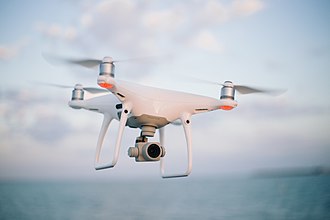
An unmanned aerial vehicle (UAV) or unmanned aircraft system (UAS), commonly known as an aerial drone or simply drone, is an aircraft with no human pilot, crew, or passengers on board, but rather is controlled remotely or is autonomous. These flying machines can be guided by a person from the ground or can follow pre-programmed paths all on their own.
UAVs were originally developed through the twentieth century for military missions too "dull, dirty or dangerous" for humans, and by the twenty-first had become essential assets to most militaries. Over time, as technology made controlling drones easier and cheaper, their use grew far beyond the battlefield.
Today, drones are used in many everyday and important ways. They help take aerial photography, monitor forests and rivers, support precision agriculture, watch over weather observation and environmental monitoring, assist police and surveillance, inspect bridges and towers, deliver products, and even race for fun in drone racing.
One big challenge with drones is making sure they follow privacy laws, so people’s personal spaces and information stay safe while these flying helpers do their jobs.
Terminology
Many words describe aircraft that fly without anyone on board. An unmanned aerial vehicle (UAV) is a powered aircraft that has no human pilot. It uses special forces to stay in the air and can fly by itself or be controlled from far away. People often use the word "drone" for both military and civilian UAVs.
UAVs are part of an unmanned aircraft system (UAS), which includes the aircraft, a person controlling it on the ground, and the equipment that sends information between them. This helps make flying these aircraft safer and more effective. Other names for these systems include unmanned aircraft vehicle system (UAVS) and remotely piloted aircraft system (RPAS).
Classification types
UAVs, or drones, can be grouped in many ways, such as by size, weight, or the height they can fly. For example, some drones are small enough to hold in your hand, while others can fly higher than any airplane. They can also be remote-controlled by a person or fly on their own.
Drones can run on different power sources like batteries, fuel, or even solar panels. Each type has its own benefits, like quieter noise or longer flight times. Some drones can stay in the air for a long time by using energy from the sun!
| Group: | Group 1 | Group 2 | Group 3 | Group 4 | Group 5 |
|---|---|---|---|---|---|
| Size | Small | Medium | Large | Larger | Largest |
| Max takeoff weight | (9.1 kg) | > 20 & | > 55 & | > 1,320 lb (600 kg) | > 1,320 lb (600 kg) |
| Operating altitude | (370 m) | (1,100 m) | (5,500 m) | (5,500 m) | > 18,000 ft (5,500 m) |
| Speed | (190 km/h) | (460 km/h) | (460 km/h) | Any speed | Any speed |
| Range category | Very close | Close | Short | Medium | Long |
|---|---|---|---|---|---|
| Range (km): | > 5 & | > 50 & | > 150 & | > 650 | |
| Endurance (hr): | 0.5 – 0.75 | 1–6 | 8–12 | 12–36 or 48 | > 36 or 48 |
| Category | Micro/Very small | Mini/Small | Medium | Large |
|---|---|---|---|---|
| Length/wingspan: | > 50 cm & | 5 –10 m | > 10 m |
History
Main article: History of unmanned aerial vehicles
The history of drones began in the 1800s when Austrian forces used balloons to try to attack Venice in 1849. These early attempts were not very successful. In 1903, a Spanish engineer introduced a radio-controlled system to test airships safely.
The development of drones sped up in the 1900s, mainly to help train military personnel. Early drones were like practice targets. During World War II, drones were used more widely, including by Nazi Germany and Italy. After the war, drones continued to evolve, with the United States and other countries developing new types for surveillance and combat.
In the 2000s, drones became more advanced and widely used. The United States and other countries used them in conflicts, and companies like DJI made drones available to the public. Today, drones are used in many ways, from military operations to space exploration, like the Ingenuity helicopter on Mars.
Design
Crewed and uncrewed aircraft share many similar parts, but UAVs do not have a cockpit or life-support systems. This allows them to be smaller and lighter, especially when carrying lightweight payloads like cameras. Military UAVs can carry weapons but are generally lighter than aircraft designed for people.
Small civilian UAVs, often called drones, can be made from lighter materials because they don’t need life-critical systems. The quadcopter design, with four rotating blades, is popular for small drones. UAVs are controlled remotely using cameras and digital commands, or they can fly on their own with autopilot software.
UAVs can be built in many shapes since they don’t need a cockpit or human-friendly design. Common shapes include flying wings and blended wing bodies, which are light and hard to detect. Larger UAVs often have a clear body with a tail for stability. For flying straight up or hovering, quadcopters are common for small drones, while larger ones may use many rotors for safety.
Traditional engines are still used for long-distance flights, but electric power is more common for shorter missions. Small drones usually use lithium-polymer batteries, while some larger ones use hydrogen fuel cells for longer flight times. Flapping-wing drones, inspired by birds and insects, are used for quiet, stealthy missions.
Main article: Short-life engine
Computer control systems
UAV computing has grown with technology, starting from simple analog controls to today's advanced microcontrollers and single-board computers. Modern UAV control systems, often called flight controllers, include a main processor, a backup processor, and sensors like accelerometers and gyroscopes all in one unit. In 2024, a new standard was set for UAV flight controllers to help drones fly safely in busy air spaces.
UAVs use many sensors to know where they are and what’s around them. They also have devices to control their movement, like motors and propellers. They run special software that helps them fly automatically, follow routes, and even avoid obstacles. Some drones can complete tasks all by themselves, like taking off, landing, or flying to a specific location.
Performance considerations
UAVs can be programmed to perform special maneuvers and land on different surfaces. Some can even perch on vertical surfaces and climb to better spots for communication.
UAVs do not have pilots, so their endurance is not limited by human needs. Small engines and special cooling help them fly longer. New technologies like hydrogen fuel cells and solar power could let UAVs stay in the air for hours or even weeks. Some solar-powered UAVs can fly so high they almost reach space, helping with weather monitoring and other tasks. Engineers work to make UAVs more reliable and able to keep flying even if some parts fail.
Main article: PHASA-35
Main articles: Resilience engineering, Fault tolerance
| UAV | Flight time hours:minutes | Date |
|---|---|---|
| Boeing Condor | 58:11 | 1989 |
| General Atomics Gnat | 40:00 | 1992 |
| TAM-5 | 38:52 | 11 August 2003 |
| QinetiQ Zephyr Solar Electric | 54:00 | September 2007 |
| RQ-4 Global Hawk | 33:06 | 22 March 2008 |
| QinetiQ Zephyr Solar Electric | 82:37 | 28–31 July 2008 |
| QinetiQ Zephyr 7 | 336:22 | 9–23 July 2010 |
Applications
Main article: List of unmanned aerial vehicle applications
Autonomous drones are changing many areas because they can fly far from people while helping work, saving money, and keeping sites safe. They are also used for things like delivering packages, as shown by Amazon Prime Air, and bringing important health supplies.
UAVs have many uses in civilian, commercial, and military jobs. These include recreation, helping during disaster relief, studying archeology, protecting biodiversity and habitat, aiding law enforcement, and even in terrorism.
Warfare
Main articles: Drone warfare, Unmanned combat aerial vehicle, Loitering munition, One-way attack drone, Unmanned surveillance and reconnaissance aerial vehicle, Miniature UAV, Micro air vehicle, and Target drone
By 2020, seventeen countries had armed UAVs, and over one hundred countries used them for military jobs. Top makers include Baykar, General Atomics, and Elbit Systems. Since 2010, China has grown a lot in making military drones. In the early 2020s, Turkey also grew in this area.
Israel once focused on small surveillance drones, exporting many of them. The US had over nine thousand military UAVs in 2014. Chinese drone companies have exported many drones since 2010. Twelve of eighteen countries that got military drones from 2010 to 2019 bought them from China. This grew more in the 2020s because of better Chinese technology and wars like the Russo-Ukrainian war and the Gaza war.
For secret missions, tiny micro UAV drones that look like birds or insects can fly without being noticed. These are used for watching, attacking, clearing mines, and practice.
Since the Russo-Ukrainian war began, both Ukraine and Russia have quickly made new drones. Ukraine used drones to send medical supplies to hurt soldiers. Both sides made new drones very fast because they worked closely with companies.
The 2026 Iran war showed that many countries needed better ways to stop drones after many attacks on places like airports and energy centers. Iran used lots of cheap drones, and stopping them cost more than the drones themselves. New, cheaper drone hunters were made to stop these attacks.
Civil applications
The market for civilian drones is led by Chinese companies. DJI alone had seventy-four percent of this market in 2018. By 2025, Chinese companies held ninety percent of the world market, with DJI making up eighty percent. The US stopped some of these drones, but they are still very popular.
By May 2021, over eight hundred thousand UAVs were registered in the US, with forty-two percent for business and fifty-eight percent for fun. People are buying drones with more features, especially expensive ones.
Civil drones are used a lot by police and military because they are cheap and useful. Since 2018, the Israeli army has used DJI drones for watching. Chinese and American police also use them. Both Ukraine and Russia used DJI drones in their war, getting them from many places.
Entertainment
See also: Drone art and Drone racing
Drones are used at night for shows that are safer and better for the environment than fireworks. They can also race, with or without special glasses.
Aerial photography
See also: Drone journalism
Drones are great for taking pictures from the air. Small drones let one person fly and take pictures. Bigger drones have a pilot and a camera person. Drones can reach dangerous or far places.
Environmental monitoring
UAVs help watch the environment by taking very detailed pictures and data. This helps study nature, farms, rivers, buildings, and even find minerals. They can also watch for landslides and study wildlands and animals.
Geological hazards
UAVs help study dangers like landslides. They can fly to hard-to-reach places and take pictures that show cracks and changes in the land.
Mineral exploration
UAVs help find new minerals by using special tools to look at the ground and air.
Agriculture, forestry and environmental studies
Main article: Agricultural drone
As we need more food, drones help farms work better. They can watch crops, spread seeds, and fight fires. Drones also help watch animals like birds and seals.
Law enforcement
Main article: Use of UAVs in law enforcement
Police use drones to find lost people and watch traffic.
Humanitarian aid
See also: Delivery drone
Drones help in emergencies by bringing food, medicine, and supplies to far places or after disasters.
Safety and security
UAVs, or drones, can create safety issues in the sky. They might bump into other airplanes by accident, or someone might use them to cause trouble near airports or wildfires. For example, drones caused big problems at Gatwick Airport in December 2018, and flying drones near fires in California can stop firefighters from doing their work.
To keep everyone safe, many countries have rules about how and where drones can fly. In the United States, most drones must be registered, and in China, new rules in 2026 require drones to have special IDs and be monitored in real time. These rules help make sure drones don’t cause accidents or security problems.
Main article: Regulation of unmanned aerial vehicles
Images
Related articles



This article is a child-friendly adaptation of the Wikipedia article on Unmanned aerial vehicle, available under CC BY-SA 4.0.
Images from Wikimedia Commons. Tap any image to view credits and license.