
Walter Ulbricht
Walter Ernst Paul Ulbricht was a German communist politician who lived from 30 June 1893 to 1 August 1973. He was an important leader in the creation of the Communist Party of Germany and later played a major role in establishing the German Democratic Republic, or East Germany. As the leader of East Germany from 1950 to 1971, he made many big decisions that shaped the country.
Ulbricht started his political life during the German Empire, joining different political groups before becoming a key figure in the Communist Party. After World War II, he helped reorganize the party in the area controlled by the Soviet Union and became the main leader of East Germany in 1950.
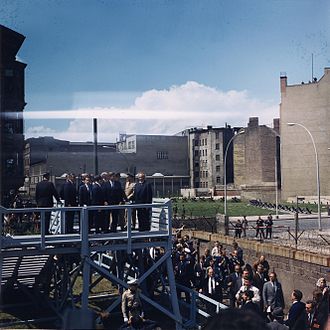
One of Ulbricht’s most well-known actions was pushing for the building of the Berlin Wall in 1961. He believed it was needed to stop many people from leaving East Germany for West Germany. Though it caused international tension, the Wall did reduce the number of people moving west.
Ulbricht’s economic policies did not succeed in improving living standards in East Germany, leading to his retirement in 1971. He stayed as the symbolic head of state until his death in 1973.
Early years
Walter Ulbricht was born in 1893 in Leipzig, Saxony. He grew up in a Protestant family. His father was a tailor, and his mother was also very active in their community. Ulbricht went to primary school, called Volksschule, for eight years. After that, he decided to train as a joiner instead of continuing with more schooling. Both of his parents supported the Social Democratic Party (SPD), and Ulbricht joined this party in 1912 when he was young. He first heard about ideas for change from radical socialism at home in Leipzig’s Naundörfchen workers’ district before his family moved to the Gottschedstrasse.
First World War and the German Revolution
Walter Ulbricht served in the Imperial German Army during World War I from 1915 to 1917. He fought in Galicia, the Eastern Front, and the Balkans. In 1918, he left the army because he was against the war and was jailed for two months. After his release, he was arrested again in Brussels for having anti-war leaflets but was later released when the November Revolution happened due to the collapse of Imperial Germany.
In 1917, Ulbricht joined the Independent Social Democratic Party after it split from the Social Democratic Party because of disagreements over Germany’s role in World War I. During the German Revolution of 1918, he became part of a soldier’s group in his army corps. In 1919, he joined the Spartakusbund.
The Weimar years
Walter Ulbricht joined a political group and became an important organizer in 1920. He quickly rose in leadership and became part of the Central Committee in 1923. He studied in Moscow and returned to help a new party leader in 1926. He was elected to local government and later to the national parliament.
During this time, there were many conflicts between different political groups. Ulbricht became an important official in his party during these troubled years. In one event meant for discussion, a fight broke out between different groups, and many people were hurt before it ended.
The Bülowplatz murders
Main article: Murder of Paul Anlauf and Franz Lenck
In the years before a big change in government, some members of Ulbricht's party decided to attack police officers as a response to police actions against them. Ulbricht spoke strongly about this issue. Sadly, this led to a very sad event where two police officers were attacked. One of these officers was known for his tough methods against protests.
Nazi and war years
When the Nazi Party took control of Germany in 1933, they began removing leaders of other political groups, including the Communist Party. Walter Ulbricht tried to become the new leader after the main leader was arrested.
Ulbricht spent time living in Paris and Prague before moving to the Soviet Union in 1937, where he stayed until 1945. During World War II, he worked with a group of German communists who created messages for German soldiers. After the war, he returned to Germany to help rebuild the country.
Post-war political career
In April 1945, Ulbricht led a group of party members called the "Ulbricht Group" back into Germany to rebuild the communist party. He aimed to create a system that looked democratic but was fully controlled by communists. In the area controlled by the Soviet Union, he helped merge another political group, the Social Democrats, with the Communists to form the Socialist Unity Party of Germany. This new party was mostly under communist control.
After the German Democratic Republic was founded in 1949, Ulbricht became a key leader in the government. By 1950, he had risen to become the main leader of the Socialist Unity Party, a role he held for many years.
Leadership of East Germany
After the leader of the Soviet Union died, Walter Ulbricht's position became unsure because leaders in Moscow were thinking about being softer with Germany.
In 1953, people in East Berlin protested and demanded changes. The government needed help from Soviet soldiers to stop the protests. After this, Ulbricht was fully supported by Soviet leaders as the main leader of East Germany. Many people tried to leave East Germany for the West, and over 360,000 people did so in 1952 and early 1953.
Ulbricht announced plans to double industrial production by 1950. By 1952, 80% of industry was owned by the government. The border between East and West Germany was closed in 1952. The army and secret police were created to control the people. By 1960, farms were also taken over by the government.
In 1961, over 1.65 million people had left East Germany. Ulbricht asked the Soviet Union to stop people from leaving. The Berlin Wall was built to stop people from escaping. Soldiers and police sealed the border overnight. After the wall was built, it became very hard to cross between East and West Berlin.
Ulbricht tried new economic plans to make the economy stronger, but they were not very popular. He also tried to protect East German culture from Western influences. By the late 1960s, Ulbricht was isolated and faced many problems. In 1971, he was forced to step down from most of his positions and was replaced by Erich Honecker. Ulbricht died in 1973.
Legacy
Walter Ulbricht stayed true to his beliefs all his life and was known for being strict and hard to work with. Even though he helped make East Germany more stable and improved its economy, the living conditions there were not as good as in West Germany.
Historians agree that the government Ulbricht led was strict and did not allow many different opinions or freedoms.
Cult of personality
Walter Ulbricht was not seen as a very exciting leader. He was short, had a high voice, and spoke in a way that many found uninteresting. Because of this, leaders in East Germany tried to make him seem more important than he was.
They named buildings and schools after him and put his picture in many places. They celebrated his birthdays with big events and gave him many awards. However, many people did not believe the praise and made fun of him instead.
Personal life
Walter Ulbricht lived in Majakowskiring, Pankow, East Berlin. He married twice: first in 1920 to Martha Schmellinsky, and then from 1953 until he passed away to Lotte Ulbricht, born Kühn. With Martha, he had a daughter in 1920. He later had another daughter, Rose, with Rosa Michel. His marriage to Lotte remained childless, but they adopted a daughter named Beate in 1944.
Decorations
In 1956, Ulbricht received the Hans Beimler Medal for those who served in the Spanish Civil War. Later, in 1963, he was honored with the title Hero of the Soviet Union. During a visit to Egypt in 1965, he was given the Great Collar of the Order of the Nile by Nasser. He also received the Order of the Yugoslav Great Star in 1965.
Pictures
Keep exploring



This article is a child-friendly adaptation of the Wikipedia article on Walter Ulbricht, available under CC BY-SA 4.0.
Images from Wikimedia Commons. Tap any image to view credits and license.