 Safekipedia
East Germany
Adapted from Wikipedia · Discoverer experience
East Germany, officially the German Democratic Republic (GDR), was a country in Central Europe from its formation on 7 October 1949 until its reunification with West Germany on 3 October 1990. It was established after World War II when Soviet forces occupied part of Germany. The government was led by the Socialist Unity Party, which followed communist ideas.
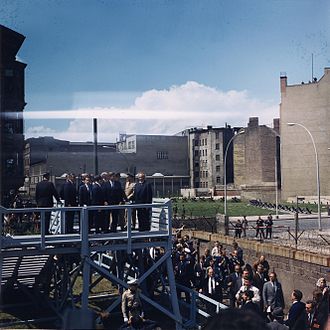
The GDR bordered the Baltic Sea, Poland, and Czechoslovakia, and shared a close border with West Berlin. Its economy was managed by the state, but many people wanted to move to West Germany. In 1961, the government built the Berlin Wall to stop people from leaving.
In 1989, peaceful protests helped bring changes. The Berlin Wall fell, leading to free elections and talks about reuniting Germany. By 1990, East Germany joined West Germany, ending the GDR's time as a separate country.
Etymology
The official name of East Germany was Deutsche Demokratische Republik ('German Democratic Republic'), often shortened to DDR (GDR). Both names were used in East Germany, with the shorter form becoming more common, especially after 1968.
In the West, people often used different names like Ostzone ('Eastern Zone') or Sowjetische Besatzungszone ('Soviet Occupation Zone'') at first. Over time, though, even people in the West started using the name DDR more often. Before World War II, the term Ostdeutschland ('East Germany') referred to areas east of the Elbe river.
History
Main article: History of East Germany
Further information: History of Germany
East Germany, also known as the German Democratic Republic (GDR), existed from 1949 until 1990. It was established in the Soviet-occupied zone of Germany after World War II. The GDR was a communist state, with the Socialist Unity Party as its ruling party. It focused on creating a socialist society, which included changes to its industrial and agricultural sectors, and its educational system.
The GDR's history began when the Allies divided Germany into occupation zones after World War II. The Soviet Union controlled the eastern part, where East Germany was later formed. Over time, East Germany developed its own identity, separate from West Germany. This included efforts to preserve parts of its culture and traditions that were not directly tied to its communist ideology.
Origins
At the Yalta Conference during World War II, the Allies agreed to divide defeated Nazi Germany into occupation zones, including an American, a British, a French, and a Soviet zone. This division set the stage for the creation of East Germany in the Soviet zone.
1949 establishment
The Socialist Unity Party of Germany (SED) was formed in 1946 through a merger of the Communist Party and the Social Democratic Party in the Soviet zone. This party became the dominant political force in East Germany. The German Democratic Republic was formally established on October 7, 1949, with Wilhelm Pieck as its first president and Walter Ulbricht as the leader of the SED, holding most executive power.
Zones of occupation
Following World War II, the Allies established joint military occupation and administration of Germany through the Allied Control Council. The Soviet Union administered its zone separately, leading to the creation of a socialist government in East Germany. The division was solidified when the Soviets withdrew from the Allied Control Council in 1948.
Partition
The division between East and West Germany became more pronounced over the years. East Germany claimed to be the true successor of the German state, while West Germany saw itself as the only legitimate government. The construction of the Berlin Wall in 1961 was a key event that physically and symbolically divided the two Germanies.
GDR identity
East Germany worked to establish its own national identity, separate from its Prussian past. It emphasized its socialist values and the struggles of the working class. The regime also focused on anti-fascist themes, highlighting the resistance against Nazi Germany.
Die Wende (German reunification)
Main articles: Die Wende, Peaceful Revolution, and German reunification
In 1989, widespread public anger over election fraud and restrictions on travel led to mass protests and demonstrations across East Germany. The opening of the border between Austria and Hungary allowed many East Germans to escape to the West, further fueling the movement for change. The fall of the Berlin Wall on November 9, 1989, marked the beginning of the end for East Germany. Free elections were held in March 1990, and negotiations led to the reunification of Germany on October 3, 1990.
Government and politics
Main article: Politics of East Germany
The political history of East Germany had four periods: 1949–1961, which saw the "Construction of Socialism"; 1961–1970, after the Berlin Wall closed off escape, was a period of stability and consolidation; 1971–1985 was termed the "Honecker Era", and saw closer ties with West Germany; and 1985–1990 saw the decline and extinction of East Germany.
East Germany officially described itself as a socialist workers' and peasants' state. The ruling political party was the Sozialistische Einheitspartei Deutschlands (Socialist Unity Party of Germany; SED). The SED was created through the Soviet-directed merger of the Communist Party of Germany (KPD) and the Social Democratic Party of Germany (SPD) in the Soviet-controlled zone. The internal power organisation of East Germany was a unitary state.
Important non-parliamentary mass organisations in East German society included the German Gymnastics and Sports Association (Deutscher Turn- und Sportbund; DTSB), and the People's Solidarity (Volkssolidarität), an organisation for the elderly. Another society of note was the Society for German–Soviet Friendship.
The flag of the German Democratic Republic consisted of three horizontal stripes in the traditional German-democratic colors black-red-gold; at its center was a GDR national coat of arms, consisting of a wreath of corn surrounding a hammer and compass, which symbolised the alliance of workers, peasants, and intelligentsia.
After being a member of the Thälmann Pioneers, which was for schoolchildren ages 6 to 14, East German youths would usually join the Free German Youth (Freie Deutsche Jugend; FDJ).
Administrative districts
Main articles: Administrative divisions of East Germany and List of leaders of administrative divisions of East Germany
Until 1952, East Germany comprised the capital, East Berlin (though legally it was not fully part of the GDR's territory), and the five German states of Mecklenburg-Vorpommern (in 1947 renamed Mecklenburg), Brandenburg, Saxony-Anhalt (named Province of Saxony until 1946), Thuringia, and Saxony.
The East German Administrative Reform of 1952 established 14 Bezirke (districts) and de facto disestablished the five Länder. The new Bezirke, named after their district centres, were as follows: (i) Rostock, (ii) Neubrandenburg, and (iii) Schwerin created from the Land (state) of Mecklenburg; (iv) Potsdam, (v) Frankfurt (Oder), and (vii) Cottbus from Brandenburg; (vi) Magdeburg and (viii) Halle from Saxony-Anhalt; (ix) Leipzig, (xi) Dresden, and (xii) Karl-Marx-Stadt (Chemnitz until 1953 and again from 1990) from Saxony; and (x) Erfurt, (xiii) Gera, and (xiv) Suhl from Thuringia.
East Berlin was made the country's 15th Bezirk in 1961 but retained special legal status until 1968, when the residents approved the new (draft) constitution.
Economy
Main article: Economy of East Germany
East Germany's economy started slowly because of damage from World War II. Cities were bombed, and many young people were lost. The country also had to pay reparations to the Soviet Union, which took away some factories and resources. By the 1950s, East Germany joined a trade group called COMECON and built up its industry. It became one of the strongest economies in the Eastern Bloc, with steady growth each year.
East Germany made many things people around the world used, like cameras, cars, and watches. Even though it had a strong economy, there were shortages of some everyday items like sugar and coffee. The government helped by keeping prices low for basic goods. Later on, East Germany started making its own computers, though it still didn't have as many as Western countries.
| East Germany | West Germany | |
| 1945–1960 | 6.2 | 10.9 |
| 1950–1960 | 6.7 | 8.0 |
| 1960–1970 | 2.7 | 4.4 |
| 1970–1980 | 2.6 | 2.8 |
| 1980–1989 | 0.3 | 1.9 |
| Total 1950–1989 | 3.1 | 4.3 |
Demographics
East Germany had a population of about 19 million in 1948, but this number fell to around 16 million by 1990. This decline happened for a few reasons. First, many people left East Germany for West Germany before the Berlin Wall was built in 1961. Second, East Germany had fewer babies compared to West Germany for most of its history.
Religion
Main articles: Christianity in East Germany, Persecution of Christians in the Eastern Bloc, and Irreligion in Germany
Religion was a complicated topic in East Germany. The government did not believe in religion and tried to convince people that there was no God. However, many people still went to church. In the beginning, about 85% of people in East Germany were Protestants, and 10% were Catholics. By 1989, only 25% were Protestants and 5% were Catholics. Most people, around 70%, said they did not believe in any religion.
Education
Childcare system
East Germany had a system to take care of children while their parents worked. About 600,000 children were in these special homes. Some of these homes were not very nice places for children.
| Year | Pop. | ±% |
|---|---|---|
| 1950 | 18,388,000 | — |
| 1960 | 17,188,000 | −6.5% |
| 1970 | 17,068,000 | −0.7% |
| 1980 | 16,740,000 | −1.9% |
| 1990 | 16,028,000 | −4.3% |
| Source: DESTATIS | ||
| City | Population |
|---|---|
| East Berlin | 1,200,000 |
| Leipzig | 556,000 |
| Dresden | 520,000 |
| Karl-Marx-Stadt (Chemnitz) | 314,437 |
| Magdeburg | 290,579 |
| Rostock | 253,990 |
| Halle (Saale) | 236,044 |
| Erfurt | 220,016 |
| Potsdam | 142,862 |
| Gera | 134,834 |
| Schwerin | 130,685 |
| Cottbus | 128,639 |
| Zwickau | 121,749 |
| Jena | 108,010 |
| Dessau | 103,867 |
Culture
Main article: Culture of East Germany
East Germany's culture was shaped by its communist beliefs. The government controlled all art and writing to match socialist ideas. Schools taught science and politics to prepare young people for life in the country.
Music was popular, with bands like The Puhdys and Karat becoming famous. The government supported classical music and built many concert halls. Theatre and cinema also thrived, with famous plays and films reflecting life in East Germany. Sports were important too, with the country excelling in events like swimming and gymnastics.
| Date | English name | German name | Remarks |
|---|---|---|---|
| 1 January | New Year's Day | Neujahr | |
| March–April | Good Friday | Karfreitag | |
| March–April | Easter Sunday | Ostersonntag | |
| March–April | Easter Monday | Ostermontag | Was not an official holiday after 1967. |
| 1 May | International Workers' Day/May Day | Tag der Arbeit (name in FRG) | The official name was Internationaler Kampf- und Feiertag der Werktätigen (approx. "International Day of the Struggle and Celebration of the Workers") |
| 8 May | Victory in Europe Day | Tag der Befreiung | The translation means "Day of Liberation" |
| April–June | Father's Day/Ascension Day | Vatertag/Christi Himmelfahrt | Thursday after the 5th Sunday after Easter. Was not an official holiday after 1967. |
| May–June | Whit Monday | Pfingstmontag | 50 days after Easter Sunday |
| 7 October | Republic Day | Tag der Republik | National holiday |
| November | Day of Repentance and Prayer | Buß- und Bettag | Wednesday before Totensonntag. Originally a Protestant feast day, it was demoted as an official holiday in 1967. |
| 25 December | First Day of Christmas | 1. Weihnachtsfeiertag | |
| 26 December | Second Day of Christmas | 2. Weihnachtsfeiertag |
Legacy
At the time East Germany joined with West Germany in 1990, much of its roads, trains, sewers, and buildings needed repair because they had not been well maintained. Over the next 30 years, Germany spent a lot of money to improve these things and bring East Germany up to standard.
Many people in East Germany felt upset after the country joined with West Germany. Some West Germans acted like they were better, which made East Germans unhappy. Some East Germans looked back on their old country with a feeling called "Ostalgie," which means a longing for the past. Even though most people in East Germany now prefer living in a united country, some still feel like they don’t quite fit in.
The political views in East and West Germany also differ. Some people in the eastern states support parties like Die Linke and the Alternative for Germany (AfD), while western states tend to support more centrist parties. There are also fewer religious people in the eastern states compared to the west.
Images
Related articles


This article is a child-friendly adaptation of the Wikipedia article on East Germany, available under CC BY-SA 4.0.
Images from Wikimedia Commons. Tap any image to view credits and license.