 Safekipedia
2 Pallas
Adapted from Wikipedia · Explorer experience
What is 2 Pallas?
2 Pallas is a very big space rock. It is one of the biggest objects in the Solar System. It was the second asteroid ever found. Scientists think it might be a piece left over from when planets were made.
Where is 2 Pallas?
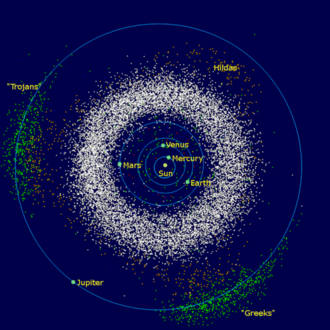
Pallas lives in the asteroid belt. The asteroid belt is a place between Mars and Jupiter full of many small rocks. Pallas moves around the Sun in a tilted path. Sometimes it gets very close to bright stars, like Sirius.
Why Do People Know About 2 Pallas?
People know about Pallas because it was discovered a long time ago, in 1802. An astronomer named Heinrich Wilhelm Matthias Olbers found it. At first, people thought it was a planet! Now we know it is an asteroid. Pallas is very big—it is about three-quarters the size of 4 Vesta and makes up around 7% of all the material in the asteroid belt.
Fun Fact
Pallas is the third-largest asteroid in our solar system. It is a little smaller than Vesta but still very big. From Pallas, we can sometimes see planets like Earth passing in front of the Sun!
Images
Related articles




This article is a child-friendly adaptation of the Wikipedia article on 2 Pallas, available under CC BY-SA 4.0.
Images from Wikimedia Commons. Tap any image to view credits and license.