Safekipedia

Asteroid

Explorer · ages 7 and underAdapted from Wikipedia
A mosaic of the asteroid Bennu, pieced together from images taken by NASA's OSIRIS-REx spacecraft, which orbited the asteroid for over two years.

What is an asteroid?

An asteroid is a minor planet that travels around the Sun. Most asteroids are found in the asteroid belt, between Mars and Jupiter. Some asteroids are very small, and some are almost 1000 km wide.

Rocks in space

Asteroids are made of rock, metal, or ice. They do not have air around them. Some are small piles of rubble, and some are shaped like tiny planets. Ceres is a dwarf planet and is the biggest one of all.

How people learned about asteroids

People have watched asteroids from Earth since they were found in 1801. Later, space robots called NASA and JAXA visited some asteroids. Some of these missions brought back small samples to Earth. One asteroid, 433 Eros, was studied up close by a spacecraft.

Why asteroids matter

Scientists study asteroids to learn how the Solar System began. Asteroids may even have helped bring water to Earth long ago. Some people think asteroids could one day give us useful materials.

Quiz time!

3 questions about Asteroid

Question 1 of 3

What is an asteroid?

Pictures

A color photo of Phobos, the larger of Mars's two moons, taken by NASA's Mars Reconnaissance Orbiter in 2008. The big crater near the lower right is Stickney, the moon's largest feature.
NASA's NEAR Shoemaker spacecraft took this view of the asteroid Eros, looking down on its northern polar region. The image was built from six photos taken in February 2000 and shows a crater, a saddle-shaped dip, and a long ridge stretching across the asteroid's surface.
A false-color image of the asteroid 243 Ida, taken by NASA's Galileo spacecraft in 1993. Its tiny moon, Dactyl, can be seen to the right. The bluish colors show differences in the minerals on the asteroid's surface.
A true-color view of the dwarf planet Ceres, taken by NASA's Dawn spacecraft in 2015. The bright crater on the right is Haulani, and the smaller bright spot to its left is on the floor of Oxo crater.
A comparison of the sizes of eight different asteroids, shown side by side to help us see how big or small each one is.
A size comparison of Vesta, Ceres, and Earth's Moon. Vesta is an asteroid, Ceres is a dwarf planet, and the Moon is our closest neighbor in space.
A radar image of asteroid 2013 ET, captured by scientists to learn about the shape and size of this space rock.
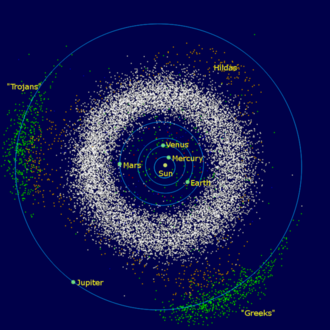
A diagram showing where asteroids and other objects are located in the inner Solar System, viewed from above.
Forty-two of the largest asteroids in the asteroid belt between Mars and Jupiter, pictured to compare their sizes. The biggest, Ceres and Vesta, are shown alongside much smaller ones, all photographed by the Very Large Telescope.
A size comparison of three asteroids: Ceres, Vesta, and Eros. Ceres is the largest of the three.
Cratered terrain with hills and ridges on Vesta, photographed by NASA's Dawn spacecraft on August 6, 2011.
Giuseppe Piazzi, the Italian astronomer who discovered the dwarf planet Ceres in 1801.
A diagram of the inner solar system showing the planets and groups of asteroids. The distances from the Sun are drawn to scale, but the sizes of the objects are not.
Deimos, one of the two small moons of Mars, photographed by the HiRISE camera on NASA's Mars Reconnaissance Orbiter in 2009. The colors have been enhanced to help scientists see surface details.
The asteroids of the inner Solar System, categorized by size and number
A complex horseshoe orbit (the vertical looping is due to inclination of the smaller body's orbit to that of the Earth, and would be absent if both orbited in the same plane)  Sun ·   Earth ·   (419624) 2010 SO16
Asteroid (101955) Bennu seen ejecting particles by the OSIRIS-REx
The 70m antenna at Goldstone Observatory
Radar observations of near-Earth asteroid (505657) 2014 SR339 as seen by Arecibo
WISE infrared space telescope
Artist's concept of a crewed mission to an asteroid
Frequency of bolides, small asteroids roughly 1 to 20 meters in diameter impacting Earth's atmosphere

Keep exploring

This article is a child-friendly adaptation of the Wikipedia article on Asteroid, available under CC BY-SA 4.0.

Images from Wikimedia Commons. Tap any image to view credits and license.