Safekipedia

Apatosaurus

Explorer · ages 7 and underAdapted from Wikipedia
A skeleton of an Apatosaurus, a giant plant-eating dinosaur, on display at the American Museum of Natural History in New York City.

What Is Apatosaurus?

Apatosaurus was a big, plant-eating dinosaur. It belonged to a group called sauropod dinosaurs, which had long necks and long tails. Its name means "deceptive lizard."

It lived in North America a very long time ago, during the Late Jurassic period. That was about 152 to 151 million years ago.

Where Did It Live?

Apatosaurus fossils have been found in the Morrison Formation. This area includes parts of Colorado, Oklahoma, New Mexico, Wyoming, and Utah. Apatosaurus shared its home with other dinosaurs, such as Allosaurus and Stegosaurus.

How Big Was It?

Apatosaurus was about 21 to 23 metres (69 to 75 feet) long. It weighed about 16.4 to 22.4 tonnes. It was similar to Diplodocus, another long-necked dinosaur.

Its tail was held above the ground when it walked. It likely ate plants from low and middle-height trees.

How Do We Know About It?

Scientists first found Apatosaurus fossils in 1877 near Morrison, Colorado. Othniel Charles Marsh studied these bones and gave the dinosaur its name that same year.

Quiz time!

3 questions about Apatosaurus

Question 1 of 3

What did Apatosaurus eat?

Pictures

A scale chart comparing the sizes of Apatosaurus, Brontosaurus, and a human, showing how huge these long-necked dinosaurs really were.
The skull of Apatosaurus ajax, a long-necked plant-eating dinosaur that lived about 150 million years ago, on display at the Cincinnati Museum of Natural History & Science.
Side and front views of a neck bone (cervical vertebra) from the holotype specimen of Apatosaurus ajax, a long-necked dinosaur, housed at the Yale Peabody Museum.
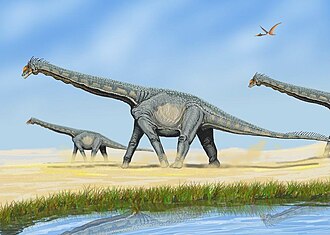
An artist's reconstruction of Apatosaurus louisae, a long-necked dinosaur that lived in what is now North America millions of years ago.
An 1877 illustration by Arthur Lakes showing the Yale crew uncovering fossil bones of Apatosaurus and Atlantosaurus near Morrison, Colorado. Benjamin Franklin Mudge (right) examines a fossil arm bone.
A scientific drawing of the sacrum, the fused group of bones at the base of the spine, of the dinosaur Apatosaurus ajax, seen from below.
A mounted skeleton of Apatosaurus, a huge long-necked dinosaur, on display at the American Museum of Natural History. This dinosaur was once called Brontosaurus, and the skull shown here was later found to belong to a different dinosaur, Camarasaurus.
The fossil specimen FMNH 25112, a sauropod dinosaur related to Apatosaurus, on display at the Field Museum.
A mounted skeleton of Apatosaurus louisae, a long-necked sauropod dinosaur that lived in what is now Utah about 150 million years ago.
A fossil skeleton of Apatosaurus, a long-necked dinosaur, on display at the Field Museum of Natural History in Chicago.
A skeleton of Apatosaurus, a long-necked dinosaur, on display at the National Museum of Nature and Science in Tokyo, Japan.
A nearly complete Apatosaurus skeleton, nicknamed "Einstein," on display at a museum. Scientists study fossils like this one to learn how these giant plant-eating dinosaurs lived long ago.
A scientific drawing of the left shoulder blade and coracoid bone of Apatosaurus ajax, a long-necked dinosaur, shown at about one-fourteenth of its natural size.
Paleoenvironment and dinosaurs of the Morrison Formation, with A. louisae at left
Tracks of a juvenile

Keep exploring

This article is a child-friendly adaptation of the Wikipedia article on Apatosaurus, available under CC BY-SA 4.0.

Images from Wikimedia Commons. Tap any image to view credits and license.