Safekipedia

Chemical element

Explorer · ages 7 and underAdapted from Wikipedia
A gold specimen showing its rich, yellowish color. Gold is rare and valuable, and it is one of the most prized metals in the world.

What is a chemical element?

A chemical element is a special kind of atom. Every atom of an element has the same number of protons in its center. This number is called the atomic number. For example, oxygen has an atomic number of 8.

Elements all around us

Many elements are found in nature. Long ago, people found materials like gold, copper, and sulfur. Today, we still use these elements.

The air we breathe is mostly nitrogen and oxygen. Water is made of two elements, hydrogen and oxygen. The first 94 elements are found naturally on Earth.

The periodic table

A Russian scientist named Dmitri Mendeleev made an important chart. In 1869, he shared the first periodic table. It puts the elements into rows and columns. Elements in the same column often behave in similar ways.

Each element has its own short name, called a chemical symbol. For example, "Fe" is the symbol for iron. The lightest elements, hydrogen and helium, were made very early in the universe.

Quiz time!

3 questions about Chemical element

Question 1 of 3

What is the air we breathe mostly made of?

Pictures

Ernst Haeckel's 1879 'tree of life' diagram, a drawing that shows how scientists of his time thought different living things were related through common ancestors.
A 32-column periodic table showing chemical elements arranged by their properties, with scandium, yttrium, lutetium and lawrencium placed in group 3.
A colorful periodic table showing how many stable isotopes each element has. Elements with even atomic numbers usually have more stable isotopes than those with odd numbers.
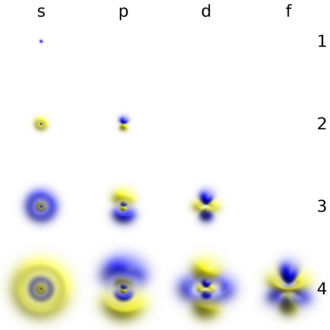
Colorful 3D diagrams showing the shapes of electron orbitals (s, p, d, and f) in atoms, where colors show the phase of each electron's wave pattern.
A periodic table showing the elements in Group 7, which are called the halogens.
A chart showing the natural forms of carbon, such as diamond and graphite, which are different arrangements of the same element.
A map of the world and the Solar System showing the places and celestial bodies that inspired the names of chemical elements. Solid-colored countries and states are named for elements, while lines point to other places, and the inset shows the Sun, Moon, some planets, and asteroids linked to element names.
John Dalton's 1808 list of atomic weights and symbols for the chemical elements, an early step toward the modern periodic table.
A pie chart showing what the Universe is made of, based on measurements from NASA's WMAP satellite. Most of the Universe is made of dark energy and dark matter, while only a small part is ordinary matter like stars, planets, and us.
An 18th-century engraved portrait of Robert Boyle, the scientist who studied gases, surrounded by scientific instruments and an air pump.
The title page of Robert Boyle's 1661 book The Sceptical Chymist, an early scientific work that questioned the alchemists of his day.
A historical portrait photograph of Dmitri Mendeleev, the Russian chemist who created the first widely recognized periodic table of the chemical elements.
A portrait of Isaac Watts, an English hymnwriter and theologian who lived from 1674 to 1748.
Nuclide chart displaying of the number of protons (Z) versus neutrons (N) for each isotope, with the color showing resulting half life
Plot of element abundances in the Solar System. The two general trends are: (1) an alternation of abundance in elements as they have even or odd atomic numbers (the Oddo–Harkins rule), and (2) a decrease in abundance as elements become heavier.

Keep exploring

This article is a child-friendly adaptation of the Wikipedia article on Chemical element, available under CC BY-SA 4.0.

Images from Wikimedia Commons. Tap any image to view credits and license.