
Chinese mathematics
Chinese Mathematics
Chinese mathematics is a wonderful way of thinking about numbers and shapes that started a very long time ago. People in China have been clever with numbers for thousands of years!
Early Ideas
Long ago, during the Shang dynasty, people in China began to think about numbers in new ways. They used special shapes called hexagrams to understand changes and patterns. They also started to use a decimal system, which is the way we count today, using tens, hundreds, and so on.
Important Books and Tools
One of the oldest math books is called The Nine Chapters on the Mathematical Art. It taught people how to solve everyday problems like sharing land and money. People used tools called counting rods to help them calculate. These were small sticks placed on a board to show numbers.
Clever Discoveries
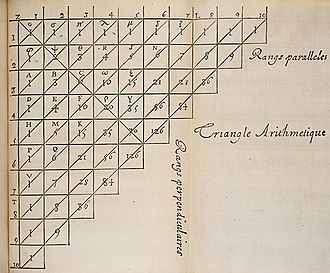
Chinese mathematicians were very smart. They figured out ways to work with very big numbers and even numbers less than zero. They also found patterns, like Pascal's triangle, long before other countries did.
During the Han dynasty, they learned how to solve hard puzzles with many answers. They also tried to find better ways to measure the shape of circles.
Fun Facts
- Chinese math used a special system with rods on a board, much like using fingers to count but in a very organized way.
- They could solve puzzles that even today are very tricky!
- Tools like the abacus, called suan pan in Chinese, became very popular and were used for hundreds of years.
Chinese mathematics shows us how clever ancient people were and how math helps us solve everyday problems.
Pictures
Keep exploring


This article is a child-friendly adaptation of the Wikipedia article on Chinese mathematics, available under CC BY-SA 4.0.
Images from Wikimedia Commons. Tap any image to view credits and license.