Color theory
What is color theory?
Color theory is an old set of ideas about how colors behave. It looks at color mixing, color contrast, color harmony, color schemes, and color symbolism. It is not the same as colorimetry.
Color theory and color science both study color. Color theory is more personal and is used in art. Color science is used in areas like chemistry, astronomy, and color reproduction. The two have helped each other grow over time.
Long ago
People have thought about color for a very long time. Aristotle wrote a book called On Colors. Bharata wrote the Nāṭya Shāstra in Ancient India. A more formal "color theory" began in the 1700s, after ideas from Isaac Newton in Opticks.
Newton showed that white light is made of many colors. Later, Johann Wolfgang von Goethe and Michel Eugène Chevreul wrote early books about color. Artists from the Bauhaus, such as Wassily Kandinsky, Johannes Itten, and Josef Albers, also wrote about color design.
Mixing colors
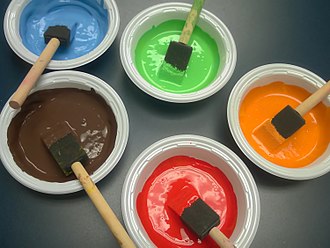
Colors mix in two main ways. Additive color mixing is used in computers. Subtractive color mixing is used in printers. Painters mix paints, and printers use inks.
Many people name three main colors: red, yellow, and blue (RYB) for paint, or red, green, and blue (RGB) for light. Mixing two main colors makes a secondary color. A color wheel helps show complementary colors, which are colors that sit opposite each other.
Colors that look good together
Chevreul also studied how colors look next to each other. For example, yellow fabric on a blue background looks orange. Warm colors often seem to come forward, while cool colors often seem to move back and feel calm.
Color harmony means colors that look good together. People can see about 2.3 million colors, so there are many ways to mix them. Some people like analogous colors, which sit next to each other on the wheel. Black and white go well with almost any colors.

Quiz time!
3 questions about Color theory
Which three colors are the main colors for paint?
Pictures
Keep exploring


This article is a child-friendly adaptation of the Wikipedia article on Color theory, available under CC BY-SA 4.0.
Images from Wikimedia Commons. Tap any image to view credits and license.