Safekipedia

Dinosaur

Explorer · ages 7 and underAdapted from Wikipedia
The holotype fossil of Tyrannosaurus rex on display at the Carnegie Museum of Natural History in Pittsburgh.

What Are Dinosaurs?

Dinosaurs are a group of reptiles that lived a very, very long time ago. They lived for most of the Mesozoic era. Dinosaur fossils have been found on every continent.

Birds are a special kind of dinosaur. Fossils show that birds are feathered dinosaurs. Birds are the only dinosaurs alive today, and there are over 11,000 kinds of birds living now.

Many Kinds of Dinosaurs

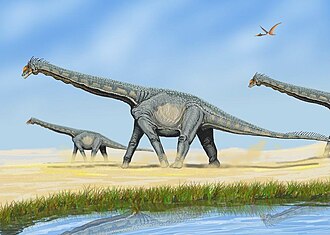
Dinosaurs came in many different shapes and sizes. Some ate plants, and some ate meat. Some were very large. The largest sauropod dinosaurs were the biggest land animals of all time.

Scientists who study fossils, called paleontologists, have found more than 900 kinds of dinosaurs that are not birds.

Dinosaurs in Our World

In 1842, a scientist named Sir Richard Owen gave dinosaurs their name. It means "terrible lizard," but these animals are not scary to learn about.

Museums around the world show dinosaur skeletons, and many people love seeing them. Dinosaurs have become a fun part of popular culture. You may have seen them in the Jurassic Park movies and books.

Quiz time!

3 questions about Dinosaur

Question 1 of 3

What group of animals are dinosaurs part of?

Pictures

Sophie the Stegosaurus, a famous dinosaur skeleton on display at the Natural History Museum in London.
A Brontosaurus skeleton stands tall in the Peabody Museum of Natural History, showing how this giant plant-eating dinosaur may have looked.
A Triceratops skeleton, nicknamed "Lane," on display at the Houston Museum of Natural Science.
A Great Egret flying over Morro Bay, California. These tall, white birds are easy to spot near water, where they hunt fish and frogs.
A collage of different birds, showing the variety of species in Neognathae, the large group that includes most living birds today.
A Triceratops skeleton on display at the Natural History Museum of Los Angeles County, showing how this plant-eating dinosaur was built.
A page from an 1841 scientific report by Richard Owen, where he proposed the name 'Dinosauria' for a group of large extinct reptiles, meaning 'fearfully great lizard.'
Paleontologist Dr. Bob Bakker poses with a Gorgosaurus skeleton at the Houston Museum of Natural Science.
A fossil skin impression from 'Dakota', a duck-billed dinosaur called Edmontosaurus, found in 1999. Its preserved skin shows the pattern of tiny scales that covered its body.
A scientific reconstruction of the colors of Sinosauropteryx, a small feathered dinosaur. Its back was darker and its belly lighter, a pattern that helped it blend in with its surroundings.
William Buckland, a British geologist and palaeontologist who studied ancient life and rocks, pictured around 1845.
Edward Drinker Cope, an American scientist who studied and named many fossil animals in the 1800s.
Othniel Charles Marsh, a paleontologist who helped discover and name many dinosaurs in the 1800s.
The early dinosaurs Herrerasaurus (large), Eoraptor (small) and a Plateosaurus skull, from the Triassic
Scale diagram comparing the average human to the longest known dinosaurs in five major clades:  Sauropoda (Supersaurus vivianae)  Ornithopoda (Shantungosaurus giganteus)  Theropoda (Spinosaurus aegyptiacus)  Thyreophora (Stegosaurus ungulatus)  Marginocephalia (Triceratops prorsus)
Comparative size of Argentinosaurus to the average human
Bruhathkayosaurus, potentially the largest terrestrial animal to ever exist
An adult bee hummingbird, the smallest known dinosaur
Various feathered non-avian dinosaurs, including Archaeopteryx, Anchiornis, Microraptor and Zhenyuanlong
Luis (left) and his son Walter Alvarez (right) at the K-T Boundary in Gubbio, Italy, 1981
Outdated Iguanodon statues created by Benjamin Waterhouse Hawkins for the Crystal Palace Park in 1853

Keep exploring

This article is a child-friendly adaptation of the Wikipedia article on Dinosaur, available under CC BY-SA 4.0.

Images from Wikimedia Commons. Tap any image to view credits and license.