Safekipedia

German Empire

Explorer · ages 7 and underAdapted from Wikipedia
Anton von Werner's painting of the proclamation of Wilhelm I as German Emperor at Versailles in 1871, painted in 1885.

What was the German Empire?

The German Reich was a time when Germany was joined together as one nation. It began with the unification of Germany in 1871 and came to an end in 1918. People also called it Imperial Germany or the Second Reich.

The empire had 25 states. Prussia was the biggest of them. The king of Prussia was also the German Emperor.

How it began

The empire was founded on 18 January 1871. Some southern German states joined the North German Confederation to make it happen. Berlin stayed the capital city.

Otto von Bismarck became the chancellor. A chancellor is the person who leads the government.

Life in the empire

During its 47 years, the empire grew into a strong country. It had many factories, new inventions, and science. Many German inventors and researchers won one-third of all Nobel Prizes.

In the 1880s, Germany joined the colonial race. This means it also built lands far away from home.

The end of the empire

Later, Wilhelm II became the emperor. In 1918, he gave up the throne. Germany then changed to a republic, which means the people chose their leaders.

Today, much of the land that was once part of the empire belongs to other countries, such as Poland, Russia, and France.

Quiz time!

3 questions about German Empire

Question 1 of 3

What was the German Empire also called?

Pictures

A map of the German Empire in 1918, showing the German Empire itself, its client states, and the territories it temporarily occupied.
A map showing the territories of the German Colonial Empire, which held colonies in Africa, the Pacific, and China before World War I.
An 1873 engraving of Otto von Bismarck, the statesman who led the unification of Germany.
The Kaiser Wilhelm National Monument beside the Berlin City Palace, as it looked around 1900.
A 17th-century map of the German lands and the Holy Roman Empire, designed by Julius Reichelt and published by Nicolaes Visscher II.
A panoramic view of the city of Essen, Germany, around 1890, looking west from the town hall tower, with the Krupp factories visible.
An 1875 cartoon from the German magazine Kladderadatsch shows Pope Pius IX and Otto von Bismarck playing chess. It comments on the Kulturkampf, the power struggle between the German government and the Catholic Church.
An old encyclopedia map from the 1880s comparing how many crimes were recorded in Germany, France, and Italy at that time, shown using colored shading for each region.
A map showing the different legal systems across Germany in 1895.
A historical map showing the areas of law used across the German Empire.
Wilhelm I, King of Prussia and the first German Emperor, photographed around 1870.
A 1901 postage stamp from the German Caroline Islands, a group of islands in the Pacific Ocean.
The German colonial empire and its protectorates in 1914
Coats of arms and flags of the constituent states in 1900
Administrative map
Population density (c. 1885)
Railway map of Germany (1908)
Border crossing at Eydtkuhnen (today the Chernyshevskoye–Kybartai border crossing)
Former border restaurant building at the Prostken–Grajewo frontier
Former border station building at Mława
Percentage of linguistic minorities of the German Empire in 1900 by Kreis
Demographics of pre-WW1 European countries
Danish
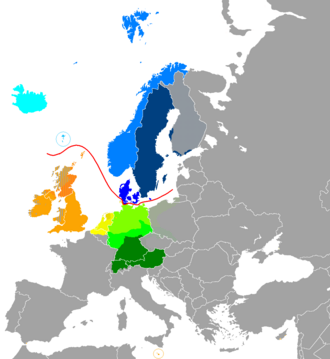
Dutch
Emperor Wilhelm II, who was the Supreme Governor of the Evangelical Church of Prussia's older Provinces, and Empress Augusta Victoria after the inauguration of the Evangelical Church of the Redeemer in Jerusalem (Reformation Day, 31 October 1898)
Distribution of Protestants and Catholics in Imperial Germany
Greater Imperial coat of arms of Germany
War flag of the German Empire used since 1903. In 1956, the Iron Cross was re-introduced as the symbol of the Bundeswehr, the modern German armed forces.
German territories lost in both World Wars are shown in black, while present-day Germany is marked dark gray on this 1914 map.

Keep exploring

This article is a child-friendly adaptation of the Wikipedia article on German Empire, available under CC BY-SA 4.0.

Images from Wikimedia Commons. Tap any image to view credits and license.