Safekipedia

Glacier

Explorer · ages 7 and underAdapted from Wikipedia
An aerial view of the Baltoro Glacier in Pakistan, flowing between towering mountain peaks like Gasherbrum IV and Mitre Peak.

What is a glacier?

A glacier is a huge, long-lasting body of natural ice. It is a bit like a river of ice, but it moves very slowly. Glaciers slowly flow and change shape because of gravity, the pull that keeps things on the ground.

A glacier forms where snow builds up faster than it melts away. This can take hundreds of years. As a glacier moves, it wears down the rock beneath it, which creates shapes like fjords.

Where are glaciers found?

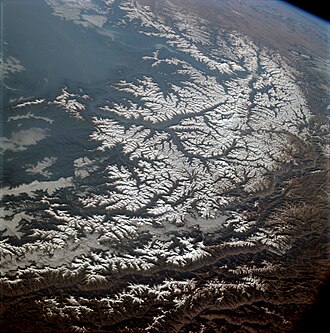
Most of the ice on Earth is held in huge ice sheets in the polar regions. Other glaciers sit high up in mountain ranges on almost every continent. Glaciers can even be found on oceanic island countries, such as New Zealand.

Glaciers cover about 10% of Earth's land. Nearly all of Antarctica is covered by ice, and Greenland has large areas of it too.

Why are glaciers important?

Glacial ice holds a lot of the world's fresh water. Glaciers store water as ice during cold seasons. Then, when summer comes, they release it as meltwater. This water is very important for plants, animals, and people.

Glaciers also look blue. Their ice absorbs more red light, so it shows a lovely blue color.

Quiz time!

3 questions about Glacier

Question 1 of 3

What is a glacier a bit like?

Pictures

Aerial view of the Geikie Plateau glacier and its mountain peaks in eastern Greenland, photographed by NASA during an IceBridge survey flight in 2013. The striped layers in the rock were formed by repeated lava flows from the ocean floor millions of years ago.
The snowy peak of the Wildspitze in Austria, seen from a nearby mountain. Faint ski tracks cross the Taschachferner glacier below, leading up toward the summit.
The Quelccaya Glacier in southern Peru, part of the Cordillera Vilcanota mountain range, with its icy crevasses and surfaces shaped by melting and flowing ice.
The icy front of Webber Glacier on Ellesmere Island in the Canadian Arctic, with meltwater waterfalls and layers of rock and soil folded into the moving ice.
The icy front of the Webber Glacier on Ellesmere Island in the Canadian Arctic, with waterfalls tumbling nearby. Dark layers of rock and dirt are squeezed into the glacier's ice.
The Geirangerfjord in Norway, a deep, narrow arm of the sea surrounded by steep green mountains and waterfalls.
Deep cracks, called crevasses, open up in the ice of the Titlis glacier in the Swiss Alps.
Chevron-shaped crevasses on the Emmons Glacier at Mount Rainier National Park. These herringbone-like cracks form when moving ice flows around rock hidden beneath the glacier.
A chart from a 2018 scientific study showing how quickly glaciers wear away rock and soil as they move.
A cross-section through the Stanley Glacier in Yoho National Park, British Columbia, Canada, photographed from inside an ice cave. The darker bands are layers of sand and rock debris trapped in the ice, which show how the glacier has moved and changed over time.
An artist's cross-section showing Lake Vostok, the largest known lake hidden beneath the ice of Antarctica. Its water is thought to take thousands of years to move through the lake.
A scientific image related to the Baltoro Glacier in the Karakoram mountains, where researchers study how ice moves on top of the glacier.
Dark and light curved stripes, called Forbes bands or ogives, run across the surface of the Mer de Glace glacier in France.
An aerial view of Fox Glacier in New Zealand, with its icy river flowing out across the wide, rocky valley below.
The stress–strain relationship of plastic flow (green section): a small increase in stress creates an exponentially greater increase in strain, which equates to deformation speed.
Diagram of glacial plucking and abrasion
Glacially plucked granitic bedrock near Mariehamn, Åland
Ice lagoon Jökulsárlón at the foot of the Vatnajökull Glacier, Iceland, 2023
Isostatic pressure by a glacier on the Earth's crust
Protonilus Mensae, Ismenius Lacus quadrangle, Mars

Keep exploring

This article is a child-friendly adaptation of the Wikipedia article on Glacier, available under CC BY-SA 4.0.

Images from Wikimedia Commons. Tap any image to view credits and license.