Safekipedia

Leonardo da Vinci

Explorer · ages 7 and underAdapted from Wikipedia
A painted portrait of Leonardo da Vinci, thought to have been made by his student Francesco Melzi.

Who was Leonardo?

Leonardo da Vinci was an Italian polymath from the High Renaissance. A polymath is a person who is good at many different things. He was born in 1452 in or near Vinci, a small town in Tuscany, Italy. Very little is known about his childhood.

When he was a young man, Leonardo learned to paint in Florence with the painter and sculptor Andrea del Verrocchio. Later he moved to other cities to work for different people. At the invitation of Francis I of France, he spent his last years in France. He passed away there in 1519.

His famous paintings

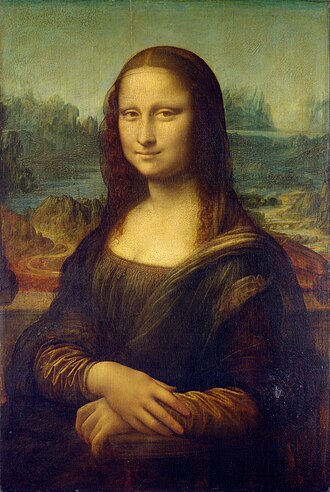
Many people know Leonardo as one of the greatest painters who ever lived. The Mona Lisa is often called the most famous painting in the whole world. The Last Supper is one of the most copied religious paintings ever made.

Leonardo also drew many pictures. His drawing Vitruvian Man is so well known that many people recognize it today.

Ideas and inventions

Leonardo filled many notebooks with drawings and notes about the things that interested him. He drew the human body, plants, and rocks. He loved to look closely at the world around him. You can learn more about his science and inventions.

He also dreamed up ideas for flying machines and other clever machines. Few of them were built while he was alive. Even so, many people still think of him as a genius. His curious mind continues to inspire people today.

Quiz time!

3 questions about Leonardo da Vinci

Question 1 of 3

What is a polymath?

Pictures

Ginevra de' Benci, a painting by Leonardo da Vinci from around 1475, shown in a portrait of a young woman in front of a landscape with a juniper tree.
The birthplace of Leonardo da Vinci in the town of Vinci, in Tuscany, Italy.
The Baptism of Christ, a painting by Andrea del Verrocchio, with a small angel by a young Leonardo da Vinci, displayed in the Uffizi Gallery in Florence.
The Adoration of the Magi is an unfinished painting by Leonardo da Vinci, started in 1481 and now displayed in the Uffizi Gallery in Florence.
Madonna with a Carnation, a painting by Leonardo da Vinci showing the Virgin Mary holding the baby Jesus.
A drawing of the Arno River valley in Tuscany, made by the artist Leonardo da Vinci in 1473.
The Madonna Benois, a Renaissance painting from Italy showing the Virgin Mary holding the baby Jesus.
The Virgin of the Rocks, a painting by Leonardo da Vinci showing the Virgin Mary, the baby Jesus, and an angel in a rocky, dreamlike landscape. It hangs in the Louvre museum in Paris.
A drawing of a young girl's head, made by the famous Italian artist Leonardo da Vinci as a study for his paintings.
Portrait of a Musician, a painting by Leonardo da Vinci from around 1483 to 1487. It was painted on a small walnut wood panel and was never finished. It is one of the few portraits of a man that Leonardo painted.
Leonardo da Vinci's famous drawing called the Vitruvian Man, which shows how the proportions of the human body can fit inside a circle and a square.
A study of a horse drawn by Leonardo da Vinci in the 1490s, made while he was planning a huge statue of a horse for the Sforza family in Milan.
Saint John the Baptist c. 1507–1516,[d 3] Louvre. Leonardo is thought to have used Salaì as the model.
A page showing Leonardo's study of a foetus in the womb (c. 1510), Royal Library, Windsor Castle
Leonardo da Vinci's baptism record
Annunciation c. 1472–1476,[d 4] Uffizi, is thought to be Leonardo's earliest extant and complete major work.
Saint Jerome in the Wilderness (unfinished) c. 1480–1490,[d 5] Vatican
Antique Warrior in Profile, c. 1472. British Museum, London
Rhombicuboctahedron as published in Pacioli's Divina proportione (1509)
Statue outside the Uffizi, Florence, by Luigi Pampaloni (1791–1847)
Tomb in the chapel of Saint Hubert at the Château d'Amboise where a plaque describes it as the presumed site of Leonardo's remains

Keep exploring

This article is a child-friendly adaptation of the Wikipedia article on Leonardo da Vinci, available under CC BY-SA 4.0.

Images from Wikimedia Commons. Tap any image to view credits and license.