
Nova
A nova is a beautiful event in space where a star suddenly becomes very bright, looking like a “new” star in the night sky. This happens because of a special pair of stars. One is called a white dwarf, and it is very small but very heavy. The other star is bigger and gives pieces of itself to the white dwarf.
When too many pieces pile up on the white dwarf, it gets very hot and bursts with bright light. This makes the white dwarf look like a brand-new star for a few weeks or months. After that, the light slowly fades away.
Novae usually appear in our sky along the path of the Milky Way, but they can show up anywhere. Most novae need a telescope to see, but sometimes one becomes bright enough that you can see it without any special tools. The last very bright nova was V1369 Centauri, which appeared in December 2013.
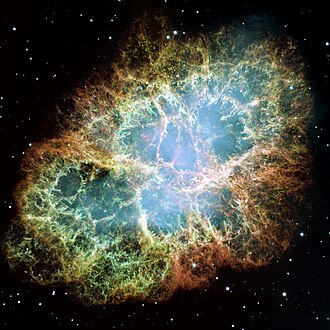
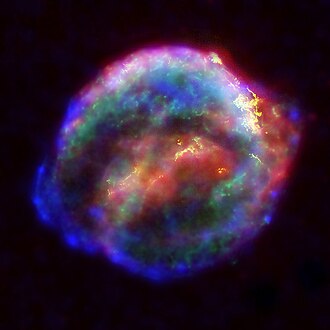
Many years ago, an astronomer named Tycho Brahe saw a bright new star in the constellation Cassiopeia. He wrote a book about it in Latin, and that is how the word “nova” began. Even though the star he saw was actually a bigger explosion called a supernova, the name nova stuck.
Novae help scientists learn about space. They show how stars change and how new material is added to the universe. Some novae can happen again after many years, and these are called recurrent novae. They are special because they burst more than once, making them very interesting to watch.
Pictures
Keep exploring


This article is a child-friendly adaptation of the Wikipedia article on Nova, available under CC BY-SA 4.0.
Images from Wikimedia Commons. Tap any image to view credits and license.