Safekipedia

Pluto

Explorer · ages 7 and underAdapted from Wikipedia
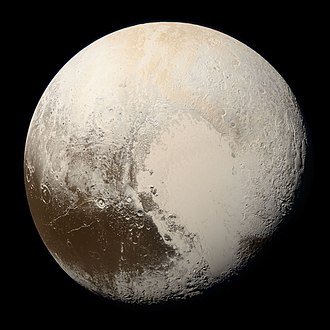
A true-color view of Pluto, taken by NASA's New Horizons spacecraft as it flew past in 2015. The bright heart-shaped region on the left is Sputnik Planitia, a large plain of icy nitrogen and methane.

What Is Pluto?

Pluto has the minor-planet number 134340. It is a dwarf planet that lives in the Kuiper belt. The Kuiper belt is a ring of icy and rocky bodies beyond the orbit of Neptune. Pluto is made mostly of ice and rock.

Pluto is much smaller than the inner planets. It has about one-sixth the mass of the Moon. Pluto was once thought to be a planet, and people called it the ninth planet. In 2006, the International Astronomical Union (IAU) changed the meaning of the word planet. Pluto became a dwarf planet. Many scientists still think of it as a planet.

Finding Pluto

Clyde Tombaugh found Pluto in 1930. It was the first known object in the Kuiper belt. The name Pluto comes from the Roman god of the underworld. A young girl in England named Venetia Burney suggested it.

Pluto is very far from the Sun. Its path around the Sun is stretched out and tilted. It takes about 248 years to go around the Sun once. Pluto stays safe from Neptune because of a steady pattern called an orbital resonance.

Pluto's Moons and Visits

Pluto has five known moons. The largest is Charon. The others are Styx, Nix, Kerberos, and Hydra. Pluto and Charon are called a binary system because they spin around a point outside of both of them. They are also tidally locked.

The spacecraft New Horizons was the first to visit Pluto. It flew past on July 14, 2015. It took detailed pictures that helped scientists learn about this small, faraway world.

Quiz time!

3 questions about Pluto

Question 1 of 3

Where does Pluto live?

Pictures

NASA's New Horizons spacecraft took this colorful, enhanced view of Pluto in 2015. The rainbow of pale blues, yellows, oranges, and reds helps scientists learn about Pluto's landforms and its history.
Photographic plates taken by astronomer Clyde Tombaugh in 1930 that helped discover Pluto. Tiny points of light are stars and distant galaxies, and the dwarf planet Pluto appears as a moving dot between the photos.
Astronomer Clyde Tombaugh, who discovered Pluto, poses with the 9-inch telescope he built himself.
A graph showing how the positions of Neptune and Pluto along their orbits differ over time, calculated using NASA's JPL Horizons system.
NASA's New Horizons spacecraft captured this view of Pluto's Sputnik Planum, where churning ice 'cells' are slowly turning over, like a cosmic lava lamp.
A map showing the craters on Pluto and its moon Charon, including the large, icy Sputnik Planitia basin on Pluto.
A colorful geological map of part of Pluto's surface, showing the icy plain Sputnik Planum and nearby mountains, hills, craters, and highlands, each area colored to show its different landforms.
A NASA image from the New Horizons spacecraft showing small patches of exposed water ice on Pluto, highlighted in blue. The scene is about 450 kilometers (280 miles) across.
A diagram showing the layers inside Pluto, including its icy crust, a possible liquid water ocean beneath, and a rocky silicate core.
A size comparison of Pluto, the Moon, and Earth, showing how these worlds differ in diameter. Pluto is the smallest of the three.
NASA's New Horizons spacecraft took this colorful farewell view of Pluto's blue haze layers as it flew away from the distant dwarf planet in 2015.
An animation showing how Pluto moves around the Sun from 1850 to 2097, alongside Saturn, Uranus, and Neptune.
An animation showing how Pluto travels around the Sun. Pluto takes about 248 Earth years to complete one orbit, and its path is tilted compared to the flat orbits of the planets.
An animation showing Pluto turning slowly, built from images taken by NASA's New Horizons spacecraft as it flew past the distant dwarf planet.
An oblique view of the Pluto–Charon system, showing that Pluto orbits a point outside itself. The two bodies are mutually tidally locked.
Computer-generated rotating image of Pluto based on observations by the Hubble Space Telescope in 2002–2003
Pluto and Charon seen orbiting each other by New Horizons

Keep exploring

This article is a child-friendly adaptation of the Wikipedia article on Pluto, available under CC BY-SA 4.0.

Images from Wikimedia Commons. Tap any image to view credits and license.