 Safekipedia
Yukon River
Adapted from Wikipedia · Explorer experience
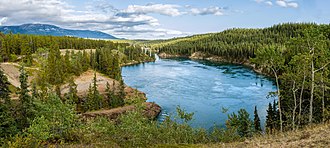
The Yukon River
The Yukon River is a very long river in northwestern North America. It starts in British Columbia and flows through the Canadian territory of Yukon. The lower part of the river goes through the U.S. state of Alaska and ends in the Bering Sea at the Yukon–Kuskokwim Delta. The river is about 3,190 kilometres (1,980 miles) long.
The Yukon River was very important during the Klondike Gold Rush. People used paddle-wheel riverboats on the river until the 1950s, when the Klondike Highway was built.
Today, the river is still important for people who live near it. It provides food and water for many animals and fish, like salmon. People also use the river for travel and fishing.
The name Yukon comes from a phrase used by the Gwich’in people. It means white water river. This describes the pale colour of the river’s water from glacial runoff.
The Yukon River passes many towns and villages, such as Whitehorse, Dawson City, and many places in Alaska. Near the end, the river spreads out into smaller channels before reaching the ocean.
There are only four bridges for cars crossing the Yukon River. In summer, a car ferry crosses the river at Dawson City; in winter, an ice bridge is used instead.
Images
Related articles


This article is a child-friendly adaptation of the Wikipedia article on Yukon River, available under CC BY-SA 4.0.
Images from Wikimedia Commons. Tap any image to view credits and license.