 Safekipedia
Great Britain
Adapted from Wikipedia · Adventurer experience
Great Britain is an island in the North Atlantic Ocean near the northwest coast of continental Europe. It has three countries: England, Scotland, and Wales. This island is the largest in the British Isles, the largest in Europe, and the ninth-largest island in the world.
It covers 209,331 km2 (80,823 sq mi) and has mild weather, so it is never too hot or too cold. To the west of Great Britain is the island of Ireland, which is smaller. Together with over 1,000 nearby islands, they form the British Isles archipelago.
Until about 9,000 years ago, Great Britain was connected to Europe by a land bridge named Doggerland. People have lived there for around 30,000 years. In 2011, about 61 million people lived in Great Britain, making it the third-most-populous island in the world, after Honshu in Japan and Java in Indonesia. When people refer to Great Britain, they often mean the lands of England, Scotland, and Wales, which together with Northern Ireland, form the United Kingdom.
Terminology
See also: Terminology of the British Isles
Toponymy
Main article: Britain (place name)
The archipelago has had one name for over 2000 years. The term 'British Isles' comes from old maps. By 50 BC, Greek mapmakers used a name like Prettanikē. After the Romans came, they used the Latin word Britannia for the big island, which is Great Britain.
The oldest name for Great Britain is Albion, which might mean "white" because of the white cliffs of Dover. One early writer, Aristotle, mentioned two big islands called the British Isles, Albion and Ierne.
The word Britain comes from the Latin Britannia, used by the Romans. Old French and Middle English also used versions of this name. The people were called Πρεττανοί or Priteni, which might mean "the painted ones" because of body decorations.
Derivation of Great
A scientist named Ptolemy called the bigger island great Britain and Ireland little Britain. Later, after the Angles and Saxons came, the name Britain was mostly used for history. In 1474, the term Great Britain was used in a marriage document. By 1604, James VI and I called himself "King of Great Brittaine".
Modern use of the term Great Britain
Great Britain means the big island with England, Scotland, and Wales. Sometimes people use it to mean the whole United Kingdom, which also includes Northern Ireland, but this isn’t completely correct.
Political definition
When people talk about Great Britain in politics, they mean England, Scotland, and Wales together, not Northern Ireland. This includes small islands around them, like the Isle of Wight and the Isles of Scilly. The two countries became one in 1707 with the Acts of Union. Before that, the same king ruled both countries since 1603, when James VI of Scotland also became king of England as James I.
History
Prehistoric period
Main article: Prehistoric Britain
The oldest signs that people were in Britain are footprints and stone tools found in Norfolk. They date back to around 950–850,000 years ago. Before 450,000 years ago, Britain was connected to Europe. Big floods later turned it into an island. People lived there during warm times but left when it got colder. About 40,000 years ago, modern humans arrived, after other ancient humans called Neanderthals had gone away. Until about 9,000 years ago, Britain was still linked to Europe by land that is now underwater.
In those early times, Britain had many different groups. Farmers from a place called Anatolia came around 4000 BC and changed the population. Later, around 2000 BC, new people arrived bringing what is called the Bell Beaker Culture. Around 1000 BC, more people came, possibly bringing Celtic languages.
Roman and medieval period
Main articles: Roman Britain, Medieval England, Medieval Scotland, and Medieval Wales
The Romans took control of most of Britain, up to a wall in northern England, and called it Britannia. After the Roman Empire ended, groups from Germany, like the Angles, Saxons, and Jutes, came and took over much of the south and east. In the north-west, people from Ireland mixed with local groups and later formed the Kingdom of Scotland. The people in the south became known as English, named after the Angles.
The term "Welsh" came from German-speaking people and was used for those living in what is now Wales. The people there kept their Celtic language. Some Britons moved to an area now called Brittany, where their language, Breton, is still spoken. In the 9th century, Danish attacks led to parts of England being under Danish rule. By the 10th century, all English areas were united under one king. In 1066, England was taken over by Norman rulers.
Early modern period
Main article: Early modern Britain
Further information: History of the United Kingdom
In 1604, King James called himself "King of Great Brittaine, France, and Ireland". Later, in 1707, England and Scotland joined together by an Act of Union, creating one kingdom called "Great Britain". This new kingdom had one parliament starting on 1 May 1707.
Geography
Further information: Geography of England, Geography of Scotland, and Geography of Wales
See also: Geography of the United Kingdom
Great Britain is a large island in the North Atlantic Ocean, near the northwest coast of Europe. It is part of the European continental shelf and sits on the Eurasian Plate. The island is separated from Europe by the North Sea and the English Channel. It covers an area of 209,331 km2 (80,823 sq mi).
The landscape changes from low, rolling countryside in the east and south to hills and mountains in the west and north. Over 1,000 smaller islands and islets surround it. The greatest distance between two points on the island is about 968 kilometers (601 miles).
Geology
Main article: Geology of Great Britain
Great Britain has experienced many geological changes over millions of years. Different plate movements, changing sea levels, and ancient collisions between continents have shaped its landscape. These events created folds, faults, and mountains, leaving behind a variety of rocks and landforms.
The oldest rocks are found in the far northwest and the Hebrides, dating back over 2.7 billion years. In the north, the land is rising because the weight of ancient ice has been lifted, while the south and east are slowly sinking.
Fauna
Main article: Fauna of Great Britain
Great Britain has a modest variety of animals due to its size, history, and separation from Europe. Some animals, like rats, foxes, and grey squirrels, have adapted well to cities.
Rodents make up many of the mammal species, including squirrels, mice, voles, rats, and beavers that have been brought back. There are also rabbits, hares, shrews, moles, and several kinds of bats. Carnivores include foxes, badgers, otters, weasels, stoats, and the rare Scottish wildcat. Deer are the largest land animals, with species like red deer, roe deer, and fallow deer. There are many birds, with over 628 species recorded, including eagles, herons, kingfishers, and sparrows. Six kinds of reptiles live there, including three snakes and three lizards. One snake, the adder, can cause illness but is rarely dangerous. Amphibians like frogs, toads, and newts are also present.
Flora
See also: List of the vascular plants of Britain and Ireland
The plant life on Great Britain includes fewer species than larger parts of Europe, with about 3,354 kinds of vascular plants. Native trees include birch, beech, ash, hawthorn, elm, oak, yew, pine, cherry, and apple. Other trees like chestnut, maple, spruce, and sycamore have been introduced from places like Europe and North America.
There are at least 1,500 species of wildflowers, some of which are rare and protected. The island also has many types of mosses, liverworts, and hornworts.
Fungi
There are thousands of types of fungi in Great Britain, including many that form lichens. Recent studies have identified over 3,600 species of one group and more than 5,100 of another. Many more fungal species are likely still unknown.
Demographics
Main article: Demographics of the United Kingdom
Further information: Demographics of England, Demographics of Scotland, Demographics of Northern Ireland, and Demographics of Wales
Settlements
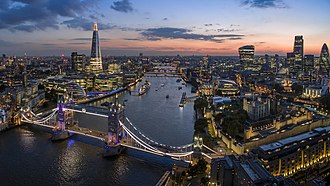
London is the capital of England and the United Kingdom. It is where the United Kingdom's government is located. Edinburgh is the capital city of Scotland and home to the Scottish Government and the highest courts in Scotland. The Palace of Holyroodhouse in Edinburgh is the official residence of the British monarch when in Scotland. Cardiff is the capital city of Wales and the seat of the Welsh Government.
Largest urban areas
See also: List of urban areas in the United Kingdom
Language
Further information: Languages of England, Languages of Scotland, and Languages of Wales
See also: Languages of the United Kingdom
British English is spoken across the island today. It developed from Old English brought by Anglo-Saxon settlers. About 1.5 million people speak Scots. Around 700,000 people speak Welsh, an official language in Wales. In parts of north west Scotland, Scottish Gaelic is still widely spoken. There are many regional dialects of English and numerous languages spoken by some immigrant groups.
Religion
Further information: Religion in England, Religion in Scotland, and Religion in Wales
See also: Religion in the United Kingdom
Christianity has been the most common religion since the Early Middle Ages. The most popular form is Anglicanism (known as Episcopalism in Scotland). The second largest Christian group is the Latin Church of the Catholic Church. The Church of Scotland, a form of Protestantism, is the third most common. Methodism is the fourth largest and grew from Anglicanism.
There are many other religions practised today. The 2011 census recorded that Islam had around 2.7 million followers. More than 1.4 million people believed in Hinduism, Sikhism, or Buddhism. Judaism had about 263,000 followers. Jews have lived in Britain since 1070.
| Rank | City-region | Built-up area | Country | Population (2011 Census) | Area (km2) | Density (people/km2) |
|---|---|---|---|---|---|---|
| 1 | London | Greater London | England | 9,787,426 | 1,737.9 | 5,630 |
| 2 | Manchester–Salford | Greater Manchester | England | 2,553,379 | 630.3 | 4,051 |
| 3 | Birmingham–Wolverhampton | West Midlands | England | 2,440,986 | 598.9 | 4,076 |
| 4 | Leeds–Bradford | West Yorkshire | England | 1,777,934 | 487.8 | 3,645 |
| 5 | Glasgow | Greater Glasgow | Scotland | 1,209,143 | 368.5 | 3,390 |
| 6 | Liverpool | Liverpool | England | 864,122 | 199.6 | 4,329 |
| 7 | Southampton–Portsmouth | South Hampshire | England | 855,569 | 192.0 | 4,455 |
| 8 | Newcastle upon Tyne–Sunderland | Tyneside | England | 774,891 | 180.5 | 4,292 |
| 9 | Nottingham | Nottingham | England | 729,977 | 176.4 | 4,139 |
| 10 | Sheffield | Sheffield | England | 685,368 | 167.5 | 4,092 |
Related articles




This article is a child-friendly adaptation of the Wikipedia article on Great Britain, available under CC BY-SA 4.0.
Images from Wikimedia Commons. Tap any image to view credits and license.