 Safekipedia
Great Pyramid of Giza
Adapted from Wikipedia · Adventurer experience
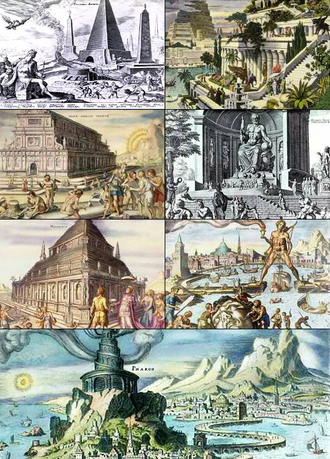
The Great Pyramid of Giza is the largest of the Egyptian pyramids and the most famous landmark of the Giza pyramid complex in Giza, Egypt. It is the oldest of the Seven Wonders of the Ancient World, and the only wonder that has stayed mostly whole. The Great Pyramid served as the tomb of Egyptian Pharaoh Khufu, who ruled during the Fourth Dynasty of the Old Kingdom. It was built around 2600 BC over about 26 years.
It was the world's tallest human-made structure for more than 3,700 years. Over time, most of the smooth white limestone covering was removed, lowering the pyramid's height.
There are three known rooms inside the Great Pyramid, including the Queen's Chamber and King's Chamber, which contain a granite stone coffin. The pyramid is part of the UNESCO World Heritage Site "Memphis and its Necropolis".
Purpose
The Great Pyramid of Giza was built as a tomb for the pharaoh Khufu. It kept his body safe and showed his important place in society. People could bring gifts there for him.
In ancient Egypt, bigger tombs showed higher status. Only kings and queens could have pyramids as their tombs. The Great Pyramid was built around 2600 BC, before pyramids were usually written on. It had special temples where people performed ceremonies for Khufu.
Attribution to Khufu
The Great Pyramid was built as a tomb for the pharaoh Khufu, who ruled ancient Egypt. Historians like Herodotus and Diodorus Siculus wrote about this long ago. In the Middle Ages, some people thought other famous figures built it, but we now know it belongs to Khufu.
Workers found hidden rooms above the main room of the pyramid. These rooms had writing on the walls with Khufu's name. More writing with Khufu's name was found on stones outside the pyramid and in other places linked to him. Graves near the pyramid held family members and important people who served Khufu. These graves also had writings mentioning Khufu and his pyramid.
A stone was found near the Great Sphinx that showed people still thought the pyramid belonged to Khufu in later times. A big boat was found near the pyramid, and writing on the boat’s stones included Khufu’s name. A diary was found that told how stones were brought to build the pyramid, and it often called the pyramid by Khufu’s name.
Age
The Great Pyramid is very old, about 4,600 years. We know this in two ways. First, we study when the pharaoh Khufu ruled, using old lists of kings and other history clues. Second, we use science to test pieces of wood and other materials found inside the pyramid.
Most experts think Khufu and his pyramid were built between the years 2700 and 2500 BC. Scientists have tested samples of the pyramid's building material. This helps us learn more about when it was built, even though some dates can be hard to figure out exactly.
| Author (year) | Estimated date |
|---|---|
| Greaves (1646) | 1266 BC |
| Gardiner (1835) | 2123 BC |
| Lepsius (1849) | 3124 BC |
| Bunsen (1860) | 3209 BC |
| Mariette (1867) | 4235 BC |
| Breasted (1906) | 2900 BC |
| Hassan (1960) | 2700 BC |
| O'Mara (1997) | 2700 BC |
| Beckarath (1997) | 2554 BC |
| Arnold (1999) | 2551 BC |
| Spence (2000) | 2480 BC |
| Shaw (2000) | 2589 BC |
| Hornung (2006) | 2509 BC |
| Ramsey et al. (2010) | 2613–2577 BC |
Historiographical record
Classical antiquity
Herodotus
The ancient Greek historian Herodotus wrote about the Great Pyramid more than 2000 years after it was built. He learned about it from Egyptians and Greek people living there. Herodotus said the pyramid was built by Khufu, whom he called Cheops. He described the workers and how it was built, but some of his details were not correct.
Diodorus Siculus
Another Greek historian, Diodorus Siculus, also wrote about the Great Pyramid. He visited Egypt around 60–56 BC. Diodorus said the pyramid was built by someone after Ramses III. He talked about how the pyramid was built and its condition at the time, and said that ramps were used to move the stones.
Strabo
The Greek geographer Strabo visited Egypt around 25 BC. In his book Geographica, he said the pyramids were tombs for kings but did not say which king was buried in the Great Pyramid. Strabo also said there was a stone on one side that could be moved to go inside.
Pliny the Elder
The Roman writer Pliny the Elder wrote in the first century AD that the Great Pyramid might have been built to keep people busy or to protect a pharaoh’s treasures. He described ways the stones were moved and said there was a deep well inside connected to the river.
Late antiquity and the Middle Ages
Oblivion
During late antiquity, some people thought the pyramids were grain stores built by Joseph from the Bible. This idea started in the 4th century AD. Later, during the Rashidun Caliphate, the Abbasid caliph al-Ma'mun entered the pyramid and found hidden passages. Many myths and stories grew up around the pyramid during this time.
Rediscovery
In the 15th century, the Italian traveler Cyriacus of Ancona visited the Giza plateau. He studied old texts and compared them to what he saw. He confirmed that the Great Pyramid was a tomb, not a granary. His writings helped correct wrong ideas and showed that the Great Pyramid was the only one of the Seven Wonders of the Ancient World still standing.
Construction
The Great Pyramid of Giza was built on a hill that was made flat. Workers used simple tools and good planning to get ready.
The pyramid is made from millions of stone blocks. Most blocks came from nearby places, and some came from far away, like Aswan and Tura. Builders used copper tools, wooden mallets, and ropes to cut and move the stones.
The pyramid was built by many skilled workers, not slaves. Teams worked together to cut and place the blocks. With good planning, the pyramid could have been finished in about 27 years.
Casing
When the Great Pyramid was finished, it was covered in white limestone. The stones were cut very precisely and placed in layers. This made four even sides, each angled at 51°50'40".
The layers of stones are not all the same height. The bottom layers are the tallest, about 1.49 metres high. The layers near the top are only a little over half a metre high. The stones in the upper layers weigh around 500 kilograms each.
Over time, many of the outer stones were removed. This happened especially during the Middle Ages, when they were used for building in nearby Cairo. Today, only a few of the original bottom stones remain in place. Researchers have studied the mortar used to hold the stones together.
Pyramidion and missing tip
The Great Pyramid of Giza once had a special top piece called a pyramidion. People think it might have been made of limestone, granite, or basalt. Some stories say it was even made of gold or electrum. Today, we know that older pyramids had pyramidions made of white limestone.
The Great Pyramid lost its pyramidion a long time ago. Writers from the past said there was just a flat area on top. Over many years, stones from the top were taken away, so the pyramid is now shorter than before.
In 1874, a scientist named David Gill put a pole on top to help with his measurements. In 2019, someone climbed the pyramid and damaged the pole, but this did not harm the ancient pyramid.
Interior
The Great Pyramid has three main rooms: the King's Chamber, the Queen's Chamber, and the Subterranean Chamber. There is also a Grand Gallery and many hallways and shafts. The walls inside are plain, but marks and names left by workers can be seen on some blocks.
There are two ways to get into the pyramid: the original entrance and a forced passage that meet at a point. One path goes down to the Subterranean Chamber, while the other goes up to the Grand Gallery. From the Grand Gallery, you can go down a vertical shaft, across a horizontal hallway to the Queen's Chamber, or up to the King's Chamber, which holds a stone coffin.
Both the King's Chamber and the Queen's Chamber have small "air-shafts". Above the King's Chamber are five rooms built to support the roof.
Entrances
Original entrance
The original entrance is on the north side of the pyramid. Before people started taking stones away, you could enter through a hole in the 19th layer of stones. Inside, there is a row of special blocks that help keep the weight of the pyramid off the entrance. Over time, some of these blocks have been lost.
Many drawings and writings by visitors are carved into the stones around the entrance. One famous example is a large square of hieroglyphs carved in honor of a king by a group of explorers in 1842.
North Face Corridor
In 2016, a team of scientists found a hidden space behind the entrance using special cameras. In 2019, they confirmed it was a hallway at least 5 meters long. In 2023, they explored this hallway and found it to be 9 meters long with walls about 2 meters square.
Robbers' Tunnel
Today, visitors enter the pyramid through the Robbers' Tunnel, which was cut straight through the stones of the pyramid. The tunnel was made a long time ago, possibly around 820 AD by workers using a heavy tool. Scholars debate when this tunnel was really made, with some thinking it was done much earlier.
Descending Passage
From the original entrance, a hallway goes down through the pyramid and into the ground below, leading to the Subterranean Chamber.
The hallway is about 1.2 meters tall and 1 meter wide, sloping down at an angle of 26 degrees. After 28 meters, you reach the lower end of another hallway that goes up. This part was once blocked by stones, but a small tunnel was made around them. The hallway continues down for another 72 meters, now through the natural rock below the pyramid. Near the end, there is a connection to a vertical shaft that leads up to the Grand Gallery.
A shorter hallway connects the end of this descending hallway to the Subterranean Chamber. It is about 9 meters long, 85 cm wide, and 91–95 cm tall. There is a small extra space on the west wall near the end.
Subterranean Chamber
The Subterranean Chamber, also called the "Pit", is the lowest of the three main rooms and is dug into the rock below the pyramid.
It is about 8.4 meters from north to south and 14.1 meters from east to west, with a height of about 4 meters. The west side of the room is rough and unfinished, with marks left by workers. There is a small space cut into the north side of the west wall. The only way in is through the Descending Passage on the east side of the north wall.
Opposite the entrance, a hallway goes south for 11 meters and then bends slightly for another 5.4 meters. On the east side of the room is a large hole called Perring's Shaft. It was made deeper over time, but no hidden chamber was found. Rubble from this digging still fills part of the room.
Ascending Passage
The Ascending Passage connects the Descending Passage to the Grand Gallery. It is 39.3 meters long and has the same size as the hallway it starts from, but it slopes at a slightly lower angle of 26 degrees.
The lower end of this hallway is blocked by three large granite stones that were moved into place from the Grand Gallery. Most of the walls have joints that run straight across, except for a few special stones in the middle.
Well Shaft and Grotto
The Well Shaft links the lower end of the Grand Gallery to the bottom of the Descending Passage, about 50 meters lower.
The shaft takes a winding path. It starts vertical for 8 meters, then angles south for about the same distance until it reaches the natural rock about 5.7 meters above the base of the pyramid. It goes vertical again for a short way, then angles down through the rock at about 45 degrees for 26.5 meters before a steeper part leads to the end. The last part connects almost horizontally to the Descending Passage. The builders had trouble lining up the end.
People think this shaft was used to give air to the Subterranean Chamber or to help workers move the blocking stones into place.
The Grotto is a natural cave in the limestone that was probably filled with sand before building began. It was later emptied out by people looking for treasure. A granite block inside might have been part of a door for the King's Chamber.
Queen's Chamber
The Horizontal Passage connects the Grand Gallery to the Queen's Chamber. At the start, there are five pairs of holes that might have once hidden doors. The hallway is about 1 meter wide and 3.8 feet tall for most of its length, but it gets taller near the chamber. The west wall has two layers of stones with continuous vertical lines.
The Queen's Chamber is in the middle of the pyramid. It is about 5.2 meters from north to south, 5.8 meters from east to west, and has a pointed roof reaching 6.3 meters high. On the east end is a space 4.7 meters high. The original depth was 1 meter, but it has been made deeper by people looking for treasure.
In 1872, shafts were found in the north and south walls of the Queen's Chamber. Their purpose is unknown. In one shaft, a ball of stone, a bronze hook, and a piece of wood were found. The wood was later dated to between 3341 and 3094 BC. The northern shaft changes angle to avoid the Grand Gallery, while the southern shaft goes straight.
In 1993, a robot explored these shafts and found a stone door with two metal parts in one of them. In 2002, another robot drilled a small hole and found another stone behind it. In 2011, a camera went through the hole and saw markings that might show the length of the shaft. They also saw that the metal parts were likely for decoration.
Grand Gallery
The Grand Gallery continues the slope of the Ascending Passage towards the King's Chamber, rising 21 meters from the 23rd to the 48th layer of stones. It is 8.6 meters high and 46.68 meters long, with walls of polished limestone. The floor is 2.1 meters wide at the base, but the walls lean inward by 6–10 cm on each side after two layers, making it only 1 meter wide at the top.
The roof is made of stone slabs laid at a steeper angle than the floor, fitting into slots like the teeth of a ratchet. This keeps each block supported by the wall instead of the block below it.
At the top end of the Gallery, there is a hole near the roof that leads to a small tunnel to the lowest of the relieving chambers.
The floor has a step on each side, leaving a lower path 1 meter wide in the middle. There are 56 slots on the steps, 28 on each side, and 25 niches above them on each wall. Their purpose is unknown, but the central groove might have held beams to keep back blocking stones. One theory is that they held a wooden frame to help move heavy blocks.
At the top of the Gallery, there is a small platform where a tunnel leads through the Antechamber to the King's Chamber.
The Big Void
In 2017, scientists found a large empty space above the Grand Gallery using special imaging. They called it the "ScanPyramids Big Void". It is at least 30 meters long and has a shape similar to the Grand Gallery. Its purpose is unknown, and it cannot be entered. The team thinks it might have been a gap used during building, but it is different from known spaces.
Plans to study it further were delayed by the COVID-19 pandemic.
Antechamber
The last protection against people getting in was a small room designed to hold large stone doors, called the Antechamber. It is mostly made of granite and lies between the upper end of the Grand Gallery and the King's Chamber. Three places for stone doors line the east and west walls of the room. Each has a curved groove on top for a log that ropes could go around.
The granite doors were about 52.4 cm thick and were lowered into place using ropes tied through holes in the blocks. There are four vertical grooves on the south wall for the ropes.
The Antechamber has a flaw: the space above the doors can be reached, so all but the last door could be gotten around. This was used by people long ago who broke through the ceiling of the tunnel behind to get into the King's Chamber. Later, all three doors were broken and removed. Pieces of these blocks can be found in different places in the pyramid.
King's Chamber
The King's Chamber is the topmost of the three main rooms of the pyramid. It is made entirely of granite and measures 10.5 meters from east to west and 5.2 meters from north to south. The flat ceiling is about 5.8 meters above the floor, made of nine stone slabs weighing about 400 tons together. The roof beams show cracks because the chamber has settled by 2.5–5 cm.
The walls are made of five layers of blocks that are not carved with pictures, as was normal for tombs of this time. The stones fit together precisely. The surfaces are smoothed in different ways, with some still showing marks left by workers. The backs of the blocks were only roughly shaped, as was usual for hard-stone blocks, probably to save time.
Sarcophagus
The only thing left in the King's Chamber is a sarcophagus made from a single block of granite. When it was found in the Early Middle Ages, it had been broken open and any contents had already been taken. It is shaped like early Egyptian sarcophagi, rectangular with grooves for a missing lid and three small holes to hold pegs. The inside measures about 198 cm by 68 cm, and the outside is 228 cm by 98 cm, with walls about 15 cm thick. The sarcophagus is too big to turn between the Ascending and Descending Passages, so it must have been placed in the chamber before the roof was put on.
Air shafts
In the north and south walls of the King's Chamber are two narrow shafts, known as "air shafts". They face each other and are about 0.91 meters above the floor, 2.5 meters from the east wall, with widths of 18 and 21 cm and heights of 14 cm. Both start horizontal through the granite blocks and then turn upward.
The southern shaft goes up at a 45-degree angle with a slight curve to the west. One ceiling stone was found unfinished, called a "Monday morning block". The northern shaft changes angle several times, shifting west, possibly to avoid the Big Void. The builders seem to have had trouble with the angles, making parts of the shaft narrower. Both now lead outside. Whether they ever went through the outer casing is unknown.
The purpose of these shafts is unclear: they were once thought to be for air, but this idea is now mostly rejected in favor of them serving a religious purpose linked to the king's spirit rising to the heavens.
The idea that the shafts point to stars or parts of the sky has been largely dismissed because the northern shaft has a bend and the southern shaft has a curve of about 20 cm, showing no intent to point to celestial objects.
In 1992, as part of a project, a ventilation system was put in both air shafts of the King's Chamber.
Relieving chambers
Above the roof of the King's Chamber are five spaces, named (from lowest to highest) "Davison's Chamber", "Wellington's Chamber", "Nelson's Chamber", "Lady Arbuthnot's Chamber", and "Campbell's Chamber".
They were probably meant to keep the roof of the King's Chamber from collapsing under the weight of the stone above, so they are called "relieving chambers".
The granite blocks separating the chambers have flat bottoms but roughly shaped tops, giving all five chambers an uneven floor but a flat ceiling, except the top chamber, which has a pointed limestone roof.
Nathaniel Davison is credited with finding the lowest of these chambers in 1763, after a French merchant told him about it. It can be reached through an ancient passage from the top of the south wall of the Grand Gallery. The upper four chambers were found in 1837 by Howard Vyse after he found a crack in the ceiling of the first chamber. This let him put in a long reed, which, with gunpowder and boring tools, opened a tunnel up through the stone. Since no passages existed for the upper four chambers — unlike Davison's Chamber — they were completely unreachable until then.
Inscriptions
The walls of the upper four relieving chambers have many drawings made with red paint.
The drawings show the names of work-groups, such as "Khufu-excites-love". The blocks were marked before being placed, so some drawings are partly covered by other blocks or turned sideways or upside down. Similar drawings were found in other Egyptian pyramids, like those of Menkaure and Sahure.
The drawings were correctly understood only years after they were found and refer to four work-groups:
-
"The gang, The Horus Medjedu-is-the-purifier-of-the-two-lands" (Medjedu is Khufu's Horus name) Found once in relieving chamber 3
-
"The gang, The Horus Medjedu-is-pure" Found seven times in chamber 4
-
"The gang, Khufu-excites-love" Found once in chamber 5 (top chamber)
-
"The gang, The-white-crown-of Khnumkhufu-is-powerful" (Khnum-Khufu is Khufu's full birth name) Found once in chambers 2 and 3, ten times in chamber 4 and twice in chamber 5
A 3D study in 2024 found new drawings. The west wall of Nelson's Chamber was found to have a date from “the year of the 6th census, second month of the Peret season, day […]” (the census happened every two years during Khufu's rule). A mention of the goddess Wadjet, which might have been part of a work-group name, was also found on the same wall.
Marks made by builders to level and guide the stones during building are also found throughout the relieving chambers.
Pyramid complex
See also: Giza pyramid complex
The Great Pyramid is part of a large group of buildings called the Giza pyramid complex. Around the pyramid, there are smaller pyramids, temples, and other structures.
Temples and causeway
There was a big temple next to the pyramid, but most of it has gone. Only a few pieces of black stone are left. There is also a path called a causeway that used to connect the pyramid to a smaller temple closer to the valley, but only small parts of this path remain today. This smaller temple is hidden under a village, and only a few pieces of stone have been found there.
East cemetery
The tomb of Queen Hetepheres I, who was the sister and wife of a king named Sneferu and the mother of Khufu, is located not far from the Great Pyramid. This tomb was found by accident, and although the coffin was sealed, it was empty inside.
Subsidiary pyramids
On one side of the Great Pyramid, there are four smaller pyramids. Three of them are still standing fairly tall and are often called the Queens' Pyramids (G1-a, G1-b and G1-c). The fourth pyramid is much smaller and broken down, and people did not even know it existed until pieces of its stones were found during digs in the early 1990s.
Boats
Main articles: Khufu ship and Solar barque
Near the pyramid, there are pits shaped like boats. These pits are big enough to have held whole boats, but they are so shallow that any extra parts of the boats must have been taken away or taken apart.
Two more long, narrow pits were found on the other side of the pyramid, still covered with heavy stone slabs.
In 1954, an archaeologist named Kamal el-Mallakh found the first of these pits. Inside, there were many pieces of wood, and a boat builder named Haj Ahmed Yusuf put them together. It took fourteen years to fix and straighten the wood, and the result was a beautiful cedar-wood boat almost 44 meters long, held together by ropes. This boat was kept in a special museum shaped like a boat next to the pyramid, but it is now in the Grand Egyptian Museum (Giza Solar boat museum and Grand Egyptian Museum).
While building this museum in the 1980s, workers found a second sealed pit with another boat inside. They did not open it until 2011, when they began to dig out the boat.
Pyramid town
Around the pyramid complex, there is a huge stone wall called the Wall of the Crow. An archaeologist named Mark Lehner found a town outside this wall, called “The Lost City”. By looking at the style of the pottery, seals, and layers of earth, he figured out that this town was built and used during the time when two kings, Khafre and Menkaure, ruled.
Lehner and his team made many discoveries, including what looks like a busy port. This made them think that the town might have been home not to the workers who built the pyramids, but to soldiers and sailors who used the port. Lehner wonders if the pyramid workers maybe lived on the ramps used to build the pyramids, or perhaps in nearby quarries.
In the 1970s, an Austrian archaeologist named Karl Kromer dug up a mound in the South Field of the plateau. He found items including mudbrick seals that belonged to Khufu, suggesting this was a place where artisans lived. Other mudbrick buildings near Khufu’s temple also had seals of Khufu and might have been used for ceremonies after his death. In 1990, another archaeologist found a cemetery used by workers from Khufu’s time up until the end of a later dynasty called the Fifth Dynasty.
Looting
Some historians think that many pyramids, including the Great Pyramid of Giza, were entered and their treasures taken away long ago. They believe this started during a time called the New Kingdom when new tombs were being built in the Valley of the Kings. Others think the Great Pyramid might have been opened and emptied even earlier.
A famous traveler named Herodotus heard stories about secret rooms under the pyramid, but experts think the treasures had already been taken long before his time. Over the years, people may have shared and changed these stories, which could explain why Herodotus heard such tales.
Images
Related articles



This article is a child-friendly adaptation of the Wikipedia article on Great Pyramid of Giza, available under CC BY-SA 4.0.
Images from Wikimedia Commons. Tap any image to view credits and license.