Isthmus of Panama
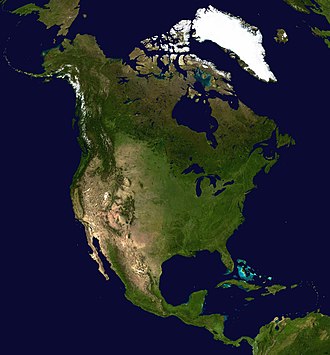
The Isthmus of Panama, once known as the Isthmus of Darien, is a narrow strip of land. It lies between the Caribbean Sea and the Pacific Ocean, and it connects North and South America.
The country of Panama is on the isthmus. The Panama Canal is also there. Like many isthmuses around the world, it is a thin bridge of land between two nearby seas. This makes it very important for travel and for countries' plans.
The isthmus is thought to have formed about 3 million years ago (Ma). It split the Atlantic and Pacific Oceans apart. This also led to the creation of the Gulf Stream, an ocean current. Henry Fairfield Osborn first suggested this in 1910. He based his idea on the fossil record of mammals in Central America. His idea later helped Alfred Wegener when he proposed the theory of continental drift in 1912. Some newer studies suggest the isthmus may have formed earlier, perhaps as long ago as 4 Ma.
History
Main article: History of Panama
The Isthmus of Panama has always been important to the whole world. When it formed, it changed plants, animals, and weather across the planet. The separation of the oceans created more sea life on both sides. The connection between the American continents let interchange of terrestrial life happen. The isthmus changed how warm and cold ocean currents moved, which helped the northern polar ice cap form. It also helped create the Gulf Stream and the Atlantic system of weather and currents. These helped the "triangle trade" routes, which were the basis of the Atlantic World in the early modern era. Remains of Paleolithic animals found in the Canal Zone in 2007 included bear-dogs, miniature horses, rhinos, camels, early relatives of modern hippos, and at least one kind of chalicothere.
The first people to live on the isthmus were Paleo-Indians, who probably arrived between 18,000 and 15,000 years ago. Indigenous peoples have lived there ever since. The Monagrillo site has pottery from 2500 to 1200 BCE. This is some of the earliest pottery in Central America, and it shows some of the earliest maize farming in the region. The site grew into a range of cultures that archeologists call the Gran Coclé culture area. Gold work from this area has been found as far away as Chichin Itza in the Yucatán Peninsula. By 1501, when Europeans first arrived, Chibchan- and Chocoan-speaking peoples lived widely across the isthmus.
Vasco Núñez de Balboa, a Spanish conquistador, was the first European to reach the Pacific Ocean, on 25 September 1513. He had heard about an ocean on the other side of the isthmus from local people while sailing along the Caribbean coast. In 1519 the town of Panamá was founded near a small indigenous settlement on the Pacific coast. In 1671 Welsh privateer Henry Morgan crossed the isthmus from the Caribbean side and destroyed the city. The town was moved a few kilometers west to a small peninsula. The ruins of the old town, Panamá Viejo, are preserved. They were named a UNESCO World Heritage Site in 1997.
European colonizers caused great harm to the local Cueva people, both directly and indirectly. Hard working conditions, wars, and the breaking up of communities left very few indigenous people in the most heavily colonized parts of the isthmus. By 1550, only a small number of indigenous people remained in the cities of Panama, Nombre de Dios, and Nata.
During the Spanish colonization of Peru, the isthmus became an important trade port and a center for managing the conquests of South and Central America. Silver and gold from the viceroyalty of Peru were carried overland across the isthmus by the Spanish Silver Train to Porto Bello. From 1707, Spanish treasure fleets shipped them to Spain from there. Lionel Wafer lived among the Guna people from 1680 to 1684.
In 1698 Scotland tried to set up a settlement through the Darien scheme, but it did not succeed. It was backed largely by investors of the Kingdom of Scotland. The plan was to gain wealth and influence by founding New Caledonia, a colony in the Darién Gap on the Gulf of Darién. It also hoped to build an overland route between the Pacific and Atlantic Oceans. The expedition also claimed "Crab Isle" (now Vieques, Puerto Rico) in 1698, but that claim did not last long. Many of the people who took part died within a year, and the settlement was abandoned twice.
The California gold rush, starting in 1849, greatly increased travel from the Atlantic to the Pacific. Steamships brought gold seekers from eastern U.S. ports. They crossed the isthmus on foot, by horse, and later by rail. On the Pacific side they boarded Pacific Mail Steamship Company ships headed for San Francisco.
Ferdinand de Lesseps, who built the Suez Canal, started a Panama Canal Company in 1880. It went bankrupt in 1889 in the Panama scandals. From 1902 to 1904, the United States pushed Colombia to let the Department of the Isthmus become independent. The U.S. also bought the remaining assets of the Panama Canal Company and finished the canal in 1914.
Geology
Long ago, a sea called the Central American Seaway separated North and South America. This let the Pacific and Atlantic Oceans mix freely. Under the sea, two plates of the Earth's crust were slowly pushing together. The Cocos plate moved under the Caribbean plate. The pressure and heat made underwater volcanoes, and some grew big enough to form islands. Over time, sediment from North and South America filled the gaps between the islands.
An article in Science magazine reports that zircon crystals in Miocene rock from northern Colombia suggest a full isthmus had likely formed about 10 million years ago. A study of army ants also suggests that the land bridge appeared millions of years earlier than people long thought. Scientists still disagree about when the seaway first closed and when it finally closed. This matters because the Panama Canal later reopened it in part. Deep water connections between the oceans were broken between about 12 and 9.2 million years ago. Surface water kept mixing until about 4.6 million years ago.
Scientists also think the new land and the warm, wet weather it brought over northern Europe helped form a large Arctic ice cap and added to the current ice age. The isthmus also played a major role in biodiversity. The land bridge made it easier for animals and plants to travel between the two continents. This movement is known as the Great American Interchange. For example, the opossum, armadillo, and porcupine in North America all trace back to ancestors that crossed the land bridge from South America.
Biosphere
Panama's plants and animals come from both North and South America. This is because the isthmus is a bridge between these two large areas of land. Many birds live here, more than 978 kinds in all. The warm tropical weather helps many large, colorful animals grow. Insects, frogs and toads, birds, fish, and reptiles all live here too. A mountain range runs along the length of the land. The Atlantic side is usually wet. The Pacific side has a clearer split between wet and dry seasons.

Quiz time!
4 questions about Isthmus of Panama
Which two bodies of water does the Isthmus of Panama lie between?
Pictures
Keep exploring



This article is a child-friendly adaptation of the Wikipedia article on Isthmus of Panama, available under CC BY-SA 4.0.
Images from Wikimedia Commons. Tap any image to view credits and license.