
Senate
A senate is a deliberative assembly, which is a group that meets to discuss and make decisions. It is often the upper house or chamber of a bicameral legislature. This means it is a law-making body with two parts. The name comes from the ancient Roman Senate. Its Latin name, Senatus, comes from senex, which means "the elder" or "old man." Its members were seen as the senior people in the society or ruling class. They were thought to be wiser and more experienced. However, the Roman Senate did not lead to modern parliaments, because it was not a legislative body in the legal sense.
Many countries have an assembly called a senate. Its members, called senators, may be elected, appointed, inherited their title, or join in other ways. This depends on the country. Modern senates usually take a "sober second thought" on legislation that has already been passed by a lower house. The members of the lower house are usually elected.
Senates usually have different duties and powers than their lower houses. For example, they may have special jobs, such as filling important political positions or passing special laws. On the other hand, many senates have limited power to change or stop bills being considered. If a senate tries to delay or block a bill, the lower house or another branch of government can still move it forward.
For other uses of the words "Senator" and "Sen.", see Senator (disambiguation), Sen (disambiguation), and Senate (disambiguation).
Overview
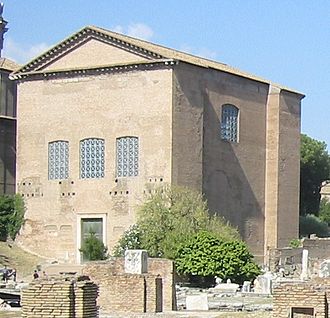
The word senate comes from the Latin word senātus, which comes from senex, meaning "elder man." A member of a senate is called a senator. The Latin word senator was taken into English with no change in spelling. The first senate was the Roman Senate, which lasted until at least CE 603. In the Eastern Roman Empire, the Byzantine Senate continued until the Fourth Crusade, around 1202–1204.
Some modern democratic countries have a bicameral parliamentary systems with a senate. The senate is usually separate from the lower house. The lower house may be called the "House of Representatives," "House of Commons," "Chamber of Deputies," "National Assembly," "Legislative Assembly," or "House of Assembly." The senate is usually the upper house and has fewer members. Some federal states also have senates at the state or province level.
In the United States, most states and territories have senates. But Nebraska, Guam, the U.S. Virgin Islands, and the District of Columbia do not. The country also has the US Senate.
In Argentina, the provinces of Buenos Aires, Catamarca, Corrientes, Entre Ríos, Mendoza, Salta, San Luis, and Santa Fe have senates. Córdoba and Tucumán changed to unicameral systems, which have only one chamber.
In Australia and Canada, only the federal upper house is called the Senate. Most Australian states have a Legislative council instead, except Queensland. In Germany, the Bavarian Senate was abolished in 2000.
Senators are chosen either by elections or appointments. In the Senate of the Philippines, elections are held every three years for half the members, and senators serve six-year terms. In the Canadian Senate, members are appointed by the Governor General on the advice of the Prime Minister of Canada. They serve until they resign, are removed, or retire at age 75.
Alternative meanings
The words senate and senator do not always mean a second chamber of a legislature. The Senate of Finland was, until 1918, the government's executive branch and the highest court. The Senate of Latvia had a similar role as a court during the years between the two World Wars (1918–1940). In Germany, three states that are also cities, Berlin, Bremen and Hamburg, have senates that act as the executive branch, and their senators hold ministerial posts. These are called Bundesländer (Federated States) and City States.
Some cities that were once members of the Hanse, a medieval group of port cities around the Baltic and North Seas, still call their city government a Senate. These include Greifswald, Lübeck, Rostock, Stralsund and Wismar. In Bavaria, the Senate was a second legislative chamber until it was removed in 1999. In German courts, the word Senat refers to a group of about five judges who work together on one area of law, though they are not called senators. The Federal Constitutional Court of Germany has two senates of eight judges each, mainly to share the work.
In Scotland, judges of the High Court of Justiciary are called Senators of the College of Justice. Some countries with one chamber and a federal-style system have legislators called senators who represent the regions, such as St. Kitts and Nevis, Comoros and Micronesia. In other countries, such as Dominica and Saint Vincent, the title is used for a different way of choosing members of the House of Assembly. Until the 2022 Jersey general election, this was also the case in the States of Jersey.
In Wales, the Welsh word "Senedd," which comes from Senatus, was first used for the Senedd building. Later it became the name of the devolved unicameral legislature that meets there, the "National Assembly for Wales." In May 2020, it was renamed "Senedd Cymru" or "the Welsh Parliament." "Senedd" became the common short name in both Welsh language and English, since Welsh has no direct word for "Parliament."
An academic senate is also the governing body of some universities. During the early stages of the Greek War of Independence, Greek rebels set up several local lawmaking and government groups. Two of them were called senates: the Peloponnesian Senate and the Senate of Western Continental Greece.
List of national senates
- Antigua and Barbuda
- Argentina
- Austria
- Australia
- Bahamas
- Bangladesh
- Barbados
- Belgium
- Belize
- Bolivia
- Brazil
- Burundi
- Cambodia
- Cameroon
- Canada
- Chad
- Chile
- Colombia
- Democratic Republic of the Congo
- Republic of Congo
- Czech Republic
- Dominican Republic
- Egypt
- Eswatini
- France
- Gabon
- Germany
- Grenada
- Guinea
- Haiti
- India
- Indonesia
- Ireland
- Italy
- Ivory Coast
- Jamaica
- Japan
- Jordan
- Kenya
- Kazakhstan
- Lesotho
- Liberia
- Madagascar
- Malaysia
- Mexico
- Nepal
- Netherlands
- Nigeria
- Palau
- Pakistan
- Paraguay
- Peru
- Philippines
- Poland
- Romania
- Russia
- Rwanda
- Saint Lucia
- Somalia
- Spain
- Switzerland
- Thailand
- Togo
- Trinidad and Tobago
- United States
- Uzbekistan
- Uruguay
- Wales
- Zimbabwe
Defunct and unestablished senates
See also: List of abolished upper houses
Several places gave up their senate and became a unicameral system, which has only one lawmaking house. These included Greece in 1863, Maldives in 1954, Sudan in 1958, Kenya in 1966 (restored in 2013), Ceylon (now Sri Lanka) in 1971, Iran in 1979, South Africa in 1981, Republic of China (Taiwan) in 1993, Germany in 2000, and Mauritania in 2017. Some provinces in Argentina also made this change, including Santiago del Estero Province in 1904, Tucumán Province in 1990, and Córdoba Province in 2001.
Other lawmaking groups were ended. These included the Roman Republic/Empire in 603, the Byzantine Empire in 1204, the Confederate States of America in 1865, and Yugoslavia from 1931 to 1941. Many countries also wrote a new constitution that changed their senates. Examples include Costa Rica (1847, 1871, and 1919), Sweden in 1866, Japan in 1890, Russia in 1917, Portugal in 1926, Brazil in 1930, Malta in 1949, Indonesia in 1950, Peru in 1993, and Fiji in 2013. Some senates were included in a country's constitution but were never set up. These include those planned in Malawi, Georgia, Iraq, Burkina Faso, Central African Republic, and Mali.
Proposed
- In Bangladesh, a 2026 vote on changes to the constitution was held, and people voted yes. The lower house has to pass the law within 180 days.
Keep exploring


This article is a child-friendly adaptation of the Wikipedia article on Senate, available under CC BY-SA 4.0.
Images from Wikimedia Commons. Tap any image to view credits and license.