
Tanana Athabaskans
The Tanana Athabaskans are an Alaskan Athabaskan people from the Athabaskan-speaking ethnolinguistic group. They are the original inhabitants of the Tanana River in east-central Alaska Interior, United States, with a small part living in Yukon, Canada. They are known by different names in various languages.
In Alaska, the Tanana Athabaskans are divided into groups based on the languages they speak: Tanana proper or Lower Tanana, Middle Tanana, Tanacross, and Upper Tanana. Their culture is a hunter-gatherer culture with a matrilineal system, and they lived in settlements in the Tanana Valley lowlands.
Tanana Athabaskans were semi-nomadic, moving between a central winter camp and several seasonal hunting and fishing camps. They hunted animals like moose, caribou, and Dall sheep, and also did trapping. Each small band of people had its own territory and moved based on the season and available resources.
Bands
The Tanana Athabaskan people lived in four main areas: the Yukon Tanana upland, the Northway-Tanacross Lowlands, the Eastern Alaskan range, and the Northern foothills. The Goodpaster River helped separate different language groups.
Tanana Athabaskans had special ways to connect with family and community. In winter, bigger groups split into smaller ones, usually four families together. These smaller groups would meet for special gatherings and then return to their own areas for activities like trapping.
Prehistory
Archaeological sites in Alaska show some of the earliest evidence of ancient people. Interior Alaska has been home to people for about 14,000 to 12,000 years. During the last ice age, Interior Alaska had no ice, which created a path between Siberia and North America.
Scientists divide the early history of Interior Alaska into three main periods:
Paleo-Arctic tradition
The Paleo-Arctic tradition lasted from about 12,000 to 6,000 years ago. This is the time of the first people in Alaska. In Interior Alaska, this tradition includes two groups: the Nenana complex and the Denali complex.
The Nenana complex began around 11,000 years ago. Many important sites from this time are in the Tanana Valley.
The Denali complex dates from about 10,500 to 8,000 years ago. Some of its sites include Mt. Hayes and Swan Point.
Northern Archaic tradition
The Northern Archaic tradition was from 6,000 to 1,000 years ago. During this time, more people lived in Interior Alaska, and they used special stone tools.
Athabascan tradition
The Athabascan tradition was from 1,300 to 800 years ago. Evidence suggests Athabascan culture may have been in the Tanana Valley as early as 2,500 years ago. Athabascan people made many different tools and objects from bone, antler, and birch bark. They moved often to find food and resources.
History
Ernest S. Burch described four important time periods in the history of the Alaska Natives, including the Tanana Athabaskans.
The first period, called the Early Historic period (1816–1838), began when they first met outsiders after an expedition in 1778. The Fragmentation period (1838–1897) brought big changes to their traditional ways of living. The Colonial period (1898–1960) started when many new people arrived during the gold rush. Finally, the Native Claims period (1960–1977) was shaped by a big law about land rights for native people.
Russian fur traders began to settle in Interior Alaska in the 1810s, setting up trading places. British traders also arrived later. After the U.S. purchased Alaska in 1867, American traders took over. This new contact and trade brought many changes to the traditional ways of life for the Tanana Athabaskans. Missionaries also arrived, changing social customs and introducing new religions. These changes disrupted traditional practices and ways of living for the people in the area.
Hunting-gathering
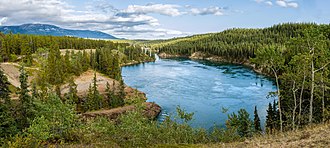
The Tanana Athabaskans lived in the cold forests of Interior Alaska-Yukon lowland taiga. Their homes were in two main areas: the south of the Tanana River and the north of the Tanana River.
The Tanana Athabaskans moved with the seasons to find food. They hunted animals like caribou, moose, and Dall sheep. They also fished for whitefish, Pacific salmon, and other fish. Birds like ducks, geese, and ptarmigan were important food sources too.
In addition to hunting and fishing, the Tanana Athabaskans gathered plants, berries, and roots. These gave them food and materials for making tools and other items. The white spruce and black spruce trees were useful for building and making canoes.
| Resource | Oct | Nov | Dec | Jan | Feb | Mar | Apr | May | Jun | Jul | Aug | Sep |
|---|---|---|---|---|---|---|---|---|---|---|---|---|
| Porcupine caribou hunting |  | | | | | | | | ||||
| Alaska moose hunting | | | | | | | | |||||
| Dall sheep hunting | | | | | | |||||||
| Snowshoe rabbit hunting | | | | | | |||||||
| Beaver & Muskrat trapping | | | ||||||||||
| Ptarmigan & Grouse hunting | | | | | | | | | | | | |
| Whitefish catching | | | ||||||||||
| Berry gathering | | | ||||||||||
| Fur trapping | | | | | |
Kinship
The Tanana kinship system is based on what is called an Iroquois kinship. It has a matrilineal clan system, where people are born into their mother's clan. The society has eight or nine clans grouped into two moieties: Raven (or Crow) and Sea Gull (or Wolf). Marriages traditionally happened between people from different clans.
Main article: Iroquois kinship
Main articles: matrilineal
clan
cross-cousin
exogamous
moieties
Culture
Religion
Historically, the Tanana Athabaskans believed that animals and some objects had spirits. These spirits were important because they helped animals know hidden things. People believed they needed to treat animals with respect, or the animals might stay away and people could go hungry. Special people called shamans were very important. They helped connect people with these spirits. Shamans could help when people were sick, predict where animals might be found, and protect people from bad spirits. They also taught that everything in nature should be treated with care and respect.
Potlatches
Potlatches were big gatherings that brought together people from different groups. These events were important for making friends, trading, and sometimes arranging marriages. Potlatches could last a whole week. One special kind of potlatch was held to honor someone who had passed away. Families would hold these gatherings a year after the person died to remember and show respect. Today, one of the most famous potlatches is the Nuchalawoyya Potlatch held by the Native Village of Tanana.
Literature
The Upper Tanana people have a long tradition of storytelling. These stories were told in the winter evenings and often included tales from long ago when animals and humans could talk to each other. Stories were shared to teach lessons to younger people.
Art
Tanana Athabaskan artists create beautiful birch bark baskets, which are very important in their culture. Women make these baskets, and they are still used today for special purposes.
Cuisine
A special treat for the Tanana Athabaskans is a kind of dessert called Indian ice cream. It is made from dried meat mixed with moose fat. This is different from the ice cream made by some other groups. They also have special songs for dances and gatherings, including songs for potlatches and remembering people who have passed away. Some old songs were even sung while making this special dessert.
Transportation
Historically, the Tanana Athabaskans walked to travel. In winter, they wore special shoes made from birch bark in the snow. They also hunted animals like caribou while wearing these snowshoes. Women carried their children using a special belt.
Dogs were important in many villages. They helped with hunting and carrying goods. Some nearby groups used dog sleds, but the Tanana Athabaskans mostly used dogs for hunting and carrying goods by hand.
Modern tribal unions
Historically, the Tanana Athabaskan people did not use the word "tribes." This idea is newer and linked to being recognized by the U.S. government.
Alaska Native tribal entities for Tanana Athabaskans are recognized by the United States Bureau of Indian Affairs:
The Alaska Native Regional Corporations of Tanana Athabaskans were created in 1971 when the United States Congress passed the Alaska Native Claims Settlement Act (ANCSA).
The Tanana Chiefs Conference is a group for all Central Alaskan Athabaskans, except for the Southern Alaskan Athabaskans, which include the Dena'ina and Ahtna.
- Yukon-Tanana Subregion
- Upper Tanana Subregion
- Dot Lake Village Council, Dot Lake, members are Mansfeld-Kechumstuk band of Tanacross
- Healy Lake Traditional Council, Healy Lake, members are Healy River-Joseph band of Tanacross
- Tanacross IRA Council, Tanacross, members are Mansfeld-Kechumstuk band of Tanacross
- Tok Native Association, Tok, members are Mansfeld-Kechumstuk band of Tanacross
- Northway Traditional Council, Northway, members are Lower Nabesna band of Upper Tanana
- Tetlin IRA Council, Tetlin, members are Tetlin-Last Tetlin band of Upper Tanana
| Tribal entities | Location (native name) | Ethnolinguistic group |
|---|---|---|
| Native Village of Minto | Minto (Menh Ti) | Lower Tanana |
| Nenana Native Association | Nenana (Toghotthele) | Lower Tanana |
| Village of Dot Lake | Dot Lake (Kelt'aaddh Menn' - 'Waterlily Lake') | Tanacross |
| Healy Lake Village | Healy Lake (Mendees Cheeg - 'shallows mouth lake') | Tanacross |
| Native Village of Tanacross | Tanacross (Taats'altęy) | Tanacross |
| Northway Village | Northway (K'ehtthiign) | Upper Tanana |
| Native Village of Tetlin | Tetlin (Teełąy) | Upper Tanana |
| Native Village Corporation | Community | Alaska Native Reg. Corp. | Ethnolinguistic group |
|---|---|---|---|
| Seth-do-ya-ah Corporation | Minto | Doyon, Limited | Lower Tanana |
| Toghotthele Corporation | Nenana | Doyon, Limited | Lower Tanana |
| Dot Lake Native Corporation | Dot Lake | Doyon, Limited | Tanacross |
| Mendas Cha-ag Native Corporation | Healy Lake | Doyon, Limited | Tanacross |
| Tanacross Inc. | Tanacross | Doyon, Limited | Tanacross |
| Northway Natives Inc. | Northway | Doyon, Limited | Upper Tanana |
| Tetlin Indian Reservation | Tetlin | Doyon, Limited | Upper Tanana |
Sources of language materials in Tanana languages
Here are some books and tools that help people learn the Tanana languages.
For the Lower Tanana language, there is a book by James Kari from 1991 called Lower Tanana Athabaskan listening and writing exercises.
For the Tanacross language, I. S. Arnold, G. Holton, and R. Thoman made a dictionary in 2009 named Tanacross Learnersʼ Dictionary.
For the Upper Tanana language, Paul G. Milanowski and Alfred John created a junior dictionary in 1979 called Nee'aaneegn'/Upper Tanana (Tetlin) Junior Dictionary.
Pictures
Keep exploring




This article is a child-friendly adaptation of the Wikipedia article on Tanana Athabaskans, available under CC BY-SA 4.0.
Images from Wikimedia Commons. Tap any image to view credits and license.