Unmanned aerial vehicle
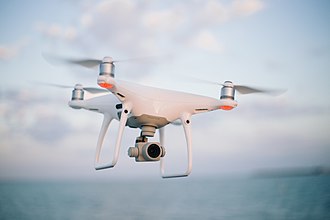
An unmanned aerial vehicle (UAV), also called an unmanned aircraft system (UAS), is commonly known as an aerial drone or simply a drone. It is an aircraft with no human pilot, crew, or passengers on board. Instead, it is either autonomous or controlled remotely.
UAVs were first developed in the twentieth century. They were made for military jobs that were hard, messy, or risky for people. By the twenty-first century, many militaries used them as important tools.
As controls got better and drones became cheaper, they were used for many non-military jobs. These include aerial photography, covering large areas, precision agriculture, watching for forest fires, monitoring rivers, environmental monitoring, weather observation, policing and watching over areas, checking buildings and bridges, smuggling, product deliveries, entertainment, and drone racing.
Terminology
Many words are used for aircraft that fly without anyone on board. The term unmanned aerial vehicle (UAV) describes a powered aircraft with no human pilot. It uses aerodynamic forces to stay in the air. It can fly on its own or be controlled from far away, and it may carry a load. UAV is often used for military aircraft. A missile is generally not called a UAV, but some propeller-based missiles are called "kamikaze drones" by the public and media. In some places, it is unclear how UAVs relate to remote controlled model aircraft. The US FAA now calls any unmanned flying craft a UAV, no matter its size. Other similar terms include remotely piloted aircraft (RPA) and remotely piloted aerial vehicle (RPAV).
UAVs can also be part of an unmanned aircraft system (UAS). This system includes the aircraft, the ground controllers, and the communication links. The United States Department of Defense and the Federal Aviation Administration started using this term in 2005. The International Civil Aviation Organization and the British Civil Aviation Authority also use it. It is also used in the Single European Sky (SES) Air Traffic Management (ATM) Research roadmap. Canada uses remotely piloted aircraft system (RPAS) in its rules. In everyday speech, people use "drone" for both military and civilian UAVs. Official documents often prefer terms like UAV or UAS. The word has been used since the early days of aviation. For example, remotely flown target aircraft were used to practise shooting at ships, such as the Fairey Queen floatplane and the de Havilland Queen Bee. Later examples included the Airspeed Queen Wasp and the Miles Queen Martinet. After these, the GAF Jindivik took their place. Some people use the word uncrewed instead of "unmanned." Autonomous drones use technologies such as cloud computing, computer vision, and artificial intelligence. These help them do their tasks without human help. Recreational drones, like those used for aerial photography, may have first-person video or automatic features.
Classification types
UAVs can be sorted in the same way as other aircraft. They can be grouped by weight, engine type, how high they fly, how much they act on their own, and what job they do. The United States Department of Defense sorts them into five groups. Drones can also be sorted by how far and how long they can fly, by their size, and by their weight. Some drones are controlled by a person from the ground. Others fly fully on their own, sometimes with help from an autopilot system. Their autonomy is the amount they can do without a person. ICAO sorts them into two groups: remotely piloted and fully autonomous.
Some groups are based on flight height. For example, MALE and HALE aircraft fly at medium or high heights for long periods. Drones can also be sorted by their power source, such as batteries, fuel, hydrogen fuel cells, or solar panels. Industry events, such as the ParcAberporth Unmanned Systems forum, use height groups too. The U.S. military's unmanned aerial systems classification uses weight, highest altitude, and speed.
| Group: | Group 1 | Group 2 | Group 3 | Group 4 | Group 5 |
|---|---|---|---|---|---|
| Size | Small | Medium | Large | Larger | Largest |
| Max takeoff weight | (9.1 kg) | > 20 & (25 kg) | > 55 & (600 kg) | > 1,320 lb (600 kg) | > 1,320 lb (600 kg) |
| Operating altitude | (370 m) | (1,100 m) | (5,500 m) | (5,500 m) | > 18,000 ft (5,500 m) |
| Speed | (190 km/h) | (460 km/h) | (460 km/h) | Any speed | Any speed |
| Range category | Very close | Close | Short | Medium | Long |
|---|---|---|---|---|---|
| Range (km): | > 5 & | > 50 & | > 150 & | > 650 | |
| Endurance (hr): | 0.5–0.75 | 1–6 | 8–12 | 12–36 or 48 | > 36 or 48 |
| Category | Micro/Very small | Mini/Small | Medium | Large |
|---|---|---|---|---|
| Length/wingspan: | > 50 cm & | 5–10 m | > 10 m |
History
Main article: History of unmanned aerial vehicles
The first known use of an unmanned aircraft in war was in July 1849. Austrian forces were surrounding Venice and tried to send about 200 fire balloons over the city. Most of them missed because the wind changed. In 1903, the Spanish engineer Leonardo Torres Quevedo showed a radio-controlled system called the Telekino. In the 1900s, drones were developed mainly to give military personnel targets to practice on. By 1935, the film star Reginald Denny had built the first scaled remote-controlled aircraft. During World War II, Nazi Germany built and used several UAV aircraft. Denny also started the Radioplane Company in 1940. During the Vietnam War, the U.S. military used UAVs. In the 1973 Yom Kippur War, Israel built the IAI Scout, the first UAV that could send live pictures back to the ground. Many UAVs were used in the 1991 Gulf War. Some of them carried weapons, such as the General Atomics MQ-1 Predator, which could fire AGM-114 Hellfire air-to-ground missiles.
In the 2000s, the European Union ran a project called CAPECON to develop UAVs. By 2013, at least 50 countries were using UAVs. In 2013, DJI released the first Phantom drone. It was affordable and easy to use, and it became one of the most popular drones ever made. In 2020, a Kargu 2 drone attacked a person in Libya. This may have been the first time a weapon of this kind acted on its own to attack people. NASA has also sent drones to other worlds. The Ingenuity helicopter flew on Mars from 2021 to 2024. The Dragonfly spacecraft is being built to explore Titan, a moon of Saturn. In 2022, the Russian invasion of Ukraine was widely described as the first large war to use many consumer drones, such as quadcopters and first-person view (FPV) drones, for military purposes.
Design
Crewed and uncrewed aircraft of the same type usually have similar parts. The main differences are the cockpit and the environmental control system or life-support systems. Some drones carry small payloads, such as a camera, that weigh much less than a person, so they can be much smaller. Small civilian drones do not have life-critical systems, so they can use lighter materials that are not as strong. The quadcopter design is popular for small drones, but it is rarely used for crewed aircraft. Control is also different. A camera and video link take the place of cockpit windows, and radio commands replace physical controls. Autopilot software is used on both crewed and uncrewed aircraft.
Without a cockpit or the need to keep a person comfortable, drones can have many shapes. Air safety is less of a concern, so designers have more freedom. Drones are usually designed around their payloads and ground equipment. The flying wing and blended wing body are light and have low drag and stealth. Larger drones are more likely to have a fuselage with a tail, and wing configurations vary widely. For hovering, the quadcopter is simple to control. Multirotor designs with 6 or more rotors are more common on larger drones. Traditional internal combustion and jet engines are still used for long-range drones. Electric power has almost completely taken over for shorter flights.
See also: Short-life engine
Besides the traditional piston engine, some drones use the Wankel rotary engine. Small drones mostly use lithium-polymer batteries. Some larger vehicles use a hydrogen fuel cell made with Hydrogen and proton-exchange membrane fuel cells. Flapping-wing ornithopters copy birds or insects. Some have flown as microUAVs. Their stealth makes them suited to spy missions.
Computer control systems
Computers on UAVs have improved along with computing technology. They started with analog controls and later used microcontrollers, then system-on-a-chip (SOC) and single-board computers (SBC). The main control hardware is often called the flight controller (FC), flight controller board (FCB), or autopilot. It usually puts a main processor, a backup processor, and sensors in one module. These sensors include accelerometers, gyroscopes, magnetometers, and barometers. In 2024, EASA agreed on the first certification basis for a UAV flight controller, for Embention's autopilot. Certification like this helps UAVs fit into the airspace and fly in important areas.
UAVs use sensors to know where they are and how they are moving. Cameras or LiDAR can collect extra information. Their actuators, such as digital electronic speed controllers that control the RPM of motors and propellers, turn commands into movement. The software ranges from basic firmware that reads sensors and controls motors, to higher-level flight planning, such as trajectory optimization run on Linux. UAVs use open-loop control, which sends commands without sensor feedback. They also use closed-loop control, which uses sensor feedback. The PID controller is common, and feedforward is sometimes used.
UAVs communicate by radio. They use narrowband links for early control and telemetry data. They use broadband links for control, telemetry, and video together. These links can use quality of service techniques and TCP/IP traffic. Signals can come from ground control, a radio transmitter/receiver, a military ground control station (GCS), satellite links, or another aircraft acting as a relay. Remote ID messages help UAVs avoid collisions.
Main article: Autonomous aircraft
The level of autonomy varies a lot. Many UAVs can hold their altitude, hover in place using GNSS, return home, follow a moving object, or fly to waypoints. Some can also perform autoland, image recognition, or pre-programmed aerobatics. Automation is also used for specific tasks, such as airborne refueling or switching batteries on the ground. One way to measure autonomy uses OODA terms, as suggested in a 2002 report by the Air Force Research Laboratory. Other features in development include collision avoidance, swarming, cognitive radio, and machine learning. Computer vision helps keep flights safe.
Performance considerations
UAVs can be programmed to make bold moves, such as landing or perching on slanted surfaces, and then climbing toward better spots for communication. Some UAVs can change how they fly, such as VTOL designs, and they can also perch on a flat vertical surface. They can keep flying for longer than a human pilot could, because they do not get tired.
Because they are small, light, and produce little vibration, Wankel rotary engines are used in many large UAVs. Overheating and engine failure are the most common causes of drone failure, so good cooling is important for long flights. Hydrogen fuel cells may help small UAVs fly for several hours. Small flying machines that flap their wings last the longest, followed by planes, while multirotors last the least, because of their lower Reynolds number. Some solar-electric UAVs have flown for several weeks. Solar-powered flying machines that stay high in the sky could do some jobs more cheaply and flexibly than low Earth orbit satellites. These jobs include weather drones for weather monitoring, disaster recovery, Earth imaging and communications. A UAV that can stay in the air for a long time could also watch a battlefield and record events. The British PHASA-35 military drone has stayed at 65,000 feet for 24 hours, and Airbus' Zephyr has reached 70,000 feet and flown for 64 days. That is high enough to be close to near-space, so it can be called a "pseudo-satellite."
Reliability improvements aim at all parts of UAV systems, using resilience engineering and fault tolerance techniques. Flight controllers are made strong so UAVs stay safe, without adding extra parts that raise cost and weight. Checking the flight envelope while flying helps damaged UAVs keep working, using non-linear analysis. UAV software is moving toward the design and certification standards of crewed avionics software. Groups of UAVs, called swarms, can keep working and share out tasks when single units fail.
| UAV | Flight time hours:minutes | Date |
|---|---|---|
| Boeing Condor | 58:11 | 1989 |
| General Atomics Gnat | 40:00 | 1992 |
| TAM-5 | 38:52 | 11 August 2003 |
| QinetiQ Zephyr Solar Electric | 54:00 | September 2007 |
| RQ-4 Global Hawk | 33:06 | 22 March 2008 |
| QinetiQ Zephyr Solar Electric | 82:37 | 28–31 July 2008 |
| QinetiQ Zephyr 7 | 336:22 | 9–23 July 2010 |
Applications
Main article: List of unmanned aerial vehicle applications
Drones can fly beyond the pilot's sight and are used in many areas. These include recreation, disaster relief, archeology, protecting biodiversity and habitat, law enforcement, and crime and terrorism prevention. Businesses use drones to watch areas from the air, for filmmaking, journalism, scientific research, surveying, cargo transport, mining, manufacturing, forestry, solar farming, thermal energy, ports, and agriculture. Drones can also deliver packages, as shown by Amazon Prime Air.
Warfare
Main articles: Drone warfare, Unmanned combat aerial vehicle, Loitering munition, One-way attack drone, Unmanned fighter aircraft, Loyal wingman drone, Unmanned surveillance and reconnaissance aerial vehicle, Miniature UAV, Micro air vehicle, and Target drone
Many militaries use drones. As of 2020, seventeen countries had armed drones, and more than 100 countries used them for military purposes. Major military drone makers include Baykar, General Atomics, Elbit Systems, Boeing, and Lockheed Martin. China grew its place in the military drone market after 2010, and Turkey did the same in the early 2020s. Drones are used for reconnaissance, attack, demining, and target practice. Since the Russo-Ukrainian war began, drone development has grown quickly. In the 2026 Iran war, cheap drones such as the Shahed-136 led many countries to think again about how to defend against them.
Civil applications
The Chinese company DJI held most of the civilian drone market. Consumer drones are also used by police and military groups around the world because they are affordable. DJI drones were used by American police departments and during the Russian invasion of Ukraine. Drones help with photography and filming, and they can reach dangerous or hard-to-reach places. They are also used in farming and forestry, where they can help agriculture work with less waste. They also help people study wildlife and fight wildfires. Drones light up the night sky in displays, which are quieter and cleaner than fireworks. They also support environmental monitoring and are used to study landslides. They can deliver supplies in humanitarian aid and help with search and rescue and traffic monitoring for police. Scientists also use them to look for mineral deposits.
See also: List of UAV-related incidents and Unmanned combat aerial vehicle
Drones can cause problems in the sky. They can crash into or get in the way of other aircraft, and they can distract pilots. The first drone-airplane collision happened in October 2017 in Quebec City, Canada. In 2018, a drone hit a hot air balloon over Driggs, Idaho, United States. No one was hurt, and the balloon pilot reported the incident to the National Transportation Safety Board. Drones also caused significant disruption at Gatwick Airport during December 2018, and the British Army had to help. In 2014 and 2015, drones got in the way of firefighting aircraft in California, including at the Lake Fire and the North Fire. Drones have also been used to drop items into prisons. Security researchers have found weaknesses in some drones. Researchers from the Federal Trade Commission were able to hack into three consumer quadcopters. Handling drones under privacy laws is also a difficult issue.
Further information: Electronic warfare
To deal with these problems, many countries have developed counter unmanned air system (C-UAS) technologies. These systems can detect drones with cameras and computer learning, then stop them with force or by blocking their signals. Some anti-aircraft systems, such as the Iron Dome, are also being improved to counter drones. Governments and officials are also working on rules for drones. Regulatory bodies are developing unmanned aircraft system traffic management to help drones share the airspace safely. Civil aviation authorities in each country are increasingly setting limits that depend on a drone's size and use. The International Civil Aviation Organization (ICAO) began studying drones in 2005. The EASA and the FAA later set their own rules, including a requirement for Remote ID on many drones. Drone technology is also limited by the Missile Technology Control Regime, which restricts exports of larger drones in many countries.

Quiz time!
4 questions about Unmanned aerial vehicle
What does it mean that a UAV is "unmanned"?
Pictures
Keep exploring



This article is a child-friendly adaptation of the Wikipedia article on Unmanned aerial vehicle, available under CC BY-SA 4.0.
Images from Wikimedia Commons. Tap any image to view credits and license.