
1968 United States presidential election
Presidential elections were held in the United States on November 5, 1968. The Republican ticket of former Vice President Richard Nixon and Maryland governor Spiro Agnew defeated the Democratic ticket of incumbent Vice President Hubert Humphrey and Senator Edmund Muskie, as well as the American Independent Party ticket of former Alabama governor George Wallace and general Curtis LeMay. This election happened during a very busy and difficult time in American history.
Many important events affected the election. There were protests against the Vietnam War, and sad events like the death of civil rights leader Martin Luther King Jr. and Robert F. Kennedy. President Lyndon B. Johnson decided not to run for re-election, which changed the race for the Democratic nomination.
Nixon promised to bring stability and new leadership, especially on issues like the Vietnam War and keeping cities safe. He won the election by a very small margin, which showed how closely divided the country was at that time. This election also marked important changes in how people voted, especially after new laws helped protect voting rights for all Americans.
Background
In the 1964 U.S. presidential election, Democratic President Lyndon B. Johnson won by a large margin against Republican Senator Barry Goldwater. During his time in office, Johnson achieved many important goals, including passing major laws to help people and exploring space.
However, his popularity did not last long. The country faced many problems, including disagreements about race and foreign policy. The Vietnam War caused many people to lose trust in Johnson's leadership. The war became very difficult, and many Americans began to wonder if it was worth continuing. These challenges made it hard for Johnson to keep the support of the nation.
Republican Party nomination
Main article: 1968 Republican Party presidential primaries
Nixon became the Republican Party’s nominee for president in 1968. He started his campaign early and had strong support from party leaders. Nixon had lost two big elections before, but he worked hard and had a good team helping him.
Other Republicans tried to win the nomination too, like George W. Romney and Ronald Reagan, but they couldn’t catch up to Nixon. He won most of the votes in the primaries and secured the nomination at the convention in Miami Beach, Florida. Nixon picked Spiro Agnew, the governor of Maryland, to be his running mate.
 1968 Republican Party ticket 1968 Republican Party ticket | |||||||||||||||||||||||||||||
| Richard Nixon | Spiro Agnew | ||||||||||||||||||||||||||||
|---|---|---|---|---|---|---|---|---|---|---|---|---|---|---|---|---|---|---|---|---|---|---|---|---|---|---|---|---|---|
| for President | for Vice President | ||||||||||||||||||||||||||||
| 36th Vice President of the United States (1953–1961) | 55th Governor of Maryland (1967–1969) | ||||||||||||||||||||||||||||
| Campaign | |||||||||||||||||||||||||||||
| Candidates in this section are sorted by date of withdrawal from the nomination race | |||
| Ronald Reagan | Nelson Rockefeller | Harold Stassen | George W. Romney |
|---|---|---|---|
| Governor of California (1967–1975) | Governor of New York (1959–1973) | Former president of the University of Pennsylvania (1948–1953) | Governor of Michigan (1963–1969) |
| Campaign | Campaign | Campaign | |
| Lost nomination: August 8, 1968 1,696,632 votes | Lost nomination: August 8, 1968 164,340 votes | Lost nomination: August 8, 1968 31,665 votes | Withdrew: February 28, 1968 4,447 votes |
Ronald Reagan: 1,696,632 (37.93%) Richard Nixon: 1,679,443 (37.54%) James A. Rhodes: 614,492 (13.74%) Nelson Rockefeller: 164,340 (3.67%) Unpledged: 140,639 (3.14%) Eugene McCarthy (write-in): 44,520 (1.00%) Harold Stassen: 31,655 (0.71%) John Volpe: 31,465 (0.70%) Others: 21,456 (0.51%) George Wallace (write-in): 15,291 (0.34%) | Robert F. Kennedy (write-in): 14,524 (0.33%) Hubert Humphrey (write-in): 5,698 (0.13) Lyndon B. Johnson (write-in): 4,824 (0.11%) George W. Romney: 4,447 (0.10%) Raymond P. Shafer: 1,223 (0.03%) William Scranton: 724 (0.02%) Charles H. Percy: 689 (0.02%) Barry Goldwater: 598 (0.01%) John Lindsay: 591 (0.01%) |
| President | (before switches) | (after switches) | Vice President | Vice-presidential votes |
|---|---|---|---|---|
| Richard Nixon | 692 | 1238 | Spiro Agnew | 1119 |
| Nelson Rockefeller | 277 | 93 | George W. Romney | 186 |
| Ronald Reagan | 182 | 2 | John V. Lindsay | 10 |
| Ohio governor James A. Rhodes | 55 | — | Massachusetts senator Edward Brooke | 1 |
| Michigan governor George W. Romney | 50 | — | James A. Rhodes | 1 |
| New Jersey senator Clifford Case | 22 | — | not voting | 16 |
| Kansas senator Frank Carlson | 20 | — | — | |
| Arkansas governor Winthrop Rockefeller | 18 | — | — | |
| Hawaii senator Hiram Fong | 14 | — | — | |
| Harold Stassen | 2 | — | — | |
| New York City mayor John V. Lindsay | 1 | — | — |
Democratic Party nomination
Main article: 1968 Democratic Party presidential primaries
Other major candidates
The following candidates were often talked about by news stations, appeared in public opinion polls, or ran campaigns beyond their home states. Humphrey got 166,463 votes in the primaries.
Enter Eugene McCarthy
Because President Lyndon B. Johnson had only been elected once in 1964 and had served less than two full years before that, the rules did not stop him from running again in 1968. At the start of 1968, most people thought Johnson would run and win the Democratic nomination easily.
However, as more people disagreed with Johnson's handling of the Vietnam War, it became clear that someone else might challenge him. Senator Robert F. Kennedy of New York, who spoke out against Johnson’s policies, decided not to run at first. But things changed when a big attack called the Tet Offensive happened in Vietnam in January 1968. This made people lose faith in Johnson's promises about ending the war.
Then, Senator Eugene McCarthy of Minnesota decided to run against Johnson. He focused on the New Hampshire primary, where he got 42% of the vote compared to Johnson's 49%. This strong showing made McCarthy look like a real contender. Just a few days later, Robert F. Kennedy announced he would also run.
Johnson withdraws
Main article: Withdrawal of Lyndon B. Johnson from the 1968 United States presidential election
On March 31, 1968, President Johnson gave a speech saying he would stop bombing North Vietnam to try for peace. At the end of the speech, he surprised everyone by saying he would not run for re-election. He explained that with problems at home and abroad, he needed to focus on being president full-time.
After Johnson dropped out, the Democratic Party split into different groups. Some supported Humphrey, Johnson’s Vice President. Others backed McCarthy or Robert F. Kennedy. There were also those who supported George Wallace, a former governor of Alabama, who ran on a separate ticket.
Contest
After Johnson left the race, Vice President Hubert Humphrey announced he was running. Robert F. Kennedy won several primaries, as did Eugene McCarthy. But Humphrey focused on winning support from party leaders in states that did not hold primaries.
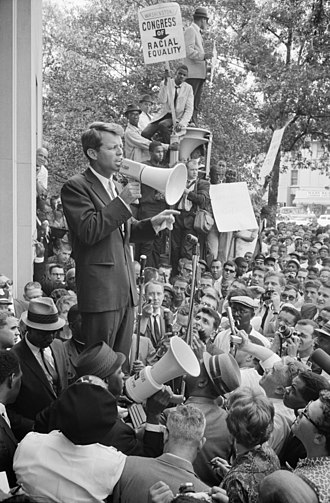
Tragedy struck on June 5, 1968, when Robert F. Kennedy was shot after a speech in Los Angeles. He died the next day. This changed everything for the race.
Democratic Convention and antiwar protests
Robert Kennedy’s death made Humphrey the likely nominee. But many people who opposed the Vietnam War were unhappy with him because they thought he supported Johnson’s policies.
When the Democratic Convention met in Chicago in August 1968, many young people came to protest the war. There were violent clashes between protesters and police, which were shown on TV. This bad publicity hurt Humphrey’s campaign.
Humphrey chose Senator Edmund Muskie of Maine as his running mate. He had been a strong supporter of environmental issues.
Endorsements
Hubert Humphrey
- President Lyndon B. Johnson
- Mayor Richard J. Daley of Chicago
- Former President Harry S. Truman
- Singer/actor Frank Sinatra
Robert F. Kennedy
- Senator Abraham Ribicoff from Connecticut
- Senator George McGovern from South Dakota
- Senator Vance Hartke from Indiana
- Labor Leader Cesar Chavez
- Writer Truman Capote
- Writer Norman Mailer
- Actress Shirley MacLaine
- Actress Stefanie Powers
- Actor Robert Vaughn
- Actor Peter Lawford
- Singer Bobby Darin
Eugene McCarthy
- Representative Don Edwards from California
- Actor Paul Newman
- Actress Tallulah Bankhead
- Playwright Arthur Miller
- Writer William Styron
George McGovern (during convention)
- Senator Abraham Ribicoff from Connecticut
- Governor Harold E. Hughes of Iowa
 1968 Democratic Party ticket 1968 Democratic Party ticket | |||||||||||||||||||||||||||||
| Hubert Humphrey | Edmund Muskie | ||||||||||||||||||||||||||||
|---|---|---|---|---|---|---|---|---|---|---|---|---|---|---|---|---|---|---|---|---|---|---|---|---|---|---|---|---|---|
| for President | for Vice President | ||||||||||||||||||||||||||||
| 38th Vice President of the United States (1965–1969) | U.S. Senator from Maine (1959–1980) | ||||||||||||||||||||||||||||
| Campaign | |||||||||||||||||||||||||||||
| Candidates in this section are sorted by date of withdrawal from the nomination race | ||||||||
| Eugene McCarthy | George McGovern | Channing E. Phillips | Lester Maddox | Robert F. Kennedy | Lyndon B. Johnson | |||
|---|---|---|---|---|---|---|---|---|
| U.S. senator from Minnesota (1959–1971) | U.S. senator from South Dakota (1963–1981) | Reverend at Lincoln Temple from Washington, D.C. | Governor of Georgia (1967–1971) | U.S. senator from New York (1965–1968) | 36th President of the United States (1963–1969) | |||
| Campaign | Campaign | Campaign | Campaign | Campaign | ||||
| Lost nomination: August 29, 1968 2,914,933 votes | Lost nomination: August 29, 1968 0 votes | Lost nomination: August 29, 1968 0 votes | Withdrew and endorsed George Wallace: August 28, 1968 0 votes | Assassinated: June 5, 1968 2,305,148 votes | Withdrew and endorsed Hubert Humphrey: March 31, 1968 383,590 votes | |||
Eugene McCarthy: 2,914,933 (38.7%) Robert F. Kennedy: 2,304,542 (30.6%) Stephen M. Young: 549,140 (7.3%) Lyndon B. Johnson: 383,048 (5.1%) Roger D. Branigin: 238,700 (3.2%) George Smathers: 236,242 (3.1%) Hubert Humphrey: 166,463 (2.2%) | Unpledged: 670,328 (8.9%) George Wallace: 33,520 (0.4%) Richard Nixon (write-in): 13,035 (0.2%) Nelson A. Rockefeller: 5,116 (0.1%) Ronald Reagan (write-in): 4,987 (0.1%) Ted Kennedy: 4,052 (0.1%) Others: 10,963 (0.1%) |
| Presidential tally | Vice Presidential tally | ||
|---|---|---|---|
| Hubert Humphrey | 1759.25 | Edmund S. Muskie | 1942.5 |
| Eugene McCarthy | 601 | Not Voting | 604.25 |
| George S. McGovern | 146.5 | Julian Bond | 48.5 |
| Channing Phillips | 67.5 | David Hoeh | 4 |
| Daniel K. Moore | 17.5 | Edward M. Kennedy | 3.5 |
| Edward M. Kennedy | 12.75 | Eugene McCarthy | 3.0 |
| Paul W. "Bear" Bryant | 1.5 | Others | 16.25 |
| James H. Gray | 0.5 | ||
| George Wallace | 0.5 | ||
American Independent Party nomination
See also: George Wallace 1968 presidential campaign
The American Independent Party chose former Alabama Governor George Wallace as its candidate for president in 1968. Wallace was known for his strong views on keeping different racial groups separate, which many people did not support. His campaign had a big impact, especially in the southern United States. Although he did not win the election, his votes came mostly from younger men and workers in some northern and midwestern states.
Wallace’s goal was not to win the election but to make sure no one got enough votes to win right away. His running mate was retired General Curtis LeMay. Before choosing LeMay, Wallace considered other people for this role, but they could not agree on important issues.
Other parties and candidates
Other candidates included Eldridge Cleaver for the Peace and Freedom Party, Henning Blomen for the Socialist Labor Party, Fred Halstead for the Socialist Workers Party, and Charlene Mitchell for the Communist Party, who was the first African-American woman to run for president. Some people also made humorous or protest votes, like a pig named Pigasus.
 1968 American Independent Party ticket | |||||||||||||||||||||||||||||
| George Wallace | Curtis LeMay | ||||||||||||||||||||||||||||
|---|---|---|---|---|---|---|---|---|---|---|---|---|---|---|---|---|---|---|---|---|---|---|---|---|---|---|---|---|---|
| for President | for Vice President | ||||||||||||||||||||||||||||
| 45th Governor of Alabama (1963–1967) | Chief of Staff of the United States Air Force (1961–1965) | ||||||||||||||||||||||||||||
| Campaign | |||||||||||||||||||||||||||||
General election
The election on November 5, 1968, was very close. It was not until the next morning that news networks could say Richard Nixon had won. Nixon won key states like California, Illinois, and Ohio by very small margins. If Hubert Humphrey had won all three, he would have been president. If he had won just two, George Wallace might have stopped either candidate from getting enough votes to win, and the decision would have gone to Congress.
Nixon won with just over half the votes, but his victory in the Electoral College was much larger. He got 301 electoral votes from 32 states. Humphrey got 191 electoral votes from 13 states, and Wallace got 46 electoral votes from five states. This election was one of the closest in American history.
| Publisher | Date | Prediction |
|---|---|---|
| 1964 result | Nov 3, 1964 | D: 486, R: 52 |
| 1968 result | Nov 5, 1968 | A: 45, D: 191, R: 301 |
| Newsweek | Oct 27, 1968 | A: 56, D: 46, R: 287, Tossup: 149 |
| Associated Press | Oct 20, 1968 | A: 45, D: 17, R: 222, Tossup: 154 |
| N.Y. Times | Oct 6, 1968 | A: 64, D: 28, R: 380, Tossup: 64 |
| The Washington Post | Oct 6, 1968 | A: 53, D: 46, R: 346, Tossup: 93 |
| CBS | Oct 28, 1968 | A: 58, D: 25, R: 270, Tossup: 185 |
| CQ | Oct 25, 1968 | A: 53, D: 32, R: 317, Tossup: 136 |
Results
Nixon's win changed American politics. Before 1968, the Democratic Party usually won elections. But after this election, Republicans started winning more often. This shift stayed until 2004.
The election also changed voting in the South. Many people there stopped voting for Democrats. Now, Republicans often won in those areas. This made it harder for Democrats to win national elections.
-
Results by state, shaded according to winning candidate's percentage of the vote
-
Results by county, shaded according to winning candidate's percentage of the vote
-
Results by district, shaded according to winning candidate's percentage of the vote
Cartographic gallery
-
Presidential election results by county
-
Republican presidential election results by county
-
Democratic presidential election results by county
-
American Independent presidential election results by county
-
"Other" presidential election results by county
-
Cartogram of presidential election results by county
-
Cartogram of Republican presidential election results by county
-
Cartogram of Democratic presidential election results by county
-
Cartogram of American Independent presidential election results by county
-
Cartogram of "Other" presidential election results by county
Results by state
Source:
States that flipped from Democratic to Republican
- Alaska
- California
- Colorado
- Delaware
- Florida
- Idaho
- Illinois
- Indiana
- Iowa
- Kansas
- Kentucky
- Missouri
- Montana
- Nebraska
- Nevada
- New Mexico
- New Hampshire
- New Jersey
- North Carolina
- North Dakota
- Ohio
- Oklahoma
- Oregon
- South Dakota
- Tennessee
- Utah
- Virginia
- Vermont
- Wisconsin
- Wyoming
States that flipped from Republican to American Independent
- Georgia
- Louisiana
- Alabama
- Mississippi
States that flipped from Democratic to American Independent
Close states
States where margin of victory was less than 5 percentage points (223 electoral votes):
States where margin of victory was more than 5 percentage points, but less than 10 percentage points (155 electoral votes):
Notes: In Alabama, Wallace was the official Democratic Party nominee, while Humphrey ran on the ticket of short-lived National Democratic Party of Alabama, loyal to him as an official Democratic Party nominee.
In North Carolina one Nixon Elector cast his ballot for George Wallace (President) and Curtis LeMay (Vice President).
Statistics
Counties with Highest Percent of Vote (Republican)
- Hooker County, Nebraska 87.94%
- Jackson County, Kentucky 84.09%
- McIntosh County, North Dakota 82.65%
- McPherson County, South Dakota 80.34%
- Sioux County, Iowa 80.04%
Counties with Highest Percent of Vote (Democratic)
- Duval County, Texas 88.74%
- Jim Hogg County, Texas 82.06%
- Washington, D.C. 81.82%
- Webb County, Texas 79.65%
- Suffolk County, Massachusetts 75.62%
Counties with Highest Percent of Vote (American Independent)
- Geneva County, Alabama 91.73%
- George County, Mississippi 91.20%
- Lamar County, Alabama 88.25%
- Calhoun County, Mississippi 87.80%
- Holmes County, Florida 87.21%
| Richard Nixon Republican | Hubert H. Humphrey Democratic | George Wallace American Independent | Margin | Margin swing | State Total | ||||||||||
|---|---|---|---|---|---|---|---|---|---|---|---|---|---|---|---|
| State | electoral votes | # | % | electoral votes | # | % | electoral votes | # | % | electoral votes | # | % | % | # | |
| Alabama | 10 | 146,923 | 13.99 | - | 196,579 | 18.72 | - | 691,425 | 65.86 | 10 | -494,846 | -47.13 | -83.8% | 1,049,917 | AL |
| Alaska | 3 | 37,600 | 45.28 | 3 | 35,411 | 42.65 | - | 10,024 | 12.07 | - | 2,189 | 2.64 | 34.5% | 83,035 | AK |
| Arizona | 5 | 266,721 | 54.78 | 5 | 170,514 | 35.02 | - | 46,573 | 9.56 | - | 96,207 | 19.76 | 18.8% | 486,936 | AZ |
| Arkansas | 6 | 189,062 | 31.01 | - | 184,901 | 30.33 | - | 235,627 | 38.65 | 6 | -46,565 | -7.64 | 13.1% | 609,590 | AR |
| California | 40 | 3,467,664 | 47.82 | 40 | 3,244,318 | 44.74 | - | 487,270 | 6.72 | - | 223,346 | 3.08 | 21.4% | 7,251,587 | CA |
| Colorado | 6 | 409,345 | 50.46 | 6 | 335,174 | 41.32 | - | 60,813 | 7.50 | - | 74,171 | 9.14 | 32.2% | 811,199 | CO |
| Connecticut | 8 | 556,721 | 44.32 | - | 621,561 | 49.48 | 8 | 76,650 | 6.10 | - | -64,840 | -5.16 | 29.5% | 1,256,232 | CT |
| Delaware | 3 | 96,714 | 45.12 | 3 | 89,194 | 41.61 | - | 28,459 | 13.28 | - | 7,520 | 3.51 | 25.7% | 214,367 | DE |
| D.C. | 3 | 31,012 | 18.18 | - | 139,566 | 81.82 | 3 | - | - | - | -108,554 | -63.64 | 7.4% | 170,578 | DC |
| Florida | 14 | 886,804 | 40.53 | 14 | 676,794 | 30.93 | - | 624,207 | 28.53 | - | 210,010 | 9.60 | 11.9% | 2,187,805 | FL |
| Georgia | 12 | 380,111 | 30.40 | - | 334,440 | 26.75 | - | 535,550 | 42.83 | 12 | -155,439 | -12.43 | -11.9% | 1,250,266 | GA |
| Hawaii | 4 | 91,425 | 38.70 | - | 141,324 | 59.83 | 4 | 3,469 | 1.47 | - | -49,899 | -21.12 | 36.4% | 236,218 | HI |
| Idaho | 4 | 165,369 | 56.79 | 4 | 89,273 | 30.66 | - | 36,541 | 12.55 | - | 76,096 | 26.13 | 28.0% | 291,183 | ID |
| Illinois | 26 | 2,174,774 | 47.08 | 26 | 2,039,814 | 44.15 | - | 390,958 | 8.46 | - | 134,960 | 2.92 | 21.9% | 4,619,749 | IL |
| Indiana | 13 | 1,067,885 | 50.29 | 13 | 806,659 | 37.99 | - | 243,108 | 11.45 | - | 261,226 | 12.30 | 24.7% | 2,123,597 | IN |
| Iowa | 9 | 619,106 | 53.01 | 9 | 476,699 | 40.82 | - | 66,422 | 5.69 | - | 142,407 | 12.19 | 36.2% | 1,167,931 | IA |
| Kansas | 7 | 478,674 | 54.84 | 7 | 302,996 | 34.72 | - | 88,921 | 10.19 | - | 175,678 | 20.13 | 29.2% | 872,783 | KS |
| Kentucky | 9 | 462,411 | 43.79 | 9 | 397,541 | 37.65 | - | 193,098 | 18.29 | - | 64,870 | 6.14 | 34.5% | 1,055,893 | KY |
| Louisiana | 10 | 257,535 | 23.47 | - | 309,615 | 28.21 | - | 530,300 | 48.32 | 10 | -220,685 | -20.11 | -18.4% | 1,097,450 | LA |
| Maine | 4 | 169,254 | 43.07 | - | 217,312 | 55.30 | 4 | 6,370 | 1.62 | - | -48,058 | -12.23 | 25.4% | 392,936 | ME |
| Maryland | 10 | 517,995 | 41.94 | - | 538,310 | 43.59 | 10 | 178,734 | 14.47 | - | -20,315 | -1.64 | 29.3% | 1,235,039 | MD |
| Massachusetts | 14 | 766,844 | 32.89 | - | 1,469,218 | 63.01 | 14 | 87,088 | 3.73 | - | -702,374 | -30.12 | 22.6% | 2,331,752 | MA |
| Michigan | 21 | 1,370,665 | 41.46 | - | 1,593,082 | 48.18 | 21 | 331,968 | 10.04 | - | -222,417 | -6.73 | 26.9% | 3,306,250 | MI |
| Minnesota | 10 | 658,643 | 41.46 | - | 857,738 | 54.00 | 10 | 68,931 | 4.34 | - | -199,095 | -12.53 | 15.2% | 1,588,510 | MN |
| Mississippi | 7 | 88,516 | 13.52 | - | 150,644 | 23.02 | - | 415,349 | 63.46 | 7 | -264,705 | -40.44 | -4.7% | 654,509 | MS |
| Missouri | 12 | 811,932 | 44.87 | 12 | 791,444 | 43.74 | - | 206,126 | 11.39 | - | 20,488 | 1.13 | 29.2% | 1,809,502 | MO |
| Montana | 4 | 138,835 | 50.60 | 4 | 114,117 | 41.59 | - | 20,015 | 7.29 | - | 24,718 | 9.01 | 27.4% | 274,404 | MT |
| Nebraska | 5 | 321,163 | 59.82 | 5 | 170,784 | 31.81 | - | 44,904 | 8.36 | - | 150,379 | 28.01 | 33.2% | 536,851 | NE |
| Nevada | 3 | 73,188 | 47.46 | 3 | 60,598 | 39.29 | - | 20,432 | 13.25 | - | 12,590 | 8.16 | 25.3% | 154,218 | NV |
| New Hampshire | 4 | 154,903 | 52.10 | 4 | 130,589 | 43.93 | - | 11,173 | 3.76 | - | 24,314 | 8.18 | 36.0% | 297,298 | NH |
| New Jersey | 17 | 1,325,467 | 46.10 | 17 | 1,264,206 | 43.97 | - | 262,187 | 9.12 | - | 61,261 | 2.13 | 33.9% | 2,875,395 | NJ |
| New Mexico | 4 | 169,692 | 51.85 | 4 | 130,081 | 39.75 | - | 25,737 | 7.86 | - | 39,611 | 12.10 | 31.1% | 327,281 | NM |
| New York | 43 | 3,007,932 | 44.30 | - | 3,378,470 | 49.76 | 43 | 358,864 | 5.29 | - | -370,538 | -5.46 | 31.8% | 6,790,066 | NY |
| North Carolina | 13 | 627,192 | 39.51 | 12 | 464,113 | 29.24 | - | 496,188 | 31.26 | 1 | 131,004 | 8.25 | 20.6% | 1,587,493 | NC |
| North Dakota | 4 | 138,669 | 55.94 | 4 | 94,769 | 38.23 | - | 14,244 | 5.75 | - | 43,900 | 17.71 | 33.8% | 247,882 | ND |
| Ohio | 26 | 1,791,014 | 45.23 | 26 | 1,700,586 | 42.95 | - | 467,495 | 11.81 | - | 90,428 | 2.28 | 28.2% | 3,959,698 | OH |
| Oklahoma | 8 | 449,697 | 47.68 | 8 | 301,658 | 31.99 | - | 191,731 | 20.33 | - | 148,039 | 15.70 | 27.2% | 943,086 | OK |
| Oregon | 6 | 408,433 | 49.83 | 6 | 358,866 | 43.78 | - | 49,683 | 6.06 | - | 49,567 | 6.05 | 33.8% | 819,622 | OR |
| Pennsylvania | 29 | 2,090,017 | 44.02 | - | 2,259,405 | 47.59 | 29 | 378,582 | 7.97 | - | -169,388 | -3.57 | 26.6% | 4,747,928 | PA |
| Rhode Island | 4 | 122,359 | 31.78 | - | 246,518 | 64.03 | 4 | 15,678 | 4.07 | - | -124,159 | -32.25 | 29.5% | 385,000 | RI |
| South Carolina | 8 | 254,062 | 38.09 | 8 | 197,486 | 29.61 | - | 215,430 | 32.30 | - | 38,632 | 5.79 | -12.0% | 666,982 | SC |
| South Dakota | 4 | 149,841 | 53.27 | 4 | 118,023 | 41.96 | - | 13,400 | 4.76 | - | 31,818 | 11.31 | 22.5% | 281,264 | SD |
| Tennessee | 11 | 472,592 | 37.85 | 11 | 351,233 | 28.13 | - | 424,792 | 34.02 | - | 47,800 | 3.83 | 14.8% | 1,248,617 | TN |
| Texas | 25 | 1,227,844 | 39.87 | - | 1,266,804 | 41.14 | 25 | 584,269 | 18.97 | - | -38,960 | -1.27 | 25.6% | 3,079,406 | TX |
| Utah | 4 | 238,728 | 56.49 | 4 | 156,665 | 37.07 | - | 26,906 | 6.37 | - | 82,063 | 19.42 | 29.1% | 422,568 | UT |
| Vermont | 3 | 85,142 | 52.75 | 3 | 70,255 | 43.53 | - | 5,104 | 3.16 | - | 14,887 | 9.22 | 41.8% | 161,404 | VT |
| Virginia | 12 | 590,319 | 43.36 | 12 | 442,387 | 32.49 | - | 321,833 | 23.64 | - | 147,932 | 10.87 | 18.2% | 1,361,491 | VA |
| Washington | 9 | 588,510 | 45.12 | - | 616,037 | 47.23 | 9 | 96,990 | 7.44 | - | -27,527 | -2.11 | 22.5% | 1,304,281 | WA |
| West Virginia | 7 | 307,555 | 40.78 | - | 374,091 | 49.60 | 7 | 72,560 | 9.62 | - | -66,536 | -8.82 | 27.1% | 754,206 | WV |
| Wisconsin | 12 | 809,997 | 47.89 | 12 | 748,804 | 44.27 | - | 127,835 | 7.56 | - | 61,193 | 3.62 | 28.0% | 1,691,538 | WI |
| Wyoming | 3 | 70,927 | 55.76 | 3 | 45,173 | 35.51 | - | 11,105 | 8.73 | - | 25,754 | 20.25 | 33.4% | 127,205 | WY |
| TOTALS: | 538 | 31,783,783 | 43.42 | 301 | 31,271,839 | 42.72 | 191 | 9,901,118 | 13.53 | 46 | 511,944 | 0.70 | 23.3% | 73,199,998 | US |
Missouri, 1.13% (20,488 votes) Texas, 1.27% (38,960 votes) Maryland, 1.64% (20,315 votes) Washington, 2.11% (27,527 votes) New Jersey, 2.13% (61,261 votes) Ohio, 2.28% (90,428 votes) (tipping point state for Nixon win) Alaska, 2.64% (2,189 votes) Illinois, 2.92% (134,960 votes) (tipping point state for Humphrey win) California, 3.08% (223,346 votes) Delaware, 3.51% (7,520 votes) Pennsylvania, 3.57% (169,388 votes) Wisconsin, 3.62% (61,193 votes) Tennessee, 3.83% (47,800 votes) |
Kentucky, 5.14% (64,870 votes) Connecticut, 5.16% (64,840 votes) New York, 5.46% (370,538 votes) South Carolina, 5.79% (38,632 votes) Oregon, 6.05% (49,567 votes) Michigan, 6.73% (222,417 votes) Arkansas, 7.64% (46,565 votes) Nevada, 8.17% (12,590 votes) New Hampshire, 8.17% (24,314 votes) North Carolina, 8.25% (131,004 votes) West Virginia, 8.82% (66,536 votes) Montana, 9.01% (24,718 votes) Colorado, 9.14% (74,171 votes) Vermont, 9.22% (14,887 votes) Florida, 9.60% (210,010 votes) |
National voter demographics
Source: Congressional Quarterly Weekly Report. "Group Analysis of the 1968 Presidential Vote" XXVI, No. 48 (November 1968), p. 3218.
Voter demographics in the South
Source: Congressional Quarterly Weekly Report. "Group Analysis of the 1968 Presidential Vote", XXVI, No. 48 (November 1968), p. 3218.
Estimated voting age population
In October 1968, officials guessed that about 121.5 million people were old enough to vote. This included people in the military, whether they were in the United States or somewhere else. If we only count people living in the United States, it was about 120 million. If we just look at everyday people not in the military, it was about 118.5 million.
| The 1968 presidential vote by demographic subgroup | |||
|---|---|---|---|
| Humphrey | Nixon | Wallace | |
| Gender | |||
| Men | 41 | 43 | 16 |
| Women | 45 | 43 | 12 |
| Age | |||
| Under 30 | 47 | 38 | 15 |
| 30-49 | 44 | 41 | 15 |
| 50 or Older | 41 | 47 | 12 |
| Race | |||
| White | 38 | 47 | 15 |
| Non-White | 85 | 12 | 3 |
| Religion | |||
| Protestant | 35 | 49 | 16 |
| Catholic | 59 | 33 | 8 |
| Education | |||
| College | 37 | 54 | 9 |
| High School | 42 | 43 | 15 |
| Grade School | 52 | 33 | 15 |
| Occupation | |||
| Business | 34 | 56 | 10 |
| White Collar | 41 | 47 | 12 |
| Manual | 50 | 35 | 15 |
| Farmer | 29 | 51 | 20 |
| Party ID | |||
| Republican | 9 | 85 | 5 |
| Democrat | 74 | 12 | 14 |
| Independent | 31 | 44 | 25 |
| Region | |||
| East | 50 | 43 | 7 |
| Midwest | 44 | 47 | 9 |
| South | 31 | 36 | 33 |
| West | 44 | 49 | 7 |
| Union Status | |||
| Union Family | 56 | 29 | 15 |
| NBC sample precincts 1968 election | |||
|---|---|---|---|
| % Humphrey | % Nixon | % Wallace | |
| High income urban | 32 | 63 | 5 |
| Middle income urban | 43 | 44 | 13 |
| Low income urban | 69 | 19 | 12 |
| Rural (all income) | 33 | 46 | 21 |
| African-American neighborhoods | 94 | 5 | 1 |
| Italian neighborhoods | 51 | 39 | 10 |
| Slavic neighborhoods | 65 | 24 | 11 |
| Jewish neighborhoods | 81 | 17 | 2 |
| Unionized neighborhoods | 61 | 29 | 10 |
| NBC sample precincts 1968 election: South only | |||
|---|---|---|---|
| % Humphrey | % Nixon | % Wallace | |
| Middle income urban neighborhoods | 28 | 40 | 32 |
| Low income urban neighborhoods | 57 | 18 | 25 |
| Rural (all income) | 29 | 30 | 41 |
| African-American neighborhoods | 95 | 3 | 2 |
| Hispanic neighborhoods | 92 | 7 | 1 |
Pictures
Keep exploring


This article is a child-friendly adaptation of the Wikipedia article on 1968 United States presidential election, available under CC BY-SA 4.0.
Images from Wikimedia Commons. Tap any image to view credits and license.