Alinda
Alinda (Ancient Greek: Ἄλινδα) was an inland city and bishopric in ancient Caria, in Asia Minor (Anatolia).
Modern scholars identify Alinda with the Hellenistic foundation of Alexandria ad Latmum (Ἀλεξάνδρεια πρὸς τῷ Λάτμῳ) noted by Stephanus of Byzantium.
For other uses, see Alinda (disambiguation).
Location and remains
The ancient city is near Demircideresi, on a hilltop above the modern town of Karpuzlu in Aydın Province, in western Turkey. It overlooks a fertile plain.
The ruins have not been restored, but they are very well preserved and many visitors come to see them. Many people visit on organized tours, called "safaris," which leave from the tourist center of Bodrum or from Milas and reach Karpuzlu by a mountain road from the south. In 2018, villagers destroyed four kilometers of the ancient stone road that connected Alinda and Latmus to make room for their olive groves.
History
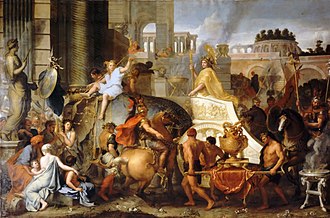
Alinda has perhaps been an important city since the second millennium BC. It has been linked to Ialanti (Iyalanti/Iyalanda), a name that appears in Hittite sources. Alinda was a member of the Delian League. It was a fortress held by the exiled Carian Queen Ada, who greeted Alexander the Great there in 334 BC. When Alexander captured Caria, he made Ada the ruler of the whole region. Shortly afterwards, the city was apparently renamed "Alexandria by the Latmos" (Greek name), as recorded by Stephanus of Byzantium, although sources disagree about where that settlement was. The old name Alinda was restored by 81 BC at the latest, and it appears as "Alinda" in Ptolemy's Geographia from the 2nd century AD.
Alinda remained an important trading city and made its own coins from the 3rd century BC to the 3rd century AD. Stephanus recorded that the city had a temple of Apollo with a statue of Aphrodite by Praxiteles. Alinda has a necropolis of Carian tombs that has been partly excavated. The city also had a major water system, including a Roman aqueduct, a nearly intact market place, a 5,000-seat Roman theater in fairly good condition, and remains of many temples and sarcophagi.
Ecclesiastical history
Alinda appears on Byzantine lists of bishoprics. It was a suffragan of the Metropolitan of Stauropolis, the capital of the Roman province of Caria, but it was to fade. Some early bishops of Alinda were Promachios (fl. 451), John (fl. 451), and Theodoretus (fl. 536).
Alinda was later restored as a Latin titular see of the Roman Catholic Church, but it has been empty since the last bishop died in 1976. Its bishops all held the lowest episcopal rank. They included Alexandre Le Roy of the Holy Ghost Fathers, who was Apostolic Vicar of Gabon and later Superior General of his order, and Eris O'Brien, who was an Auxiliary Bishop of Sydney before becoming Coadjutor Archbishop of Canberra and Goulburn. Gabriel Manek of the Divine Word Missionaries served as Apostolic Vicar of Larantuka and later as Metropolitan Archbishop of Endeh. Each of these bishops also held a Titular Archbishop title, including Cyrrhus, Apamea in Syria, and Bavagaliana.

Quiz time!
5 questions about Alinda
Where was the ancient city of Alinda located?
Keep exploring


This article is a child-friendly adaptation of the Wikipedia article on Alinda, available under CC BY-SA 4.0.
Images from Wikimedia Commons. Tap any image to view credits and license.