Brihadisvara Temple
Brihadisvara Temple, called Rajarajesvaram (lit. 'Lord of Rajaraja') by its builder, is also known locally as Thanjai Periya Kovil (lit. 'Thanjavur Big Temple') and Peruvudaiyar Kovil (lit. 'Temple of the great lord'). It is a Shaivite Hindu temple built in a Chola architectural style on the south bank of the Cauvery river in Thanjavur, Tamil Nadu, India. It is one of the largest Hindu temples and an example of Tamil architecture. It is also called Dakshina Meru (Meru of the South).
Built by Chola emperor Rajaraja I between 1003 and 1010 CE, the temple is part of the UNESCO World Heritage Site known as the "Great Living Chola Temples". The other temples in this group are the Chola-era Gangaikonda Cholapuram temple and Airavatesvara temple, which are about 70 kilometres (43 mi) and 40 kilometres (25 mi) to its northeast, respectively.
The original monuments of this 11th-century temple were built around a moat. They included a gopura, the main temple, its massive tower, inscriptions, frescoes, and sculptures. Most of these were related to Shaivism, but some were also related to Vaishnavism and Shaktism. The temple was damaged over its history, and some artwork is now missing. More mandapam and monuments were added in the centuries that followed. Today, the temple stands amidst fortified walls that were added after the 16th century.
Built using granite, the vimana tower above the shrine is one of the tallest in South India. The temple has a massive colonnaded prakara (corridor) and one of the largest Shiva lingas in India. It is famed for the quality of its sculpture. It was also the place that commissioned the brass Nataraja, Shiva as the lord of dance, in the 11th century. The complex includes shrines for Nandi, Parvati, Murugan, Ganesha, Sabhapati, Dakshinamurti, Chandeshvara, Varahi, Thiyagarajar of Thiruvarur, Siddhar Karuvoorar, and others.
The temple is one of the most visited tourist attractions in Tamil Nadu.
Nomenclature
Rajaraja Chola, who ordered the temple to be built, called it Rajarajeshvaram, which means "the temple of the god of Rajaraja." A later inscription in the Brihannayaki shrine calls the temple's deity Periya Udaiya Nayanar. This name appears to be the source of the modern names Brihadisvara and Peruvudaiyar Kovil.
Location
The Peruvudaiyar Temple is located in the city of Thanjavur, about 350 kilometres (220 mi) southwest of Chennai. The city is connected every day to other major cities by Indian Railways, Tamil Nadu bus services and the National Highways (/wiki/NH_67), 45C, (/wiki/National_Highway_226_(India)) and 226 Extn. The nearest airport with regular services is Tiruchirappalli International Airport (IATA: TRZ), about 55 kilometres (34 mi) away.
Although the city and the temple are inland, they are at the start of the Kaveri River delta. This gives them access to the Bay of Bengal and, through it, the Indian Ocean. Along with the temples, the Tamil people completed the first major irrigation network in the 11th century. It was used for farming, for moving goods, and for controlling the flow of water through the city.
History
A range of tamil temple styles kept developing from the fifth to the ninth century under Chalukya rule, as seen in Aihole, Badami and Pattadakal. Later, during the Pallava era, similar styles were seen at Mamallapuram and other monuments. Between 850 and 1280, the Cholas became the dominant dynasty. The early Chola period focused more on securing their borders and less on architecture. In the tenth century, features such as multifaceted columns with projecting square capitals appeared within the Chola empire. George Michell said this signaled the start of the new Chola style. This South Indian style is most fully realized, in both scale and detail, in the Brihadeshwara temple built between 1003 and 1010 by the Chola king Rajaraja I.
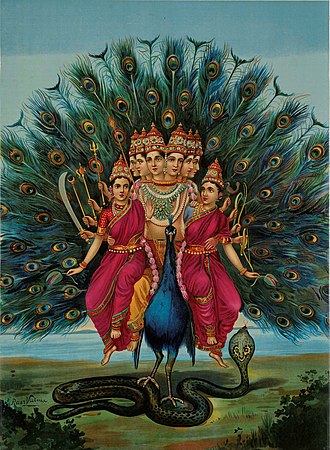
The main temple and its gopurams date from the early 11th century. Over the next 1,000 years, the temple had additions, renovations and repairs. Raids and wars, especially between Sultans who ruled Madurai and Hindu kings who ruled Thanjavur, caused damage. Hindu dynasties that regained control repaired it. Sometimes rulers covered faded paintings with new murals, and in other cases they paid for new shrines. The significant shrines of Kartikeya (Murugan), Parvati (Amman) and Nandi are from the 16th and 17th-century Nayaka era. The Dakshinamurti shrine was built later. The Marathas of Thanjavur looked after the temple well.
Description
The temple's layout follows axial and symmetrical geometry rules. Its walled complex is a large rectangle with five main parts: the sanctum with its tall vimana tower, the Nandi hall, the main community hall, the great gathering hall, and a pavilion linking the great hall to the sanctum. The entrance gateways are decorated with scenes from the Puranas, and the main gopuram is a five-story gopuram. Smaller shrines honor Parvati, Murugan, Ganesha, Varahi, and the guru of Rajaraja Chola. The Nandi bull facing the sanctum is carved from a single stone and weighs about 25 tonnes. The temple is protected by the Archaeological Survey of India, and its restoration design was led by Sheila Sri Prakash, an Indian architect and designer. Inside, the sanctum walls are decorated with pilasters, and the sanctum sanctorum holds a huge linga. In the Dravidian style, the sanctum takes the form of a miniature vimana, with a path for pradakshina around it. The main Vimana, also called the Shikhara, is a 16-storey tower with decorative columns covering its surfaces. Its articulated design includes Pilaster details. The temple honors the main deities of Vaishnavism and Shaktism alongside Shiva, and dvarapala guardians stand on each side. The sanctum walls show sculptures such as Lingodbhava, Bhikshatana, Virabhadra, Kalantaka, Harihara, and Ardhanarishvara. The second floor shows Shiva as Tripurantaka. The tower's carvings include 81 of the 108 dance poses from the Natya Sastra, the basis of Bharathanatyam, and the sanctum sits on a plinth. The main mandapas hold eight shrines for the dikpalas, the guardian deities of each direction, including Agni, Indra, Varuna, and Kubera. Other original shrines honored Surya, the Saptamatrikas, Jyeshtha, and Chandra, though many are now missing.
The temple also holds Chola-era murals found under later paintings. They were discovered in 1931 by S. K. Govindasami of Annamalai University, and they show Hindu stories, royal life, and common life. Later research suggested that some earlier interpretations were incorrect, and soot damage led to careful restoration work, including the restoration of 16 Nayaka era paintings. The temple also has Tamil and Sanskrit inscriptions from the 11th century, many recording gifts to the temple. Most of them honor Rajaraja Chola I (64 inscriptions) and Rajendra Chola I (29 inscriptions), with a few from Vikrama Chola, Kulottunga I, Rajendra II, a probable Pandyan king, and two Nayaka rulers. An inscription from 1011 CE lists more than 600 people employed by the Brihadeeswara Temple, including priests, tailors, jewelers, potters, carpenters, dancing girls, singers, and musicians. The temple also employed devadasis, who sang devotional hymns and danced, and it supported sannyasis and, during festivals, fed brahmins. According to George Michell, it was a major charity that provided daily free meals to pilgrims and travelers.
Millennium commemoration
The temple was built in 1010 CE by Chola emperor Rajaraja I in Thanjavur and is popularly known as the Big Temple. It turned 1,000 years old in September 2010, and the state government and the town held many cultural events to celebrate. The celebrations recalled the 275th day of his 25th regal year (1010 CE), when Rajaraja I (985–1014 CE) handed over a gold-plated kalasam (copper pot or finial) for the final consecration to crown the vimana, the 59.82-metre tall tower above the sanctum. The state government organised a Bharatanatyam Yajna, a classical dance show under noted dancer Padma Subramaniam. About 1,000 dancers from many places in India and abroad danced together to recorded music, and the small town became a cultural hub for two days starting on 26 September 2010.
On 26 September 2010, India Post released a special ₹ 5 postage stamp showing the 66-metre tall Raja Gopuram, in recognition of the temple's contribution to the country's cultural, architectural and epigraphical history. The Reserve Bank of India also released a ₹ 5 coin with the temple's model on it. Mumbai Mint issued a Rs 1,000 commemorative coin, the first 1,000 rupee coin released in the Republic of India coinage. In 1954, the Reserve Bank of India released a ₹ 1,000 note showing a panoramic view of the temple, and in 1975 the government led by Indira Gandhi demonetised all ₹ 1,000 notes in an effort to curtail black money. In 2010, M Karunanidhi renamed a type of high-yield paddy, Rice, as Raja Rajan-1,000 to mark the millennial year of the temple's builder, Rajaraja Chola.
Reception
The temple "testifies the brilliant achievements of the Chola in architecture, sculpture, painting and bronze casting". Many works from the time, such as Muvar Ula and Kalingathuparani, mention the temple. According to Chatterjee, Tamil architecture reached its finest form in this temple and in its successor, the Brihadisvara Temple, Gangaikonda Cholapuram. The Government of India has declared the temple a heritage monument, and the Archaeological Survey of India protects it as a monument. It is one of the most visited tourist attractions in Tamil Nadu. UNESCO declared the temple a World Heritage Site, along with the Brihadeeswara Temple at Gangaikondacholapuram and the Airavatesvara temple at Darasuram. These three are called the Great Living Chola Temples. They share similarities, but each has its own unique design and sculptures. The Cholas built all three between the 10th and 12th centuries CE, and Hindus have continued to support and use them. They are called "Great Living" because they remain active in cultural, pilgrimage and worship practices today.
The Brishadishvara temple at Thanjavur hosts annual dance festivals around February, close to Mahashivratri. Major classical Indian dance artists and regional teams perform at the Brahan Natyanjali festival over 10 days.
A Temple Chariot went on its trial run from opposite the Sri Ramar temple on 20 April 2015, watched by a large crowd. Nine days later, the first procession of the temple chariot took place. News reports said it was the first such procession at this temple in the past one hundred years. Kalki Krishnamurthy, a well-known Tamil novelist, wrote the historical novel Ponniyin Selvan, based on the life of Rajaraja. Another Tamil author, Balakumaran, wrote the novel Udaiyar, which is about the life of Rajaraja I and the building of the temple.
Administration
The temple is currently run and managed by Babaji Bhonsle, the head of the Thanjavur Maratha royal family. He is the hereditary trustee of the palace Devasthanam, which still manages 88 temples in the former Tanjore region, including the Brihadeeswara temple. Some Tamil nationalists groups have asked the Tamil Nadu government to take away these rights, but they have not been successful. They say that he is not of Chola or Tamil lineage.
One of the protesters, who is also the coordinator of the Big Temple Rights Retrieval Committee, says that Babaji Bhonsle is not the legal heir of the Maratha kings of Thanjavur.

Quiz time!
5 questions about Brihadisvara Temple
Who ordered the Brihadisvara Temple to be built?
Pictures
Keep exploring


This article is a child-friendly adaptation of the Wikipedia article on Brihadisvara Temple, available under CC BY-SA 4.0.
Images from Wikimedia Commons. Tap any image to view credits and license.