Parvati
Parvati (Sanskrit: पार्वती, IAST: Pārvatī), also known as Uma (Sanskrit: उमा, IAST: Umā) and Gauri (Sanskrit: गौरी, IAST: Gaurī), is one of the main goddesses in Hinduism. She is honoured as the goddess of power, energy, nourishment, harmony, love, beauty, devotion, and motherhood. Along with Lakshmi and Sarasvati, she forms a group known as the Tridevi.
Parvati first appears as a goddess during the epic period (400 BCE – 400 CE). She is mainly shown as the wife of the god Shiva. According to various Puranas, Parvati is the rebirth of Sati, Shiva's first wife, who gave up her body after her father, Daksha, insulted Shiva. Parvati is often linked with other goddesses, such as Sati, Uma, Kali, and Durga. Because of this close connection, these goddesses are often treated as one and the same, and their stories frequently overlap. In Hindu mythology, Parvati's birth to the mountain lord Himavan and his wife Mena is mainly understood as a cosmic event. It was meant to draw Shiva out of his withdrawn life of discipline and into marriage and family life. Parvati is also known as the mother of the well-known Hindu gods Ganesha and Kartikeya.
In Hindu philosophy, Parvati is seen as Shiva's shakti (divine energy or power), the force that creates and sustains the universe. She is the source of the power that energises Shiva, who is incomplete without her. In various Shaiva traditions, she is also seen as a model devotee and as the embodiment of Shiva's grace. She is one of the central deities of Shaktism, where she is honoured as a kind aspect of Mahadevi, the supreme deity. Parvati's statues and images can be found in Hindu temples across South Asia and Southeast Asia. In temples dedicated to her and Shiva, she is symbolically represented as the yoni.
Other uses of the name are listed on Parvati (disambiguation). The names "Parvati Devi" and "Urvi" lead here too, and you can also visit Parvati Devi (disambiguation) and Urvi (film).
Etymology and nomenclature
Further information: Hindu literature
Parvati's name comes from parvata (पर्वत), one of the Sanskrit words for "mountain." She was born as the daughter of King Himavan, also called Himavata or Parvata, and his wife Menavati. King Parvata is seen as the lord of the mountains and as the personification of the Himalayas, so Parvati means "she of the mountain." The Aparneshara Temple of Yama in Udhampur, in the Indian Union Territory of Jammu and Kashmir, is considered her birthplace. Parvati has other names linked to mountains, such as Shailaja, Haimavati, and Girija. Shaktas see her as an incarnation of Lalita Tripurasundari.
Parvati is shown as a consort goddess of Shiva, and a sculpture from the 11th century in the British Museum shows her as four-armed Lalita with her sons Ganesha and Skanda in Odisha, India. Two of her best-known names are Uma and Aparna. The name Uma was used for Sati in earlier texts, but in the Ramayana it is a name for Parvati. In the Harivamsa, she is called Aparna and then Uma, after her mother told her to stop severe fasting. She is also called Ambika, Shakti, and Maheshwari, and as a fierce goddess she is known as Durga, Bhairavi, and Bhavani. She is also the goddess of love and devotion, Kamakshi, and the goddess of food, Annapurna. Her fierce form, Mahakali, protects her devotees and destroys evil. Parvati is called both the golden Gauri and the dark Kali. Gauri is the calm wife, while Kali destroys evil. In parts of India, Gauri's golden or yellow skin honors her as the goddess of ripened corn, harvest, and fertility.
The name Parvati does not clearly appear in Vedic literature. Names such as Ambika and Rudrani are found in the Rigveda. The Kena Upanishad names a goddess called Uma-Haimavati, and Uma is a very common other name for Parvati. In that text, Parvati is shown as the shakti, or essential power, of the Supreme Brahman. She reveals the knowledge of Brahman to the Vedic Trideva of Agni, Vayu, and Varuna. Kinsley notes that linking her with the later goddess Sati-Parvati is "little more than conjecture," although later texts clearly present her as Shiva's spouse.
In the epic period (400 BCE–400 CE), both the Ramayana and the Mahabharata present Parvati as Shiva's wife. The stories of Sati-Parvati and Shiva became more detailed in the plays of Kalidasa and in the Puranas. Kinsley adds that Parvati may have come from legends of non-aryan goddesses who lived in mountains. Hopkins notes that the earliest known use of the name Pārvatī appears in the late Hamsa Upanishad. Weber suggests that Parvati, like Shiva, combines several figures. In the Puranas, she blends the wives of Rudra, bringing together the gentler Uma, Haimavati or Hemavati, and Ambika with the fiercer Kali, Gauri, and Nirriti.
Iconography and symbolism
Parvati and Shiva are often symbolized by a yoni and a linga. Together, they stand for origin, source, and the power to create new life. Shivlinga icons are common for Parvati and Shiva. Parvati is usually shown as fair, beautiful, and kind, often wearing a red dress, such as a sari. When she is shown with Shiva, she usually has two arms. Her hands may hold objects such as a trident, mirror, or flowers, and one hand may make the mudra for "fear not." Her son Ganesha is often shown on her knee.
Parvati appears in many forms. In gentle forms, a parrot sits near her shoulder, showing cheerful love and fertility. In fierce forms, such as Kali, she may have eight or ten arms. As Mahakali, she destroys evil to protect others, and as Annapurna, she provides food and abundance. In Hindu belief, she is the power of Shiva and the universal mother.
Manifestations
Parvati appears in many different forms. As Annapurna, she feeds people, and as Durga, she is fierce. Some Hindu stories describe a wild, violent side of Parvati called Shakti, which is pure, untamed energy. When her anger grows, she becomes a dark goddess with tangled hair, usually known as the fierce Mahakali, who is linked with time. In the Linga Purana, Shiva asks Parvati to become Kali so she can defeat an asura (demon) named Daruk. Even after the demon is defeated, Kali's anger cannot be calmed. Shiva then appears as a crying baby. The baby's cries awaken Kali's motherly feelings, and she returns to her gentle form as Parvati. In this baby form, Shiva is called Kshethra Balaka, who will become Rudra Savarni Manu in the future.
In the Skanda Purana, Parvati takes the form of a warrior goddess and defeats a demon named Durg, who has taken the shape of a buffalo. In this form, she is known as Durga. Parvati is seen as another side of Shakti, just like Kali, Durga, Kamakshi, Meenakshi, Gauri, and many others. However, many of these forms come from local legends and traditions. According to Shakta and Shaiva traditions, and in the Devi Bhagavata Purana, Parvati is the ancestor of all other goddesses. She is worshiped with many forms and names, and her form depends on her mood. Some examples include Akhilandeshwari, a goddess linked with water who is found in coastal parts of India, Annapurna, a goddess of food and nourishment, and Meenakshi, a local form of Parvati who is considered the queen of Madurai.
Legends
The Puranas tell how Sati married Shiva against the wishes of her father, Daksha. Daksha did not invite Shiva to his yagna (fire-sacrifice), and he insulted Shiva when Sati came on her own. Shiva withdrew to the mountains to meditate. Sati was later reborn as Parvati, daughter of Himavat and Mainavati. Her name means "she from the mountains," after her father, who is also called king Parvat. In one version of the story, Parvati decides to marry Shiva even though her parents discourage her. The god Kama tries to wake Shiva from meditation, and Shiva burns him to ashes. Parvati does not give up. She lives in the mountains like Shiva, practising yogin and tapas, until Shiva notices her. In disguise, he tries to discourage her, but she refuses to change her mind, and Shiva finally accepts her. Shiva dedicates a hymn to her, describing her as Prakṛti and himself as Purusha.
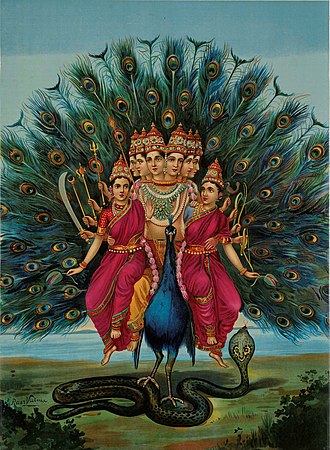
After the marriage, Parvati moves to Mount Kailash, Shiva's home. Their sons are Kartikeya, also called Skanda and Murugan and the leader of the heavenly armies, and Ganesha, the god of wisdom who removes obstacles. Other Hindu legends tell her birth differently. In the Devi Bhagavata Purana and Shiva Purana, the mountain Himalaya and his wife Mena please Adi Parashakti, who is then born as their daughter Parvati. Kalidasa's epic Kumarasambhavam tells of Parvati's devotion, the fall of Kamadeva and the universe into lifelessness, and Kamadeva's return to life after Parvati asks Shiva to help him. In the goddess-focused Shakta texts, she is even said to rise above Shiva and is seen as the Supreme Being. Parvati stands for virtues such as fertility, devotion, asceticism, and power. She represents the householder, while Shiva represents the ascetic, and both ways of life are valued among the Ashramas. When Shiva performs his wild Tandava dance, Parvati calms him with her gentle Lasya dance. In many legends she is his rival rather than only his partner, tricking him away from his ascetic practices. Three images are central to her meaning: the Shakti image of Shiva, the Ardhanarishvara form of the half-woman Lord, and the linga and yoni. Together they show harmony between the ascetic and the householder. The Puranas often show the couple debating on Mount Kailash, and in art they appear as Uma-Maheshvara or Hara-Gauri, or as Annapurna giving alms to Shiva. In a story from Tantrism, ten goddesses called the Mahavidyas block Shiva's exit after an argument. The Ardhanarishvara image appears in the Elephanta Caves. The Matsya Purana, Shiva Purana, and Skanda Purana also tell stories of Parvati and her children, such as how Parvati creates Ganesha from turmeric paste and Shiva later gives him an elephant's head.
In culture
Many festivals honour Parvati. Teej is an important festival for Hindu women, especially in northern and western India. It celebrates married life, family ties, and the monsoon, and women hang swings from trees while singing songs. In Nepal it lasts three days, with visits to Shiva-Parvati temples, and in Punjab it is called Teeyan. The Gowri Habba, or Gauri Festival, is held on the seventh to ninth days of Bhadrapada (Shukla paksha). It is linked to the festival of her son Ganesha, Ganesh Chaturthi, and is popular in Maharashtra and Karnataka. In Rajasthan, Gangaur lasts 18 days. During Navratri, her forms are worshipped over nine days, including Shailaputri, Brahmacharini, Chandraghanta, Kushmanda, Skandamata, Katyayini, Kaalratri, Mahagauri, and Siddhidatri. Thiruvathira is observed in Kerala and Tamil Nadu, where it is believed that Parvati met Shiva after her long penance and he took her as his wife.
Many Indian arts, from sculpture to dance, explore the stories of Parvati and Shiva. For example, Daksha Yagam of Kathakali, a form of dance-drama, adapts their romantic episodes. The Gauri-Shankar bead is part of religious adornment and is based on the belief that Parvati and Shiva are the ideal equal halves of each other. It is a special rudraksha bead, and sometimes two seeds of the tree grow fused together and are seen as symbolic of them. Ancient coins from Bactria (Central Asia) from the time of the Kushan Empire, and coins of king Harsha (North India), show Uma. These were issued between the 3rd and 7th centuries AD. In Bactria she is spelled Ommo and holds a flower, while Shiva stands near Nandi, his vahana. On Harsha's coins, Parvati and Shiva are seated on a bull, and the back of the coin has Brahmi script.
Major temples
See also: Shakta pithas
Parvati is often present with Shiva in Saivite Hindu temples all over South Asia and Southeast Asia. Some places, called Pithas or Shaktipeeths, are special because of their historical importance and legends about their origins in the ancient texts of Hinduism. Each major Parvati-Shiva temple is a pilgrimage site with an ancient legend, which is usually part of a larger story that links Hindu temples across South Asia.
Parvati can be found at many temples. In Jammu and Kashmir, she is honoured at the Udhampur District, Jammu Mantalai Temple and at Gauri Kund. In Karnataka, there is the Chamundeswari Temple in Mysore. In Odisha, she is worshipped as Annapurna, the consort of Lingaraj, at the Lingaraj temple complex in Bhubaneswar and at the Birja Temple, jajpur. In Kerala, temples include the Annapurneshwari Temple, Cherukunnu, Attukal Bhagavathy Temple, Chakkulathukavu Temple, Chengannur Mahadeva Temple, Oorpazhachi Kavu, Irumkulangara Durga Devi Temple, Kadampuzha Devi Temple, Mridanga Saileswari Temple, Kumaranallor bagavathi temple, and most of the 108 durgalayas in kerela. In Maharashtra, there is the Tulja Bhavani Temple. In Meghalaya, there is the Nartiang Durga Temple. In Tamil Nadu, temples include the Meenakshi Amman Temple, Kamakshi Amman Temple, Sri Siva Durga Temple, Bannari Amman Temple, Samayapuram Mariamman Temple, Vekkali Amman Temple, Mutharamman Temple, Kulasekharapatnam, Tiruverkadu Devi Karumariamman Temple, Nellaiappar Temple, Kapaleeshwarar Temple, Masani Ammam temple, Gomathi Amman, and Punnainallur Mariamman. In Tripura, there is the Tripura Sundari Temple. In Uttar Pradesh, temples include the Vishalakshi Temple, Annapurna Devi Temple, and Alopi Devi Mandir.
Parvati, shown as Uma or Durga, appears in sculptures, temples, and writings across Southeast Asia. Early inscriptions in Cambodia, dating back to the fifth century AD, mention Parvati (Uma) and Shiva, and many Cambodian temples, rock art, and river carvings such as Kbal Spean honour them both. Boisselier has identified Uma in a Champa temple in Vietnam. Dozens of ancient temples to Parvati as Uma, with Shiva, have been found in Indonesia and Malaysia, and many temples in Java date from the second half of the first millennium AD. Her form as Durga is also found in Southeast Asia. Derived from her form as Mahakali, her Japanese form is Daikokutennyo (大黒天女).
In Nakhorn Si Thammarat province of Thailand, excavations at Dev Sathan have uncovered a Hindu temple dedicated to Vishnu, a lingam in a yoni, and a Shiva temple. The Parvati sculpture found there reflects the South Indian style. In Bali, Parvati (spelled Parwati) is a main goddess in modern Hinduism. She is often called Uma and sometimes Giriputri, meaning daughter of the mountains. She is the goddess of Gunung Agung, married to the deity Siwa, and is seen as a mother goddess who nurtures life and helps crops grow. As Dewi Danu, she watches over the waters of lake Batur and Gunung Batur, a major volcano. As Dewi Durga, she takes a fierce form, and as Rangda, she is wrathful and watches over cemeteries. As Ibu Pertiwi, she is the goddess of earth. Her many forms and stories appear in Balinese literature, such as the palm-leaf manuscript Andabhuana.
Related goddesses
Tara is a goddess found in some Buddhist groups, especially in Tibet and Nepal, and she is related to Parvati. Tara also appears in many forms. In tantric Buddhism and Hinduism, detailed, balanced art called yantra or mandala is dedicated to different aspects of Tara and Parvati.
Parvati is closely linked in symbolism and powers to Cybele from Greek and Roman myths, and to Vesta, the guardian goddess of children. As Durga, she is like Mater Montana, and she matches the Magna Mater (Universal Mother). As Kali, who punishes all evil, she matches Proserpine and Diana Taurica. As Bhawani, a goddess of fertility and birth, she is like the Ephesian Diana. On Crete, Rhea is a mountain goddess who parallels Parvati, and in some island myths, Diktynna (also called Britomartis) is a fearsome goddess like Parvati. Cybele is shown with lions at Ephesus, and Parvati is sometimes shown with a lion too. Carl Jung places aspects of Parvati with goddesses like Artemis, Isis and Mary. Edmund Leach compares Parvati's relationship with Shiva to that of the Greek goddess Aphrodite, a symbol of love.

Quiz time!
5 questions about Parvati
Parvati forms a special group called the Tridevi. Which two goddesses join her in it?
Pictures
Keep exploring



This article is a child-friendly adaptation of the Wikipedia article on Parvati, available under CC BY-SA 4.0.
Images from Wikimedia Commons. Tap any image to view credits and license.