Convenience store
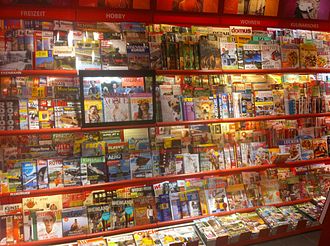
A convenience store is a small shop that sells many everyday items under one roof. These can include convenience food, groceries, beverages, tobacco products, lottery tickets, over-the-counter drugs, toiletries, newspapers and magazines.
In some jurisdictions, convenience stores (such as off-licences in the UK) are allowed to sell alcoholic drinks. Many other places only allow drinks with fairly low alcohol content, like beer and wine. Stores may also offer money order and wire transfer services. Customers can use a fax machine or photocopier for a small cost per copy. Some stores also sell tickets, recharge smart cards such as Opus cards in Montreal, Canada, or include a small deli. Unlike general stores and village shops, they are not usually found in a rural location. They are used as a convenient supplement to larger stores, which is how they got their common name.
A convenience store may be part of a gas/petrol station, so customers can buy goods while refuelling their vehicles. It may be found along a busy road, in an urban area, or near a railway or railroad station or other transport hub. In some countries, convenience stores have long shopping hours, and some stay open 24 hours.
Convenience stores often charge much higher prices than grocery stores or supermarkets. They buy smaller amounts of inventory at higher prices per item from wholesalers. Even so, customers value their longer opening hours, their many locations, and their shorter cashier lines.
Terminology
A convenience store may also be called a bodega in New York City, a carry-out, a cold store, a corner shop (mostly in the United Kingdom), a corner store (in many parts of English-speaking Canada and New England), a mini-market, a mini-mart, a party store (in Michigan), a deli or milk bar in Australia, a dairy in New Zealand, or a superette (in France, New Zealand, parts of Canada, and parts of the US).
Other names come from different countries. In Germany, it may be a späti, from "spätkauf," meaning "buy-late." In Turkey it is a bakkal, and in Japan it is a konbini, based on the English word "convenience." In Canada, mainly in Quebec, it is called a dépanneur or dep, in both English and French. This word is a loanword from the French word for "troubleshooter."
Product specialization
Convenience stores come in different types, such as liquor stores (off-licences-offices), mini-markets (mini-marts), general stores, and party stores. Most sell sweets, ice cream, soft drinks, lottery tickets, newspapers, and magazines, but what they sell varies a lot from store to store. Unless the store is a liquor store, it usually sells only a few alcoholic drinks, like beer and wine, or none at all. Most stores sell cigarettes and other tobacco products, such as cigarette papers, pipe tobacco, cigars, and e-liquid for e-cigarettes. In many North American places, tobacco makes up the largest part of sales, between 25 and 35 percent.
Some stores focus on food to attract customers who want breakfast, dinner, fast food, or pizza. The stores run by Wawa, Casey's, Buc-ee's, and Sheetz are examples of this food-focused approach. Many shops sell ready-to-eat food, such as breakfast sandwiches, and packaged foods like the British Rail sandwich and frozen burritos. Across Europe, many stores now sell fresh French bread. Some have a delicatessen counter for custom sandwiches and baguettes, while others have doughnuts. Some stores also have a self-service microwave oven for heating food. Stores that sell fast food often do not cook it on site. Instead, a local restaurant delivers a small menu several times a day. Convenience stores also sell car items, toiletries, and everyday household goods. They are common in Asian countries like Japan and Taiwan, where more people live in a small area. Because small stores have fewer staff, they usually carry few items that go bad quickly.
Differences from supermarkets
Convenience stores usually have fewer choices than supermarkets. Their prices are often higher, because they buy smaller amounts of inventory at higher prices from wholesalers. Their products often come in smaller packages, which helps keep the prices from looking so different from supermarket prices and means less leftover food goes to waste when travellers cannot carry it with them.
In the United States, convenience stores are sometimes the only businesses near an interstate highway exit where drivers can buy food or drinks for miles. Most of their profit margin comes from beer, liquor and cigarettes, which sell in large amounts even though each item earns less. Deli items earn more per item but sell in smaller numbers. In some countries, convenience stores have longer shopping hours, and some are open 24 hours.
By country
Convenience stores take different forms and have different names around the world. In Australia, many are open 24 hours a day, seven days a week, and most are small businesses. In Canada, they are called "corner stores," "mini-marts," or "variety stores," and in Quebec they are known as a dépanneur. In Japan, they are often called konbini, and the country has tens of thousands of them. In the United States, the first chain convenience store opened in Dallas, Texas in 1927. It later became 7-Eleven, the largest convenience store chain. In Turkey, they are often called bakkal, and in the United Kingdom, the "corner shop" has a long history that began with the Industrial Revolution.
Many countries have their own local styles of shops. In Taiwan, there are more than 10,000 convenience stores, and Taipei has many 7-Eleven shops close together. In Mexico, Oxxo is the largest chain, with more than 15,000 stores. In Singapore, convenience shops became popular partly because they sell imported goods and are located in housing estates. Some countries have smaller family-run shops too, such as the pulperías of Costa Rica and the kirana stores of India.
Similar concepts
Convenience stores have, to some extent, replaced the old-fashioned general store. They are similar to Australian milk bars, but unlike them, they are often franchises rather than "Mum and Dad" small businesses. In Britain, corner shops and village shops did similar jobs and came before modern European convenience shops, such as Spar. In the Canadian province of Quebec, dépanneurs (often called "deps" in English) are usually family-owned neighbourhood shops that do similar jobs.
Truck stops, also known as "travel centers", combine a shop with similar goods and a convenience store with amenities for professional drivers of semi-trailer trucks. These may include fast food restaurants, showers, and places to buy large amounts of diesel fuel. The European equivalent is the motorway service station. Neighborhood grocery stores that are not big enough to be supermarkets often compete with convenience shops. In Los Angeles, a local chain runs neighborhood grocery stores that fill the space between a traditional supermarket and a convenience shop. They sell fresh fruit and fresh meat and carry more than 5,000 items, so they are a lot like supermarkets. Because the stores are small, customers can get in and out quickly or have their shopping delivered. In Belgium, convenience shops known as night shops are only allowed to open at night.

Quiz time!
5 questions about Convenience store
Why are convenience stores often more expensive than supermarkets?
Pictures
Keep exploring


This article is a child-friendly adaptation of the Wikipedia article on Convenience store, available under CC BY-SA 4.0.
Images from Wikimedia Commons. Tap any image to view credits and license.