
Demographics of Vatican City
Vatican City is the world's smallest country, both in size and in population. In 2024, it had an estimated 882 residents, including people who are not citizens. There are also 372 Vatican citizens living abroad, mostly as diplomats of the Holy See and cardinals in Rome.
The people living in Vatican City include clergy, religious members, and workers such as the Swiss Guard, along with their families. In recent years, families of Holy See employees have lived there, and children of Swiss Guards have also called Vatican City home. Everyone living there follows the Catholic faith, and the city welcomes many visitors and workers each day.
Population
Women make up a very small part of Vatican City's population. In 2011, there were only 32 women with Vatican passports out of 572 citizens. By 2013, the number of women citizens was about 30. These women came from different places, including South America, Poland, Switzerland, and Italy.
Vatican City has had some changes to recognize the value of women. Pope Benedict XVI appointed a woman as one of his assistant editors. Pope Francis planned to appoint more women to important roles. In 2019, he appointed three women to help with important church discussions. However, women still cannot be ordained as priests or bishops, but there is a commission looking into allowing women to serve in other important roles.
Vatican City does not allow divorce, and its laws strongly prohibit certain medical procedures for women, except in very special cases to save a woman's life.
| Sex | all | ||
|---|---|---|---|
| Citizenship | Vatican | other | |
| Residency | other | Vatican City | |
| Pope | 1 | ||
| Cardinals | 55 | 9 | |
| Diplomats | 317 | ||
| Swiss Guard | 104 | ||
| Others | 132 | 518 | |
| Total | 618 | 518 | |
| 372 | 246 | ||
| 764 | |||
| 1,136 | |||
| Sex | all | male | female | ||||||
|---|---|---|---|---|---|---|---|---|---|
| Citizenship | Vatican | other | Vatican | other | Vatican | other | |||
| Residency | other | Vatican City | other | Vatican City | Vatican City | ||||
| Pope | 1 | 1 | |||||||
| Cardinals | 43 | 30 | 43 | 30 | |||||
| Diplomats | 306 | 306 | |||||||
| Swiss Guard | 86 | 86 | |||||||
| Other religious | 50 | 197 | 49 | 102 | 1 | 95 | |||
| Other lay | 56 | 24 | 25 | 3 | 31 | 21 | |||
| Total | 572 | 221 | 540 | 105 | 32 | 116 | |||
| 349 | 223 | 349 | 191 | 32 | |||||
| 444 | 296 | 148 | |||||||
| 793 | 645 | 148 | |||||||
Languages
Main article: Languages of Vatican City
Vatican City mainly uses Italian for official work and everyday life. This is because Italian is very important to Vatican City and many visitors speak it. But people in Vatican City speak many different languages because the people living there come from many places and work in different jobs, like the Holy See and the Swiss Guard.
Historically, Latin was spoken when the Roman Empire was around and it was the official language of the Papal States. When the area became part of the Kingdom of Italy in 1870, Italian became the official language. After Vatican City was created in 1929 through the Lateran Treaty, it did not pick one official language, but its laws are written in Italian in the Acta Apostolicae Sedis. Many buildings in Vatican City have writing in Latin, Italian, Greek, French, and German.
Latin is still the official language of the Holy See. Italian is used for most work and talking with other countries in Vatican City and has been the official language of the Synod of Bishops since 2014. French is sometimes used for talking with other countries.[better source needed]
The Swiss Guard uses Swiss German for giving orders, but they make their promise to protect in their own languages: German, French, Italian, or Romansh. Since Vatican City was created, the popes have spoken Italian, Polish, German, Spanish, and English.
Vatican City has many languages in its news and information. The Holy See’s newspaper, L'Osservatore Romano, is printed in several languages like Italian, English, French, German, Polish, Portuguese, and Spanish. Its website is mainly in Italian but also has full versions in English, French, German, Portuguese, and Spanish, and some versions in Arabic, Chinese, and Latin. Some content is also in Albanian, Belarusian, Croatian, Czech, Dutch, Hebrew, Hungarian, Indonesian, Japanese, Korean, Lithuanian, Maltese, Polish, Russian, Slovak, Slovene, Swahili, and Ukrainian. The Vatican News website has information in many languages, including Albanian, Amharic, Arabic, Armenian, Belarusian, Bulgarian, Chinese, Croatian, Czech, English, Esperanto, French, German, Italian, Japanese, Korean, Latvian, Lithuanian, Hindi, Hungarian, Kannada, Malayalam, Macedonian, Polish, Portuguese, Romanian, Russian, Slovak, Slovene, Spanish, Swahili, Swedish, Tamil, Tigrinya, Ukrainian and Vietnamese.
Citizenship
Vatican City is different from most countries because its citizenship is not based on where you are born or your family. Instead, you become a citizen when you are appointed to a special job serving the Holy See. This citizenship ends when you leave that job, but spouses and children of citizens can also be citizens if they live together in Vatican City.
If someone loses Vatican citizenship and does not have another country's citizenship, they automatically become an Italian citizen under the Lateran Treaty. The Holy See issues special diplomatic and service passports, while Vatican City issues regular ordinary passports for its citizens.
Statistical oddities
Vatican City often appears unusual in statistics because of its very small size and special religious role. For example, since most of its citizens are men, there are more men than women. The city also shows high numbers in some areas, like crimes against visitors and wine use, mainly because of its tiny population and religious practices.
Because of its size, Vatican City can seem like an outlier in world data. One funny example is calculating "Popes per square kilometer," which looks very high since the city is smaller than half a square kilometer.
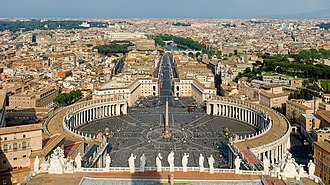
360-degree view from the dome of St. Peter's Basilica, looking over the Vatican's Saint Peter's Square (center) and out into Rome, showing Vatican City in all directions
Culture
See also: Architecture of Vatican City and Vatican Museums
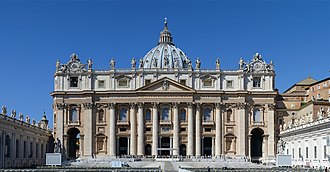
Vatican City is home to many beautiful artworks and buildings. St. Peter's Basilica is a famous example of Renaissance architecture, designed by many great artists. The Sistine Chapel is known for its colorful paintings, including work by Michelangelo.
The Vatican Apostolic Library and the Vatican Museums hold important items from history and science. In 1984, Vatican City became a UNESCO World Heritage Site, meaning it is very special and protected.
Main article: Sport in Vatican City
Vatican City does not join in the Olympic Games, but it does take part in other sports events. The country has its own group for sports, called Vatican Athletics.
Association football, or soccer, is managed by the Vatican Amateur Sports Association. This group runs a small league with eight teams, including one for the Swiss Guard. They also organize cups and manage the Vatican City national football team.
Economics
Main article: Economy of Vatican City
The economy of Vatican City is supported by selling stamps, coins, souvenirs, and charging for museum entries. In 2016, Vatican City had 4,822 people working there.
The city also gets help from Italy, like free water and taxes that are not paid. Vatican City uses the euro as its money, and it makes its own euro coins, which are special and liked by coin collectors. In 2021, Vatican City's money plans showed it earned €770 million but spent €803 million, leaving a small amount owed.
Some of its power comes from the sun using solar panels, and the rest is provided by Italy.
Law
Vatican City has its own set of laws. The most important is called canon law, which comes from the Catholic Church. The main rules for how the city is run are found in the Fundamental Law, which acts like a constitution. This law was updated in 2023 by Pope Francis.
The city has its own police force called the Corpo della Gendarmeria, which keeps order and handles security. They also help with traffic and investigations. The Pontifical Swiss Guards protect the pope and important buildings. Because Vatican City is so small, it doesn’t have its own prison. People who break the law are usually sent to prisons in Italy.
Most crimes in Vatican City are small thefts, like pickpocketing, often done by tourists. Because so many people visit each year, these small crimes happen often.
Pictures
Keep exploring


This article is a child-friendly adaptation of the Wikipedia article on Demographics of Vatican City, available under CC BY-SA 4.0.
Images from Wikimedia Commons. Tap any image to view credits and license.