 Safekipedia
Deutsche Mark
Adapted from Wikipedia · Discoverer experience
The Deutsche Mark was the official currency of West Germany from 1948 until 1990, and then of unified Germany until 2002 when it was replaced by the euro. Known as the "DM" or "D-Mark", it was divided into 100 smaller units called pfennigs. It was first issued in 1948 to replace the Reichsmark during the Allied occupation and became the currency of the Federal Republic of Germany the following year.
On 31 December 1998, the Council of the European Union set the permanent exchange rate for converting German marks to euros as DM 1.95583 = €1. In 1999, the euro officially replaced the Deutsche Mark, but people could still use marks until 1 January 2002, when euro notes and coins were introduced. After that date, the Deutsche Mark was no longer legal tender.
The Deutsche Bundesbank promised that people could exchange their old Deutsche Mark coins and banknotes for euros at any time, even by sending them by mail. In 2012, it was estimated that over 13 billion marks were still in circulation. Some people in Germany have remembered the Deutsche Mark fondly, but most agree that switching to the euro has been beneficial for the country.
History
Before 1871
See also: North German thaler, South German gulden, and German gold mark
A mark had been the currency of Germany since its original unification in 1871. Before that time, the different German states issued a variety of different currencies, the most common being the North German thaler and the South German gulden. By 1857, both currencies were linked to the Vereinsthaler, a silver coin containing 16+2⁄3 grams of pure silver. Although the German gold mark was based on gold rather than silver (at 2.79 marks per gram of fine gold), a fixed exchange rate between the Vereinsthaler and the mark of 3 marks = 1 Vereinsthaler was used for the conversion.
1873–1948
The first mark, known as the Goldmark, was introduced in 1873. With the outbreak of World War I, the mark was taken off the gold standard. The currency thus became known as the Papiermark, especially as high inflation, then hyperinflation occurred and the currency became exclusively made up of paper money. The Papiermark was replaced by the Rentenmark (RM) from 15 November 1923, and the Reichsmark (ℛ︁ℳ︁) in 1924.
Early military occupation following WWII
During the first two years of occupation the occupying powers of France, United Kingdom, United States, and the Soviet Union were not able to successfully negotiate a possible currency reform in Germany. Due to the strains between the Allies each zone was governed independently as regards monetary matters. The US occupation policy was governed by the directive JCS 1067 (in effect until July 1947), which forbade the US military governor "to take any steps to strengthen German financial structure". As a consequence a separate monetary reform in the U.S. zone was not possible. Each of the Allies printed its own occupation currency.
Currency reform of June 1948
Main article: Currency Reform of 1948
The Deutsche Mark was officially introduced on Sunday 20 June 1948 by Ludwig Erhard. Large amounts were exchanged for 10 ℛ︁ℳ︁ to 65pf. In addition, each person received a per capita allowance of DM 60 in two parts, the first being DM 40 and the second DM 20. Edward A. Tenenbaum managed the group of 11 experts that devised the currency reform, and also created "Deutsche Mark", a temporary name that became permanent.
A few weeks later Erhard, acting against orders, issued an edict abolishing many economic controls which had been originally implemented by the Nazis, and which the Allies had not removed. He did this, as he often confessed, on Sunday because the offices of the American, British, and French occupation authorities were closed that day. He was sure that if he had done it when they were open, they would have countermanded the order.
The introduction of the new currency was intended to protect western Germany from a second wave of hyperinflation and to stop the rampant barter and black market trade (where cigarettes were used as currency). Although the new currency was initially only distributed in the three western occupation zones outside Berlin, the move angered the Soviet authorities, who regarded it as a threat.[citation needed] The Soviets promptly cut off all road, rail and canal links between the three western zones and West Berlin, starting the Berlin Blockade. In response, the U.S. and Britain launched an airlift of food and coal and distributed the new currency in West Berlin as well.
Economics of 1948 currency reform
Since the 1930s, prices and wages had been controlled, but money had been plentiful. That meant that people had accumulated large paper assets, and that official prices and wages did not reflect reality, as the black market dominated the economy and more than half of all transactions were taking place unofficially. The reform replaced the old money with the new Deutsche Mark at the rate of one new per ten old. This wiped out 90% of government and private debt, as well as private savings. Prices were decontrolled, and labor unions agreed to accept a 15% wage increase, despite the 25% rise in prices. The result was the prices of German export products held steady, while profits and earnings from exports soared and were poured back into the economy. The currency reforms were simultaneous with the $1.4 billion in Marshall Plan money coming in from the United States, which primarily was used for investment. In addition, the Marshall plan forced German companies, as well as those in all of Western Europe, to modernize their business practices, and take account of the wider market.
Marshall plan funding overcame bottlenecks in the surging economy caused by remaining controls (which were removed in 1949), and opened up a greatly expanded market for German exports. Overnight, consumer goods appeared in the stores, because they could be sold for higher prices. While the availability of consumer goods is seen as a giant success story by most historians of the present, the perception at the time was a different one: prices were so high that average people could not afford to shop, especially since prices were free-ranging but wages still fixed by law. Therefore, in the summer of 1948 a giant wave of strikes and demonstrations swept over West Germany, leading to an incident in Stuttgart where strikers were met by US tanks ("Stuttgarter Vorfälle"). Only after the wage-freeze was abandoned, Deutschmark and free-ranging prices were accepted by the population.
Currency reform in the Soviet occupation zone
In the Soviet occupation zone of Germany (later the German Democratic Republic), the East German mark (also named "Deutsche Mark" from 1948 to 1964 and colloquially referred to as the Ostmark—literally Eastmark) was introduced a few days afterwards in the form of Reichsmark and Rentenmark notes with adhesive stamps to stop the flooding in of Reichsmark and Rentenmark notes from the West. In July 1948, a completely new series of East German mark banknotes was issued.
Bank deutscher Länder and the Deutsche Bundesbank
Later in 1948, the Bank deutscher Länder ("Bank of the German States") assumed responsibility, followed in 1957 by the Deutsche Bundesbank. The Deutsche Mark earned a reputation as a strong store of value at times when other national currencies succumbed to periods of inflation.[citation needed] It became a source of national pride and an anchor for the country's economic prosperity,[citation needed] particularly during the years of the Wirtschaftswunder in the 1950s.
Currency union with the Saarland
The population in the Saar Protectorate rejected in a referendum the proposal to turn it into a "European territory". Despite French pre-referendum claims that a "no" vote would mean that the Saar would remain a French protectorate it in fact resulted in the incorporation of the Saar into the Federal Republic of Germany on 1 January 1957. The new German member state of the Saarland maintained its currency, the Saar franc, which was in a currency union at par with the French franc. On 9 July 1959 the Deutsche Mark replaced the Saar franc at a ratio of 100 francs = DM 0.8507.
German reunification
The Deutsche Mark played an important role in the reunification of Germany. It was introduced as the official currency of East Germany in July 1990, replacing the East German mark (Mark der DDR), in preparation for unification on 3 October 1990. East German marks were exchanged for Deutsche Marks at a rate of 1:1 for the first M 4,000 and 2:1 for larger amounts. Before reunification, each citizen of East Germany coming to West Germany was given Begrüßungsgeld (welcome money), a per capita allowance of DM 100 in cash. The government of Germany and the Bundesbank were in major disagreement over the exchange rate between the East German mark and the German mark.
France and the United Kingdom were opposed to German reunification, and attempted to influence the Soviet Union to stop it. However, in late 1989 France extracted German commitment to the Monetary Union in return for support for German reunification.
Stability
The Deutsche Mark was known for being very stable. This was because of the rules set by the Bundesbank, the bank that controlled the money in Germany. These rules were strict about keeping prices from going up too fast and not letting politicians change them easily. Because of these rules, the Deutsche Mark became a model for the European Central Bank when it created the euro.
In 1993, when other European currencies like the French franc were having trouble, the Deutsche Mark still stayed strong. Even so, over its 53 years of use, the value of the Deutsche Mark went down by more than 70% compared to what it could buy when it first started.
Coins
The first Deutsche Mark coins were made in 1948 and 1949 by the Bank deutscher Länder. From 1950, the coins said “Bundesrepublik Deutschland” (Federal Republic of Germany) on them. These coins came in amounts of 1pf, 2pf, 5pf, 10pf, and 50pf. The smaller coins were made from bronze-covered steel, while bigger ones used brass-covered steel or a metal called cupronickel.
In 1950, coins worth 1 Deutsche Mark were released, followed by 2 Deutsche Mark and 5 Deutsche Mark coins in 1951. Germany kept using even the smallest coins, like the 1pf and 2pf pieces, until it switched to the euro.
Germany didn’t stop using the tiny coins like other countries did. Even in 2001, shops still used these small coins. There were also special coins made for collectors, but they weren’t commonly used for everyday buying and selling.
In 2000, Germany made a special gold coin to celebrate the end of the Deutsche Mark. One million of these gold coins were made and sold to collectors.
German coins have special marks to show where they were made. For example, D means Munich, F means Stuttgart, G means Karlsruhe, and J means Hamburg. These marks are still used on today’s euro coins.
Between 1990 and 1991, coins from East Germany were also used as Deutsche Mark coins because there weren’t enough small coins at the time.
Colloquial expressions
In everyday German, people sometimes called the 10pf coin a “groschen” and the 5pf coin a “sechser.” These names come from older money systems used in different parts of Germany before 1871. In some places, the 5 Deutsche Mark coin was called a “Heiermann,” and in Bavaria, the 2 Deutsche Mark coin was called a “Zwickl.” These names are still used today for some euro coins in those areas.
| Coins of the Deutsche Mark | |||||||||
|---|---|---|---|---|---|---|---|---|---|
| Image | Value | Technical parameters | Description | Issued from | |||||
| Diameter (mm) | Mass (g) | Composition | Edge | Obverse | Reverse | ||||
| 1 pf | 16.5 | 2.00 | Bronze-plated steel | Smooth | Rye stalks; value | Oak branch; lettering: Bundesrepublik Deutschland; value | 1948–1949 | ||
| Copper-plated steel | 1950–2001 | ||||||||
| 2 pf | 19.25 | 3.25 | Bronze | 1949–1968 | |||||
| 2.90 | Copper-plated steel | 1968–2001 | |||||||
| 5 pf | 18.50 | 3.00 | Brass-plated steel | 1949–2001 | |||||
| 10 pf | 21.50 | 4.00 | |||||||
| 50 pf | 20.00 | 3.50 | Cupronickel | Reeded | Value; lettering: Bundesrepublik Deutschland | Sower with an oak seedling | 1949–1971 | ||
| Smooth | 1972–2001 | ||||||||
| DM 1 | 23.50 | 5.50 | Ornamental | Oak leaves; value; year of issue | German eagle; lettering: Bundesrepublik Deutschland | 1950–2001 | |||
| DM 2 | 25.50 | 7.00 | Lettering: EINIGKEIT UND RECHT UND FREIHEIT; oak leaves | Rye stalks and grapes; value | 1951–1956 | ||||
| 26.75 | Max Planck | German eagle; value; year of issue; lettering: Bundesrepublik Deutschland | 1957–1971 | ||||||
| Magnimat: Cupronickel- plated nickel | Konrad Adenauer | 1969–1987 | |||||||
| Theodor Heuss | 1970–1987 | ||||||||
| Kurt Schumacher | 1979–1993 | ||||||||
| Ludwig Erhard | 1988–2001 | ||||||||
| Franz Josef Strauss | 1990–2001 | ||||||||
| Willy Brandt | 1994–2001 | ||||||||
| DM 5 | 29.00 | 11.20 | Silver: 62.5% Copper: 37.5% | Value; year of issue; lettering: Bundesrepublik Deutschland | German eagle | 1951–1974 | |||
| 10.00 | Magnimat: Cupronickel- plated nickel | Lettering: EINIGKEIT UND RECHT UND FREIHEIT; eagles | Value; lettering: Bundesrepublik Deutschland | German eagle; year of issue | 1975–2001 | ||||
Banknotes
There were four series of German mark banknotes:
- The first series was issued in 1948 by the Allied military. It included notes of different values, like half a mark up to 100 marks.
- The second series came in 1948 by the Bank of the German States. These notes looked similar to dollars and French francs.
- The third series started in 1960 by the Bundesbank. It featured German artists and buildings.
- The fourth series began in 1990, also by the Bundesbank. It included a new 200 mark note and better safety features to prevent copying.
The notes with values above 200 marks were not common. Some extra notes were made ready in case they were needed, but they were never used.
Banknotes of the third series (BBk I/Ia)
In 1957, new banknotes were designed when the Bank of the German States merged into the Bundesbank. The old notes wore out quickly, so new ones were needed.
These new notes had safety features like special threads and invisible fibers. They started being used in 1961, beginning with the 20 mark note. Over time, more notes of different values were added.
Banknotes of the fourth series
For many years, the designs of German banknotes stayed the same. But by the late 1980s, it became harder to stop people from making fake notes, so a new series was created. The new notes kept the same colors but had different designs. Famous German artists and scientists were featured, and the pictures on the notes showed places important to them.
The new notes had even better safety features, like special threads and hidden writing. The 100 and 200 mark notes were released first in 1990, followed by others over the next few years. Additional safety features were added later to make counterfeiting even harder.
| Issue | Date | President | Vice President | Notable other changes |
|---|---|---|---|---|
| 1 | 2 January 1960 | Karl Blessing | Heinrich Troeger | |
| 2 | 2 January 1970 | Karl Klasen | Otmar Emminger | "Zuchthaus" has been replaced with "Freiheitsstrafe" following 1969 Great Penal Code Reform |
| 3 | 1 June 1977 | Otmar Emminger | Karl Otto Pöhl | Machine-readable "M" feature, now designated BBk Ia |
| 4 | 2 January 1980 | Karl Otto Pöhl | Helmut Schlesinger | |
| 5 | "Deutsche Bundesbank" copyright notice with year of the denomination's first issue added on the bottom of the reverse |
| Face value | Image | Dimensions | Main color | Description | Date of | |||
|---|---|---|---|---|---|---|---|---|
| Obverse | Obverse | Reverse | Issue | Withdrawal | ||||
| DM 5 | 120×60 mm | Olive Green | Portrait of a Venetian Woman by Albrecht Dürer (1505) | A branch with oak leaves and acorns symbolizes German nature | 6/5/1963 | 30/6/1995 | ||
| DM 10 | 130×65 mm | Blue | Beardless Young Man by Lucas Cranach the Elder (1500) | Training ship Gorch Fock symbolizes German cosmopolitanism | 21/10/1963 | |||
| DM 20 | 140×70 mm | Green | Portrait of Elsbeth Tucher, née Pusch by Albrecht Dürer (1499) | A violin and a clarinet symbolizes the world of German music | 10/2/1961 | |||
| DM 50 | 150×75 mm | Brown | Portrait of Hans Urmiller from Portrait of Hans Urmiller and his Son by Barthel Beham (1525) | Holstentor in Lübeck symbolizes German civic pride | 18/6/1962 | |||
| DM 100 | 160×80 mm | Blue | Cosmograph Sebastian Münster by Christoph Amberger (1552) | An eagle with stretched-out wings (Federal Eagle) symbolizes German state awareness | 26/2/1962 | |||
| DM 500 | 170×85 mm | Red | Portrait of a beardless man by Hans Maler zu Schwaz (1521) | Burg Eltz in Rhineland-Palatinate symbolizes German chivalry | 26/4/1965 | |||
| DM 1000 | 180×90 mm | Brown | Portrait of Dr. Johannes Scheyring by Lucas Cranach the Elder (1529) | Limburg Cathedral symbolizes Romanesque architecture in Germany | 27/7/1964 | |||
| For table standards, see the banknote specification table. | ||||||||
| Fourth series; BBk III/IIIa Designer: Reinhold Gerstetter | ||||||||||
|---|---|---|---|---|---|---|---|---|---|---|
| Image | Value | Euro equi. | Dimensions (mm) | Main colour | Description | Printed from | First issued | |||
| Obverse | Reverse | Obverse person/historical city | Reverse | |||||||
 | 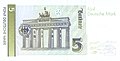 | DM 5 | €2.56 | 122 × 62 | Green | Bettina von Arnim; Berlin | Brandenburg Gate | 1991 | 27/10/1992 | |
 |  | DM 10 | €5.11 | 130 × 65 | Purple | Carl Friedrich Gauss; Göttingen | Sextant | 1989–1999 | 16/4/1991 | |
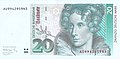 |  | DM 20 | €10.23 | 138 × 68 | Aqua | Annette von Droste- Hülshoff; Meersburg | Quill; European beech | 1991–1993 | 20/3/1992 | |
 |  | DM 50 | €25.56 | 146 × 71 | Olive | Balthasar Neumann; Würzburg | Würzburg Residence | 1989 | 30/9/1991 | |
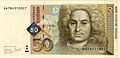 | 1996 | 2/2/1998 | ||||||||
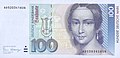 |  | DM 100 | €51.13 | 154 × 74 | Blue | Clara Schumann; Leipzig | Grand piano | 1989–1993 | 1/10/1990 | |
| 1996 | 1/8/1997 | |||||||||
 |  | DM 200 | €102.26 | 162 × 77 | Orange | Paul Ehrlich; Frankfurt am Main | Microscope | 1989 | 1/10/1990 | |
| 1996 | 1/8/1997 | |||||||||
 |  | DM 500 | €255.65 | 170 × 80 | Red | Maria Sibylla Merian; Nuremberg | Dandelion, inchworm, butterfly | 1991–1993 | 27/10/1992 | |
| DM 1000 | €511.29 | 178 × 83 | Brown | Wilhelm and Jacob Grimm; Kassel | Deutsches Wörterbuch; Alte Bibliothek | |||||
| For table standards, see the banknote specification table. | ||||||||||
Spelling and pronunciation
The German name for the money was Deutsche Mark, and it was said as "DOY-chuh mark". In English, people often called it "Deutschmark". One Deutsche Mark was split into 100 smaller parts called pfennigs.
People in Germany sometimes shortened the name to D-Mark or just Mark. Even when talking about more than one, they still used the word "Mark" without changing it, like saying "one Mark" or "thirty Mark". The small part, pfennig, could also have a plural form called "pfennige", but it was okay to just use "pfennig" too, like "one pfennig" or "thirty pfennig".
Reserve currency
Main article: Reserve currency
Before changing to the euro, the Deutsche Mark was the most important international money after the United States dollar.
The following shows how much of each currency was used around the world from 1995 to 2025.
Images
Related articles


This article is a child-friendly adaptation of the Wikipedia article on Deutsche Mark, available under CC BY-SA 4.0.
Images from Wikimedia Commons. Tap any image to view credits and license.