Dew point
This article is about the meteorological dew point. For the petroleum term, see Hydrocarbon dew point.
The dew point is the temperature that air must be cooled to, while its amount of water and its pressure stay the same, for the relative humidity to rise to 100%. This temperature depends on the pressure and the amount of water in the air. When air warmer than its dew point is cooled, it can hold less moisture. If the temperature drops below the dew point, water vapor condenses, or changes into liquid water. When this happens because the air touches a colder surface, the water that forms on that surface is called dew.
The dew point is affected by how much moisture the air holds. The more moisture the air contains, the higher its dew point.
When the temperature is below the freezing point of water, the dew point is called the frost point, because frost forms through deposition rather than condensation. For liquids, the similar idea to the dew point is the cloud point.
Humidity
The dew point is an important measure of humidity. When the dew point reaches 20 °C (68 °F), almost everyone feels "sticky," and it is the best predictor of energy use for cooling in the summer. If other factors stay the same, the relative humidity at ground level rises as the temperature falls, because the air can hold less water vapor. In technical terms, the dew point is the temperature at which water vapor in air at constant barometric pressure turns into liquid water. The liquid is called dew when it forms on a solid surface, or frost if it freezes. In the air, it is called fog or a cloud. If no dew or fog forms even though the temperature is below the dew point, the vapor is called supersaturated, which can happen when there are not enough particles in the air to act as condensation nuclei.
The dew point depends on how much water vapor the air holds. Dry air has a low dew point, so surfaces must be much cooler than the air before water condenses on them. Humid air has a high dew point, so water can condense on surfaces only a few degrees cooler. A high relative humidity means the dew point is close to the air temperature, and 100% means they are equal. Pilots in General aviation use dew point data to judge the risk of carburetor icing and fog, and to estimate the height of a cumuliform cloud base. Higher air pressure raises the dew point, and because Denver sits at a higher elevation than New York City, it has lower air pressure. So if both cities have the same dew point and temperature, Denver has more water vapor in its air.
Relationship to human comfort
When it is hot, the body cools itself as sweat evaporates. The thermoregulation system keeps making sweat to hold body temperature steady, but sweat evaporates slowly in air that already holds a lot of moisture. On humid days, a person can become coated with sweat even without exercising. A breeze or fan moves air away from the body, helping sweat evaporate faster and making a person more comfortable. A wet bulb thermometer also uses evaporative cooling, so it is a useful tool for judging comfort.
Very dry air, with a dew point below about −5 °C (23 °F), can make skin crack and become irritated, and it can dry out the airways. The US Occupational Safety and Health Administration recommends indoor air at 20–24.5 °C (68–76 °F) with 20–60% relative humidity. People in tropical and subtropical climates get used to higher dew points, so someone in Singapore or Miami may tolerate more humidity than someone in a cooler place like London or Chicago, or a desert like Riyadh, where dew points are often low. Comfort also depends on psychological factors, not only on the weather.
Altitude and clouds
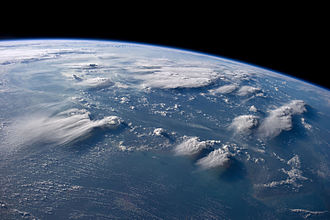
As a rising air mass moves higher into the atmosphere, the air pressure around it drops, and the air will cool. Its temperature moves closer to the dew point. Even though the amount of water vapor stays the same, the relative humidity goes up as the pressure drops. Because of this, the dew point temperature falls by 0.2 °C for every 100 m, or 4.5 °F for every 1000 ft, of height. At the height where the dew point is reached, water vapor begins to condense and form clouds, or fog when this happens near the ground. Cumulus clouds often have flat bottoms, which mark the height where the temperature reaches the dew point. As the water vapor turns into water droplets, it releases energy that warms the air around it.
Measurement
Measurement is done with special devices called "dew point meters." These devices have a polished metal mirror that is cooled as air passes over it. The dew point is found when the mirror's reflection becomes cloudy and loses its clearness. Manual devices like this can be used to check other types of humidity sensors. Automatic sensors can work with a humidifier or dehumidifier to control the dew point of the air in a building or a smaller space, such as one used for a manufacturing process.
| Dew point | Relative humidity at 32 °C (90 °F) | |
|---|---|---|
| Over 27 °C | Over 80 °F | 73% and higher |
| 24–26 °C | 75–79 °F | 62–72% |
| 21–24 °C | 70–74 °F | 52–61% |
| 18–21 °C | 65–69 °F | 44–51% |
| 16–18 °C | 60–64 °F | 37–43% |
| 13–16 °C | 55–59 °F | 31–36% |
| 10–12 °C | 50–54 °F | 26–30% |
| Under 10 °C | Under 50 °F | 25% and lower |
Calculating the dew point
See also: Psychrometric chart
Scientists can estimate the dew point using the air temperature in degrees Celsius, degrees Celsius, and the relative humidity. One common way to do this is the Magnus formula. A more complete method uses saturated water vapor pressure, measured in millibars, and the wet-bulb temperature. Some scientists use the Arden Buck equation to get more accurate results. The NOAA presentation uses constants from a 1980 paper, and these methods are all calculations, not just simple checks.
There is also a simple rule of thumb. When the dew point is the same as the air temperature, the relative humidity is 100%. For every 1 °C that the dew point is lower than the air temperature, the relative humidity drops by about 5%. This rule is accurate to within about 1 °C when the relative humidity is above 50%. More details can be found in an article in the Bulletin of the American Meteorological Society.
Frost point
The frost point is similar to the dew point. It is the temperature that a parcel of humid air must be cooled to, at constant atmospheric pressure, for water vapor to form directly as ice crystals on a surface, without first becoming liquid. This process is like sublimation in reverse, and it is called being deposited.
The frost point of a parcel of air is always higher than its dew point. This is because the bonds between water molecules on the surface of ice are stronger than those on the surface of supercooled liquid water, so breaking them takes a higher temperature.
History
In Ancient Greece, Aristotle thought that dew fell from the sky. During the Renaissance, Ferdinando II de' Medici built a hygrometer to track the temperature and wind conditions that lead to water forming. In the 1700s, Charles Le Roy tried to find the dew point by pouring cold water into a glass container.
William Charles Wells wrote the first modern theory of dew, which he shared in his 1818 Essay on Dew. In 1887, meteorologist John Aitken showed that dew comes from the ground or from plants, and does not fall from the air. The highest dew point ever recorded on Earth was 35 °C (95 °F), when the temperature was 42 °C (108 °F). This was measured at Dhahran, Saudi Arabia, at 3:00 p.m. on 8 July 2003.

Quiz time!
5 questions about Dew point
What is the dew point?
Keep exploring





This article is a child-friendly adaptation of the Wikipedia article on Dew point, available under CC BY-SA 4.0.
Images from Wikimedia Commons. Tap any image to view credits and license.