 Safekipedia
European Southern Observatory
Adapted from Wikipedia · Discoverer experience
The European Southern Observatory (ESO) is an intergovernmental research organisation made up of 16 member states for ground-based astronomy. Created in 1962, ESO has provided astronomers with some of the best tools to study the night sky. The organisation has over 750 staff members and gets money each year from its member states.
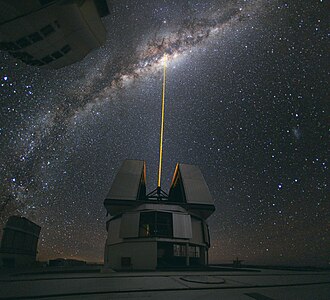
ESO has built and run some of the biggest and most advanced telescopes in the world. These include the 3.6 m New Technology Telescope, the Very Large Telescope (VLT), and the Atacama Large Millimeter Array. These telescopes help scientists see faraway stars, galaxies, and other objects in space very clearly.
One of ESO's newest projects is the Extremely Large Telescope, which is still being built. When it is finished, it will be the world's largest optical reflecting telescope. This huge telescope will help scientists study planets around other stars, the very first objects in the universe, and mysterious things like supermassive black holes, dark matter, and dark energy.
ESO's telescopes have helped make many important discoveries. For example, they found the most distant gamma-ray burst and evidence for a black hole at the centre of our Milky Way. In 2004, the VLT helped scientists take the first picture of an extrasolar planet orbiting a star 173 light-years away. Another instrument called the High Accuracy Radial Velocity Planet Searcher (HARPS) helped find many planets outside our Solar System.
Past
The European Southern Observatory (ESO) began as an idea in 1953 when astronomers Walter Baade and Jan Oort suggested creating a large shared observatory. This idea grew, and in 1954, astronomers from six European countries signed a declaration supporting a joint observatory in the southern hemisphere.
At that time, all large telescopes were in the northern hemisphere, but some important parts of the sky, like the center of the Milky Way and the Magellanic Clouds, could only be seen from the south. Originally, South Africa was considered, but tests showed that a site in the Andes mountains of Chile was better. ESO signed its official agreement in 1962, and Chile was chosen as the location for the observatory in 1963.
The first ESO telescope in Chile began working in 1966. Over the years, ESO grew and moved its headquarters to Garching, Germany. In 2015, an ESO astronomer confirmed a planet orbiting the star Proxima Centauri.
| Director General | In office |
|---|---|
| Otto Heckmann | 1962–1969 |
| Adriaan Blaauw | 1970–1974 |
| Lodewijk Woltjer | 1975–1987 |
| Harry van der Laan | 1988–1992 |
| Riccardo Giacconi | 1993–1999 |
| Catherine Cesarsky | 1999–2007 |
| Tim de Zeeuw | 2007–2017 |
| Xavier Barcons | 2017–present |
| Source: www.eso.org, about ESO | |
| Country | Accession |
|---|---|
 Belgium Belgium | 1962 |
 Germany Germany | 1962 |
 France France | 1962 |
 Netherlands Netherlands | 1964 |
 Sweden Sweden | 1964 |
 Denmark Denmark | 1967 |
 Switzerland Switzerland | 1982 |
 Italy Italy | 1982 |
 Portugal Portugal | 1 January 2001 |
 United Kingdom United Kingdom | 8 July 2002 |
 Finland Finland | 1 July 2004 |
 Spain Spain | 1 July 2006 |
 Czech Republic Czech Republic | 1 January 2007 |
 Austria Austria | 1 July 2008 |
 Poland Poland | 28 October 2014 |
 Ireland Ireland | 28 September 2018 |
Chilean observation sites
Although ESO is headquartered in Germany, its telescopes and observatories are in northern Chile, where the organisation operates advanced ground-based astronomical facilities:
- La Silla, which hosts the New Technology Telescope (NTT)
- Paranal, where the Very Large Telescope (VLT) is located
- Llano de Chajnantor, where ALMA, the Atacama Large Millimeter/submillimeter Array, is located
These are among the best locations for astronomical observations in the southern hemisphere. An ESO project is the Extremely Large Telescope (ELT), a 40-metre-class telescope. The ELT will be the largest visible and near-infrared telescope in the world.
Each year about 2,000 requests are made for the use of ESO telescopes. Observations made with these instruments appear in many scientific publications annually.
La Silla
La Silla, located in the southern Atacama Desert 600 kilometres north of Santiago de Chile at an altitude of 2,400 metres, is the home of ESO's original observation site. La Silla is far from sources of light pollution and has one of the darkest night skies on Earth. In La Silla, ESO operates three telescopes: a 3.6-metre telescope, the New Technology Telescope (NTT) and the 2.2-metre Max-Planck-ESO Telescope.
The observatory hosts visitor instruments and also hosts national telescopes, such as the 1.2-metre Swiss and the 1.5-metre Danish telescopes.
Paranal
The Paranal Observatory is located atop Cerro Paranal in the Atacama Desert in northern Chile. Cerro Paranal is a 2,635-metre-high mountain about 120 kilometres south of Antofagasta and 12 kilometres from the Pacific coast.
The observatory has several major telescopes operating in visible and infrared light: the four 8.2-metre telescopes of the Very Large Telescope, the 2.6-metre VLT Survey Telescope (VST) and the 4.1-metre Visible and Infrared Survey Telescope for Astronomy.
Llano de Chajnantor
The Llano de Chajnantor is a 5,100-metre-high plateau in the Atacama Desert, about 50 kilometres east of San Pedro de Atacama. The site is dry and inhospitable to humans, but a good site for submillimetre astronomy.
The telescopes here include the Atacama Pathfinder Experiment, and the Atacama Large Millimeter Array (ALMA). ALMA is a telescope designed for millimetre and submillimetre astronomy. This type of astronomy reveals a universe which cannot be seen in visible or infrared light and is ideal for studying cold clouds in space where new stars are born.
| Name | Short | Size | Type | Location | Year |
|---|---|---|---|---|---|
| ESO 3.6 m telescope – hosting HARPS | ESO 3.6m | 3.57 m | optical and infrared | La Silla | 1977 |
| MPG/ESO 2.2 m telescope | MPG | 2.20 m | optical and infrared | La Silla | 1984 |
| New Technology Telescope | NTT | 3.58 m | optical and infrared | La Silla | 1989 |
| Very Large Telescope | VLT | 4 × 8.2 m 4 × 1.8 m | optical to mid-infrared, array | Paranal | 1998 |
| Visible and Infrared Survey Telescope for Astronomy | VISTA | 4.1 m | near-infrared, survey | Paranal | 2009 |
| VLT Survey Telescope | VST | 2.6 m | optical, survey | Paranal | 2011 |
| Atacama Large Millimeter/submillimeter Array[A] | ALMA | 50 × 12 m 12 × 7 m 4 × 12 m | millimetre-/submillimetre-wavelength interferometer array | Chajnantor | 2011 |
| Extremely Large Telescope | ELT | 39.3 m | optical to mid-infrared | Cerro Armazones | End of this decade |
| A ALMA is a partnership among Europe, the United States, Canada, East Asia and the Republic of Chile. · Additional ESO research facilities are located in Santiago, Chile and include a library, computing resources and programmes for visiting scientists. · ESO also maintains close ties with other observatories and universities throughout the country. · Source: ESO – Telescopes and Instrumentation | |||||
Outreach
The European Southern Observatory (ESO) has a special team called the education and Public Outreach Department (ePOD) that helps share astronomy with everyone.
ePOD also takes care of the ESO Supernova Planetarium & Visitor Centre, a fun place to learn about space. It is located at the ESO Headquarters in Garching bei München and opened on April 26, 2018.
Video gallery
Here are some videos about the European Southern Observatory (ESO):
- ESO’s 50th-anniversary event (Munich Residenz in Germany, 11 October 2012)
- ESO’s first 50 years of exploring the southern sky
- José Manuel Barroso visits the ESO in January 2013
- Tim de Zeeuw talks on ESO and its 50th anniversary
- The temporary office buildings at the ESO headquarters in Garching being dismantled
- Timelapses of ESO’s VLT, ALMA and La Silla site
Images
Related articles



This article is a child-friendly adaptation of the Wikipedia article on European Southern Observatory, available under CC BY-SA 4.0.
Images from Wikimedia Commons. Tap any image to view credits and license.