 Safekipedia
Dark energy
Adapted from Wikipedia · Discoverer experience
In physical cosmology and astronomy, dark energy is a mysterious form of energy that influences the universe on its largest scales. Its most important effect is to cause the accelerating expansion of the universe. This means that instead of slowing down, the universe is growing faster over time. Dark energy also makes it harder for stars and galaxies to clump together into larger structures.
According to the lambda-CDM model, which is the most widely accepted description of our universe, dark energy makes up about 68% of all the mass and energy in the universe today. This is much more than dark matter, which accounts for 27%, and ordinary matter, which makes up only 5%. Even though dark energy is so important, it is very faint. Its density is about 7×10⁻³⁰ g/cm3, which is much lower than the density of ordinary matter in galaxies.
The idea of dark energy began with observations of Type Ia supernovae. These supernovae have a consistent brightness, so they can be used like cosmic rulers to measure distances. By comparing these distances with how fast the supernovae are moving away (measured by their redshift), scientists found that the universe's expansion is actually speeding up. Before this discovery, many scientists believed the pull of gravity would slow the universe's expansion. Since then, many other observations have supported the existence of dark energy, but exactly what it is remains one of the biggest mysteries in science.
History of discovery and previous speculation
The "cosmological constant" is a simple idea for what dark energy might be. It is a term that can be added to the equations that describe how the universe works. Einstein first thought of this idea to make the universe stay still, but later discovered the universe was actually growing.
Later, scientists like Alan Guth and Alexei Starobinsky suggested that a force similar to dark energy might have caused the universe to expand very quickly right after it began. In the 1990s, observations showed that the universe’s expansion is actually speeding up, giving strong support to the idea of dark energy.
Nature
The nature of dark energy is still a mystery. It is thought to be very smooth and does not interact with anything except gravity. Even though it is very thin — about 10−27 kg/m3 — it fills all of space and makes up most of the universe.
One idea is that dark energy comes from the energy of empty space itself. This energy should create a pulling force, which can push the universe to expand faster. However, there is a big puzzle: theories predict this energy should be much stronger than what we actually see. Dark energy must have a special kind of pressure to explain why the universe is spreading out at an accelerating pace. This special pressure works like a kind of "gravitational repulsion" that helps push everything apart.
See also: Friedmann equations
Evidence of existence
The evidence for dark energy comes from three main sources. First, measurements of how far away objects are in space, linked to how their light has stretched to redder colors, suggest the universe has expanded more in recent times than in the past. Second, theories suggest we need a special kind of energy, not made of matter, to explain why the universe looks flat. Third, studies of large waves in the amount of matter across the universe also support this idea.
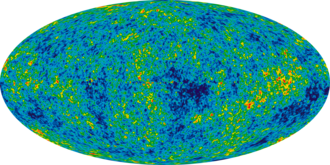
In 1998, observations of certain exploding stars called Type Ia supernovae showed that the expansion of the universe is speeding up. This important discovery was recognized with a Nobel Prize in 2011. Since then, many other observations, like studies of the oldest light in the universe and the way galaxies are arranged, have agreed with the idea that dark energy makes up about two-thirds of the universe. These observations help scientists understand how the universe has changed over time and how dark energy influences its expansion.
Theories of dark energy
Dark energy is a mysterious force that scientists are still trying to understand. One simple idea is that dark energy is a special energy that exists in empty space, called the cosmological constant. This energy would affect the way gravity works, causing the universe to expand faster over time.
Another idea is called quintessence, where a special kind of energy field causes the expansion. This field can change over time and space, unlike the cosmological constant. Scientists are still looking for evidence to support these ideas, and there are many theories about how dark energy might behave and interact with other parts of the universe.
Main article: Cosmological constant
Further information: Equation of state (cosmology)
Main article: Quintessence (physics)
Alternatives to dark energy
Some scientists think that dark energy might not exist, and that what we see could be explained by changes to our understanding of gravity or the universe. For example, theories that change Einstein’s idea of general relativity suggest we might not need dark energy at all. However, most experts still believe dark energy is real and that these ideas don’t match observations as well.
Other ideas suggest that our place in the universe might make it seem like things are expanding faster than they really are. For example, if we are in a emptier area of space, it might look like the universe is expanding quickly. There are also ideas that black holes might act in ways that look like dark energy. However, these ideas are still being studied and most scientists think more work is needed before they can replace the idea of dark energy.
Implications for the fate of the universe
Cosmologists believe that the expansion of the universe began to speed up about 5 billion years ago. Before this, the universe was slowing down because of the pull of matter. Dark energy, which we don’t fully understand, eventually became more powerful than dark matter. This means that as space grows, dark matter spreads out and weakens, but dark energy stays strong.
Scientists have different ideas about what might happen in the far future. If dark energy stays constant, galaxies far from us will move away so fast that their light will never reach us. Only galaxies in our local group, including the Milky Way, will stay together. Over time, everything else will disappear from our view. Some other theories suggest dark energy could grow even stronger, tearing apart galaxies and even atoms, or that the universe might eventually stop expanding and collapse back in on itself.
In philosophy of science
Some scientists think that dark energy is a guess added to explain things we see in space. They say it doesn’t really tell us anything new and can’t be proven wrong, according to the ideas of a scientist named Karl Popper. But not all scientists agree with this view.
Images
Related articles



This article is a child-friendly adaptation of the Wikipedia article on Dark energy, available under CC BY-SA 4.0.
Images from Wikimedia Commons. Tap any image to view credits and license.