Greco-Bactrian Kingdom
The Greco-Bactrian Kingdom was a Greek kingdom in Central Asia and Afghanistan during the Hellenistic period. It was officially called the Kingdom of Bactria. The Seleucid governor Diodotus I Soter founded it in about 256 BC. Under the Euthydemid and Eucratid dynasties, it remained a powerful force in Central Asia until it fell around 120 BC. At its height, the kingdom included present-day Afghanistan, Tajikistan, Uzbekistan and Turkmenistan. For a short time, it also held small parts of Kazakhstan, Pakistan and Iran. Its military campaigns and settlements may have reached the borders of the Qin State in China by about 230 BC.
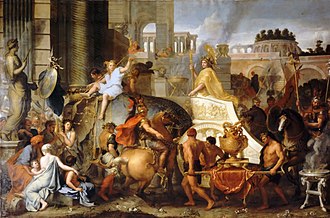
A Greek population was already living in Bactria by the 5th century BC. Alexander the Great conquered the region by 327 BC. He founded many cities, most of them named Alexandria, and settled Macedonians and other Greeks there. After Alexander died, control of Bactria passed to his general Seleucus I Nicator. The region's fertile land and prosperity led to the creation of the Greco-Bactrian kingdom under Diodotus by the early 3rd century BC. It became a successor state of the Seleucid Empire. The Bactrian Greeks grew stronger and invaded north-western India between 190 and 180 BC under king Demetrius, the son of Euthydemus. This invasion led to the creation of the Indo-Greek Kingdom, which was a successor to the Greco-Bactrian kingdom. It was later ruled by the kings Pantaleon and Apollodotus I.
Historical records show that many rich and prosperous cities existed in the kingdom, but only a few have been excavated, such as Ai-Khanoum and Bactra. Ai-Khanoum, in north-eastern Afghanistan, had all the features of a true Hellenistic city, including a Greek theater, a gymnasium and some houses with colonnaded courtyards. The kingdom reached its peak under Eucratides the Great, who seems to have seized power through a coup around 171 BC and started his own dynasty. Eucratides also invaded India and successfully fought against the Indo-Greek kings. However, the kingdom soon began to decline. The Parthians and nomadic tribes such as the Sakas and Yuezhi became a major threat. Eucratides was killed by his own son in about 145 BC, which may have further weakened the kingdom. Heliocles was the last Greek king to rule in Bactria.
Even after the Greco-Bactrian kingdom fell, its rich Hellenistic legacy lasted for many more centuries. The Yuezhi invaders settled in Bactria and became Hellenized. They later founded the Kushan Empire around 30 AD. They adopted the Greek alphabet to write their language and added Greek deities to their pantheon. The Greco-Bactrian city of Ai-Khanoum was at the doorstep of India and was known for its sophistication and Hellenistic features. Greek art spread through the Indo-Greeks, influencing Indian art, religion and culture. This led to a new style of syncretic art called Greco-Buddhist art.
History
The Oxus Valley was first settled by nomadic Zoroastrian tribes, which classical Greek writers called Scythian, and Zoroastrian writings link the region with the Turanian people. Greek settlers came to Bactria under Darius I, when many people from Barca in Cyrenaica were moved there, and more Greeks arrived under Xerxes I, including descendants of priests from near Didyma in western Asia Minor. Greek communities were already common when Alexander the Great conquered the region. He chased the Persian satrap Bessus, founded cities such as Maracanda, and settled Greek soldiers along the Jaxartes, Alexander's rule was short, and the Greek colonists later tried to return home before a rebellion faded. Around 250 BC, Diodotus, a satrap of Bactria, broke away from the Seleucid Empire and became Basileus, or king Diodotus I. Historians still debate the exact date, and some link it to the Third Syrian War. The historian Justin called the new kingdom the prosperous realm of "the thousand cities," and it grew east and west, with cities such as Bactra, Eucratidia, and Ariana included in its lands. After the Ptolemaic empire captured Antioch in 247 BC, Andragoras declared himself king in Parthia, but he was defeated and killed by Arsaces, which led to the rise of the Parthian Empire. Bactria was cut off from the Greek world, though sea trade with Greek Egypt grew. Diodotus was followed by his son Diodotus II, who allied with Arsaces against Seleucus II.
Euthydemus, an Ionian Greek from Magnesia according to Polybius, and possibly satrap of Sogdiana, overthrew Diodotus II around 230–220 BC and started his own dynasty. His lands reached beyond Alexandria Eschate in Ferghana. Around 210 BC the Seleucid ruler Antiochus III attacked him. Euthydemus lost a battle on the Arius but then resisted a three-year siege in Bactra, and Antiochus eventually accepted him as ruler. A later inscription from Kulob in Tajikistan, dedicated to Hestia, praised Euthydemus and his son Demetrius, and it calls Demetrius "Demetrius the Glorious Conqueror." Around 180 BC, Demetrius I, a son of Euthydemus, invaded the Indian subcontinent, a few years after the Mauryan Empire had been overthrown by the Shunga dynasty. Historians disagree on his motives, and some argue that accounts of Shungas persecuting Buddhists were exaggerated (Thapar, Lamotte). His campaigns reached toward Pataliputra, today's Patna, though many of them are credited to Menander. The invasion created the Indo-Greek Kingdom in northwestern India, which lasted almost two centuries, and Buddhism flourished there. Greek and Buddhist art also mixed, in what is known as Greco-Buddhism in Gandhara. Back in Bactria, Eucratides I, either a general of Demetrius or an ally of the Seleucids, overthrew the Euthydemids around 170 BC and started the Eucratid dynasty, probably removing Antimachus I and Antimachus II. Demetrius's Indian branch, likely Demetrius II, tried to win back the throne but was defeated. Eucratides campaigned widely in northwestern India, possibly as far as the Jhelum River in Punjab, but he was pushed back by Menander I. According to Justin, Eucratides was killed by his son, who was either Eucratides II or Heliocles I. Later, the Parthian king Mithridates I defeated Eucratides and took the lands of Tapuria and Traxiane. In 141 BC the Greco-Bactrians joined Demetrius II against Parthia, but Demetrius was captured. The historian Orosius reports that Mithridates later took land between the Indus and the Hydaspes, and Heliocles I ruled what remained. Nomadic invasions then weakened Bactria. The Yuezhi were pushed out of the Hexi Corridor on the edge of the Han Empire by the Xiongnu, then moved west to the Ili River valley and were driven out again by the Wusun. They moved south toward the Oxus and expelled the Sakastan people. Around 140 BC, Scythian Saka tribes also invaded Parthia, where they killed Phraates II, and in 123 BC they killed Artabanus I. The Han Chinese diplomat Zhang Qian visited around 126 BC and described Bactria, called Daxia, as weak and divided. This account was recorded in Records of the Great Historian by Sima Qian, with a translation by Burton Watson. The Yuezhi moved into Bactria around 120 BC, and the Saka tribes continued into India, where they became known as Indo-Scythians. Heliocles then moved his capital to the Kabul valley and is considered the last Greco-Bactrian king, though his descendants formed the western Indo-Greek kingdom, whose last king, Hermaeus, ruled until around 70 BC in the Paropamisadae. The Yuezhi stayed in Bactria for more than a century, adopting some Greek culture, and around 12 BC they moved into northern India and founded the Kushan Empire.
Army
Before the Greek conquest, Bactria's armies were mostly cavalry, or soldiers on horseback, and they were well known as effective fighters. Many served in the Achaemenid cavalry. 2,000 Bactrian horsemen fought at the Granicus against Alexander, and 9,000 fought at the Battle of Gaugamela on the left side of Darius' army. Herodotus also mentions that Bactrians used chariots widely. After Alexander conquered Bactria, Bactrian cavalry served in his army during the invasion of India, and he added Bactrians, Sogdians and other east Iranian cavalrymen to his elite companion cavalry. Aeschylus and Curtius both mention that Bactria could field 30,000 horsemen. Most were lightly armed with bows and javelins, then fought with swords and spears. Herodotus describes the Persian cavalry at the Battle of Plataea, which included Bactrians, as horse archers. Bactrian foot soldiers wore caps in the Median style and carried short spears and reed bows in the Scythian style.
Seleucus I and Alexander both settled Macedonians and other Greeks in Bactria. Greek garrisons were housed in fortresses and major cities, while military colonists received land in the countryside and were trained in the style of the Macedonian army. The Greco-Bactrian army was made up of many peoples. Greek colonists formed the heavy infantry, supported by local Bactrian light infantry and mercenary javelin-throwers called Thureophoroi. The cavalry was very large for a Hellenistic army and was made up mostly of Bactrian, Sogdian and other Indo-Iranian light horsemen. Polybius mentions 10,000 horsemen at the Battle of the Arius river in 208 BC. The army also included heavily armored cataphracts and small elite units of companion cavalry. Indian war elephants, some carrying a howdah with archers and javelin throwers, grew in number as the kingdom expanded into India. Other soldiers came from peoples such as the Scythians, Dahae, Indians, and Parthians.
Culture and legacy
Main article: Takht-i Sangin
Main article: Hellenistic influence on Indian art
Greeks had lived in the region long before Alexander the Great conquered it, because the Persian Empire had sent rebelling Greek communities there. The Greco-Bactrians were known for their advanced Hellenistic culture and kept contact with the Mediterranean and neighbouring India. Their city of Ai-Khanoum in northeastern Afghanistan had a Greek theater, a gymnasium, and Greek-style houses. The city was burnt to the ground around 145 BC during nomadic invasions and never re-settled, so it gives a clear picture of Greco-Bactrian life at that time. Their coins are also considered some of the finest examples of Greek art. The largest gold coin was minted by Eucratides, and the largest silver coin by the Indo-Greek king Amyntas Nicator. The kings often showed their own individuality on their coins, and some were even shown aging.
The Greco-Bactrians also had contact with other lands. Their explorers may have reached Kashgar and Ürümqi in Xinjiang, leading to some of the first known contacts between China and the West. The Chinese explorer Zhang Qian visited Bactria around 126 BC and reported Chinese products in its markets. Contacts with India were also strong. The Buddhist king Ashoka sent Buddhist emissaries to the Greek lands, and some of his emissaries were Greek Buddhist monks. Ai-Khanoum may have helped bring Western artistic styles to India. The Greco-Bactrians and their successors, the Indo-Greeks, also left a lasting legacy. The Greek language and writing were so important in Bactria that the Bactrian language was written in the Greek script until the 9th century AD. The most famous example of their influence is the Greco-Buddhist art of Gandhara.
List of Greco-Bactrian kings
The table below lists the known Greek rulers of Bactria, along with their dates and titles or nicknames.
Dates that overlap show that several kings ruled at the same time, but in different regions whose details are not known very well. For example, Apollodotus I likely ruled areas south of Bactria and the Indian subcontinent, while Antimachus I ruled in Bactria. Eucratides II and Heliocles I would each have ruled smaller parts of southern Bactria.
| Reign (approx.) | King | Title |
|---|---|---|
| 255–239 BC | Diodotus I | Soter |
| 239–223 BC | Diodotus II | Theos |
| 230–200 BC | Euthydemus I | Theos |
| 200–180 BC | Demetrius I | Anicetus |
| 200–180 BC | Pantaleon | Soter |
| 190–180 BC | Agathocles | Dikaios |
| 185–180 BC | Euthydemus II | — |
| 180–170 BC | Antimachus I | Theos |
| 180–160 BC | Apollodotus I | Soter |
| 175–160 BC | Demetrius II | — |
| 171–145 BC | Eucratides I | Megas |
| 145–140 BC | Plato | Epiphanes |
| 145–140 BC | Eucratides II | Soter |
| 140–130 BC | Heliocles I | Dikaios |

Quiz time!
5 questions about Greco-Bactrian Kingdom
What was the Greco-Bactrian Kingdom officially called?
Pictures
Keep exploring



This article is a child-friendly adaptation of the Wikipedia article on Greco-Bactrian Kingdom, available under CC BY-SA 4.0.
Images from Wikimedia Commons. Tap any image to view credits and license.