Internet
The Internet (or internet) is a global system of connected computer networks that uses the Internet protocol suite (TCP/IP) to let networks and devices communicate. It is a network of networks made up of private, public, academic, business, and government networks, ranging from local to global in scope. These networks are linked by electronic, wireless, and optical networking technologies. The Internet carries a huge range of information services and resources, such as the linked hypertext documents and applications of the World Wide Web (WWW), electronic mail, discussion groups, internet telephony, streaming media, and file sharing.
The Internet has changed many older ways of communicating. Traditional communication media, including telephone, radio, television, paper mail, newspapers, and print publishing, have all been transformed by it. This has given rise to new media such as email, online music, digital newspapers, news aggregators, and audio and video streaming websites. The Internet has also enabled and sped up new ways for people to interact through instant messaging, Internet forums, and social networking services. Online shopping has grown to occupy a significant market across many industries, helping firms extend brick and mortar presences to reach larger markets. Business-to-business and financial services on the Internet affect supply chains across entire industries.
The origins of the Internet go back to research that made it possible to time-sharing computer resources, the development of packet switching, and the design of computer networks for data communication. The set of communication protocols that allowed internetworking on the Internet came from research and development commissioned in the 1970s by the Defense Advanced Research Projects Agency (DARPA) of the United States Department of Defense. This work was done in collaboration with universities and researchers across the United States, the United Kingdom, and France.
The Internet has no single central authority over its technology or its rules for access and use. Each network sets its own policies. The basic rules for the two main name spaces on the Internet, the Internet Protocol address (IP address) space and the Domain Name System (DNS), are overseen by the Internet Corporation for Assigned Names and Numbers (ICANN). The technical foundations and standardization of the core protocols are handled by the non-profit Internet Engineering Task Force (IETF). For other uses of the word, see Internet (disambiguation).
Terminology
The word internetted was used as early as 1849, meaning interconnected or interwoven. The word Internet was used in 1945 by the United States War Department in a radio operator's manual, and in 1974 as the short form of Internetwork. Today, the term Internet most commonly refers to the global system of interconnected computer networks, though it may also refer to any group of smaller networks.
The word Internet may be capitalized as a proper noun, although this is becoming less common. Many publications, including the AP Stylebook since 2016, recommend the lowercase form in every case. In 2016, the Oxford English Dictionary found that "Internet" was capitalized in 54% of cases. The terms Internet and World Wide Web are often used to mean the same thing, and people often say "going on the Internet" when using a web browser to view web pages. However, the World Wide Web, or the Web, is only one of many Internet services. It is the global collection of web pages, documents and other web resources linked by hyperlinks and URLs.
History
Main articles: History of the Internet, History of the World Wide Web, and Protocol Wars
In the 1960s, computer scientists began developing ways to share computer resources. J. C. R. Licklider proposed the idea of a universal network while working with the Advanced Research Projects Agency of the United States Department of Defense. Ideas for packet switching, a basic Internet technology, came from Paul Baran and Donald Davies. The ARPANET began in 1969 with two connected sites, at University of California, Los Angeles and the Stanford Research Institute. By the end of 1971, 15 sites were connected. In 1982, the Internet Protocol Suite (TCP/IP) was standardized, which helped networks around the world connect. The ARPANET was decommissioned in 1990.
The linking of commercial networks in the early 1990s, along with the arrival of the World Wide Web, marked the start of the modern Internet. In 1990, Tim Berners-Lee built the tools needed for a working Web, including the first web browser. By 1995, the Internet was fully commercial in the United States. Since then, the Internet has greatly changed culture and business, bringing email, instant messaging, and video calls. In October 2016, internet use on mobile and tablet devices passed desktop use worldwide for the first time, as smartphones made going online easier.
Social impact
The Internet has made new ways of socializing and spending time together possible, and it has given rise to the study of the sociology of the Internet.
See also: Global Internet usage, English in computing, and Languages used on the Internet
Between 2000 and 2009, the number of Internet users around the world grew from 390 million to 1.9 billion. By 2025, about 6 billion people, or 74% of the world's population, used the Internet. Most users now live in Asia, and people use the Internet for many things, including watching videos on YouTube, reading blogs, and searching the web. Early computers could only show a limited set of letters, but modern systems like Unicode let people use the world's widely used languages online. Online life has also brought dangers. Children can face cyberbullying and adults who want to hurt children, who sometimes pretend to be children themselves. Many parents use Internet filtering to help protect their children.
The Internet is used for learning, through virtual universities and distance education, and for entertainment, such as multiplayer gaming and streaming media. It is also used for remote work, e-commerce, and online advertising. In politics, the Internet has become a new tool for organizing, and social media helped people organize during the Arab Spring. However, Internet censorship has been recorded in many countries, including western democracies.
Applications and services
Main article: World Wide Web
The Internet carries many applications and services, most prominently the World Wide Web, including social media, electronic mail, mobile applications, multiplayer online games, Internet telephony, file sharing, and streaming media services. The World Wide Web is a global collection of documents, images, multimedia, applications, and other resources, connected by hyperlinks and named with Uniform Resource Identifiers (URIs), which point to web servers, databases, and the resources they provide. The main way to access the Web is HyperText Transfer Protocol (HTTP), which web services also use to share information between software systems. Web browsers such as Microsoft Edge, Mozilla Firefox, Opera, Apple's Safari, and Google Chrome let users move from one page to another using hyperlinks. Pages can contain computer data, including graphics, sounds, text, video, multimedia and interactive content, and client-side scripts can add animations, games, office applications and scientific demonstrations.
Email is an important way to communicate over the Internet, and the idea of sending electronic messages, like mailing letters or memos, came before the Internet itself. Internet telephony is another common service, and the name of the main Internet protocol gave its name to voice over Internet Protocol (VoIP). VoIP systems now dominate many markets, being as easy to use as a traditional telephone while often costing much less, especially over long distances. File sharing means moving large amounts of data as computer files across the Internet, for example through file servers. The load of bulk downloads can be eased by "mirror" servers or peer-to-peer networks. Access to a file can be controlled by authentication, its trip across the Internet can be hidden by encryption, and money may be paid for access. A digital signature can check where a received file came from and whether it is genuine.
Governance
The Internet is a global network made of many networks that connect voluntarily. It has no central governing body. The core rules, IPv4 and IPv6, are developed by the Internet Engineering Task Force (IETF), a non-profit group that anyone can join by sharing technical skills. The IETF holds open work groups, and their results are published as Request for Comments (RFC) documents. The RFCs that describe the main ways the Internet works are called Internet Standards. Other documents are informative, experimental, or historical, or describe best current practices. The Internet Society (ISOC) was founded in 1992 to help the Internet develop openly and be used for the benefit of all people. It gives a home to groups such as the Internet Engineering Task Force (IETF), Internet Architecture Board (IAB), Internet Engineering Steering Group (IESG), Internet Research Task Force (IRTF), and Internet Research Steering Group (IRSG).
The main name spaces of the Internet are run by the Internet Corporation for Assigned Names and Numbers (ICANN), which is guided by an international board of directors. ICANN assigns unique identifiers such as domain names, IP addresses, and application port numbers. The National Telecommunications and Information Administration, an agency of the United States Department of Commerce, had final approval over changes to the DNS root zone until the IANA stewardship transition on 1 October 2016. Five Regional Internet registries (RIRs) were set up to give address blocks to local providers such as Internet service providers: the African Network Information Center (AfriNIC) for Africa, the American Registry for Internet Numbers (ARIN) for North America, the Asia–Pacific Network Information Centre (APNIC) for Asia and the Pacific region, the Latin American and Caribbean Internet Addresses Registry (LACNIC) for Latin America and the Caribbean region, and the Réseaux IP Européens – Network Coordination Centre (RIPE NCC) for Europe, the Middle East, and Central Asia. On 16 November 2005, the United Nations-sponsored World Summit on the Information Society in Tunis set up the Internet Governance Forum (IGF) to talk about Internet issues.
Infrastructure
See also: List of countries by number of Internet users and List of countries by Internet connection speeds
The Internet is built from physical hardware and software layers that control how it works. Like other computer networks, it uses routers, cables and radio links, repeaters, and modems. Many of its parts are not Internet equipment itself. The Internet works as a standard that runs across different kinds of heterogeneous hardware, and internetworking guides data packets to their destinations with IP routers. Internet service providers (ISPs) connect separate networks around the world. At the top are tier 1 networks, large telecommunication companies that exchange traffic directly through very fast fiber-optic cables. Tier 2 and lower-level networks buy Internet transit from other providers to reach parts of the global Internet.
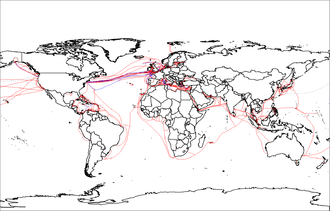
Users get online in many ways, including broadband over coaxial cable, fiber optics or copper wires, Wi-Fi, satellite, and cellular telephone technology, which is part of Internet access. Grassroots efforts have led to wireless community networks, and commercial Wi-Fi covering large areas is available in cities such as New York, London, Vienna, Toronto, San Francisco, Philadelphia, Chicago and Pittsburgh. An ISP may use one upstream provider or multihoming for backup and load sharing, while Internet exchange points are major traffic exchanges connected to many ISPs. Research networks link to large networks such as GEANT, GLORIAD, Internet2, and the UK's national research and education network, JANET. Most servers that provide internet services are now kept in data centers, and content is often reached through content delivery networks. Colocation centers often host private peering connections, meet-me rooms, and landing points for submarine communication cables that connect the Internet.
Internet Protocol Suite
The Internet standards describe a framework called the Internet protocol suite, also known as TCP/IP. It is a set of rules, called protocols, arranged into four layers based on what they do. These were first written down in RFC documents. At the top is the application layer, where programs share information in the form that suits them best. A web browser, for example, uses a client–server model and exchanges data with the HyperText Transfer Protocol (HTTP) and the HyperText Markup Language (HTML). Below it, the transport layer creates a logical channel between applications on different computers. It can deliver information in order and reliably (TCP), or send a datagram service that is not guaranteed (UDP). The Internet layer lets computers find and reach each other, and the link layer connects devices on the same physical connection, using technologies such as Wi-Fi, Ethernet, and DSL.
The most important part of this model is the Internet Protocol (IP), which connects networks and essentially creates the Internet. There are two versions, IPv4 and IPv6. The Internet also depends on business contracts, such as peering agreements, and on technical rules for sending data.
Each computer is given an IP address, which helps the Internet send information to the right place. Addresses are assigned automatically through the Dynamic Host Configuration Protocol or set by hand. Domain Name Systems turn domain names, such as "en.wikipedia.org", into IP addresses. Internet Protocol version 4 (IPv4) uses a 32-bit number for each address. It was designed in 1981, but the rapid growth of the Internet led to IPv4 address exhaustion in 2011, when the global pool of addresses ran out. To solve this, a newer version, IPv6, was developed in the mid-1990s and standardized in 1998. It uses 128 bits for each address. IPv6 deployment has been growing since the mid-2000s, as Internet address registries encouraged rapid adoption. IPv6 is not directly compatible with IPv4, so translation tools exist, and most modern operating systems support both versions.
A subnet is a smaller, logical part of an IP network. Computers in the same subnet share the same most-significant bit group in their addresses. Part of the address identifies the network, and the rest identifies a specific host. Networks can be described using Classless Inter-Domain Routing (CIDR) notation, and an IPv4 or IPv6 address block can be shown this way. For IPv4, a bitmask applied with a bitwise AND operation reveals the network part of an address, and it can be written in dot-decimal notation. Computers and routers use routing tables to forward packets toward other subnetworks. These tables are set by hand or by routing protocols. End computers usually use a default route, while Internet service routers use the Border Gateway Protocol. The default gateway is the node that forwards traffic when no other route matches the destination address.
Security
Criminals and people with harmful goals try to gain unauthorized control of Internet resources, hardware, and software. They may want to cause interruptions, commit fraud, blackmail people, or access private information. Malware is harmful software spread through the Internet. It includes computer viruses, which spread with the help of people, and computer worms, which copy themselves automatically. Other kinds are software for denial of service attacks, ransomware, botnets, and spyware that watches what users do and type. These activities are usually cybercrime. Malware causes serious problems for people and businesses. According to Symantec's 2018 Internet Security Threat Report, the number of malware variants rose to 669,947,865 in 2017, which was twice as many as in 2016. Cybercrime was predicted to cost the world economy US$6 trillion in 2021. Since 2021, some malware has been designed to target systems that run critical infrastructure, such as the electricity distribution network.
Much computer surveillance involves watching data and traffic on the Internet. In the United States, under the Communications Assistance For Law Enforcement Act, phone calls and Internet traffic must be available for real-time monitoring by Federal law enforcement agencies. Some governments, such as those of Myanmar, Iran, North Korea, Mainland China, Saudi Arabia, and the United Arab Emirates, limit access to online content, especially political and religious content. Many countries have laws against sharing certain harmful material involving children online, but do not require filter software. Programs called content-control software can help block harmful material on individual computers or networks to protect children.
Main article: Computer and network surveillance
See also: Signals intelligence and Mass surveillance
See also: Culture of fear and Great Firewall
Performance
Because the Internet is a mix of many different kinds of networks, its physical features, such as the data transfer rates of connections, vary widely. It shows emergent phenomena that depend on how its large system is organized. The amount of Internet traffic is hard to measure because there is no single place to count it. Estimates can come from the meeting points of the Tier 1 network providers, but traffic that stays local within large provider networks may not be counted. An Internet blackout can be caused by local signal problems. Damage to submarine communications cables can cause blackouts or slowdowns over large areas, as in the 2008 submarine cable disruption. Less-developed countries are more at risk because they have fewer high-capacity links. Governments can also cut off the Internet as a form of Internet censorship. For example, in 2011 most networks in the Internet in Egypt were without access in an attempt to stop anti-government protests.
The Internet's electricity usage has been a subject of disagreement. A 2014 study found that claims in earlier research differed by a factor of 20,000, ranging from 0.0064 kilowatt hours per gigabyte to 136 kWh/GB. The researchers linked these differences mainly to the year used for comparison and to whether personal computers were included. In 2011, researchers estimated that the energy used by the Internet was between 170 and 307 GW, which is less than two percent of the energy used by humanity. This included the energy to build and run about 750 million laptops, a billion smart phones, and 100 million servers, as well as the energy used by routers, cell towers, optical switches, Wi-Fi transmitters, and cloud storage devices. A 2018 study by The Shift Project, a French research group, said that nearly 4% of global CO2 emissions could be linked to data transfer and its infrastructure, and that online video streaming alone made up 60% of this data transfer.

Quiz time!
5 questions about Internet
What is the Internet best described as?
Pictures
Keep exploring




This article is a child-friendly adaptation of the Wikipedia article on Internet, available under CC BY-SA 4.0.
Images from Wikimedia Commons. Tap any image to view credits and license.