Jhelum
Jhelum (also known as Jehlum) is a city on the western bank of the Jhelum River in Punjab, Pakistan. It lies in northern Punjab and is the capital of the Jhelum District. The city is nicknamed the "City of Soldiers" or "Land of Martyrs and Warriors." Many soldiers from the area served in the British Indian Army and later in the Pakistan Armed Forces, because Punjabi tribes were described as a "martial race."
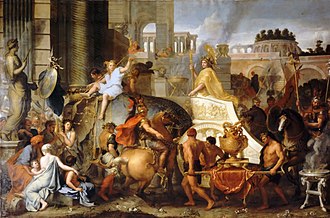
Jhelum is several miles upstream from the site of the ancient Battle of the Hydaspes, fought between the armies of Alexander III of Macedon and Porus. The modern city of Jhelum could possibly be the site of the capital of Paurava. The nearby city of Bucephala is named after Alexander's horse, Bucephalus, who died there.
Other notable places nearby include the 16th-century Rohtas Fort and the Tilla Jogian complex of ancient temples. The ancient Grand Trunk Road passes through the city. According to the 2023 Pakistani census, the population of Jhelum was 312,426.
Today, Jhelum has a number of industries, including a tobacco factory and wood, marble, glass, and flour mills.
For other uses of the name, see Jhelum (disambiguation).
Etymology
According to the Concise Dictionary of World-Place Names, the name Jhelum comes from Jal, meaning "pure water," and Ham, meaning "snow." The name refers to the water of the Jhelum River, which starts in the snow-covered Himalayas.
Historian Anjum Sultan Shahbaz described several other ideas about the name. Some writers say the city was once called Jalham. Others say a ruler named "Dara-e-Azam" set up his flag at a spot on the river bank and called it "Ja-e-Alam," meaning "Place of the Flag," which later became Jhelum. Another tradition says that Saad Bin Abi Waqas's brother, Saeed Bin Abi Waqas, saw the city's reflection in the river and named it, meaning "City besides the river, in full moonlight." Ahmed Shah Abdali also wrote "Jheelum" and "Harian" for Kharian in his diary.
History
Rajput, Gurjar, Labana, and Arain settlers were the earliest inhabitants of Jhelum. The city was the site of the Battle of the Hydaspes between Alexander III of Macedon and the local ruler, Porus the Elder. The Indian king Abisares, of the Abhira tribe, also sent messages to Alexander and was allowed to keep his kingdom. Porus' kingdom, Paurava, lay on the left bank of the Jhelum River, in the area of the present Gujrat District. The Gakhars were the dominant group in the early Muslim era and kept their independence in Jhelum and the neighboring district of Rawalpindi for a long time. In 997 CE, Sultan Mahmud Ghaznavi took over the Ghaznavid dynasty empire started by his father, Sultan Sebuktegin. In 1005 he conquered the Shahis in Kabul and then the Punjab region, including Jhelum. The Delhi Sultanate and later the Mughal Empire ruled the area. Missionary Sufi saints, whose dargahs dot the landscape, helped make the region mostly Muslim. The Mughals, who were Persianized Turks claiming descent from Timur and Genghis Khan, settled families such as the Barlas in places including Bhimber. They were largely responsible for the conversion of the Jats to Islam, as recorded in the Baburnama. After the decline of the Mughal Empire, the region fell to the Durrani Empire. After the Third Battle of Panipat, the Sikh Empire took over the Jhelum District in 1808 from its Gakhar ruler, Sultan Muqarrab Khan. In 1849, Jhelum passed with the rest of the Sikh territories to the British Raj, with help from local Gakhars who resented Sikh rule.
During British rule, Jhelum was connected by the North-Western Railway to other cities, including Calcutta, Bombay, and Karachi. The city was described in the Imperial Gazetteer of India, and its trade included octroi income. During the Mutiny of 1857, 35 British soldiers of the 24th Regiment of Foot were killed at the Battle of Jhelum by mutineers from the Honourable East India Company's 14th Bengal Native Infantry. Among the dead was Captain Francis Spring, the eldest son of Colonel William Spring. The British soldier William Connolly won a Victoria Cross for his bravery during this battle. Mirza Dildar Baig, also known as Khaki Shah, took part in the mutiny at Jhelum and was later celebrated by Indian Nationalists. During World War I, the Jhelum District "stood first" among districts in recruiting for the British war effort. After the independence of Pakistan in 1947, the minority Hindus and Sikhs migrated to India, while Muslim refugees from India settled in the Jhelum District. The predominantly Muslim population had supported the Muslim League and the Pakistan Movement.
Administration
Jhelum is the district capital and also the headquarters of Jhelum Tehsil. The city is split into seven union councils: Jhelum-I, Jhelum-II, Jhelum-III, Jhelum-IV, Jhelum-V, Jhelum-VI and Jhelum-VII.
Demographics
Population
As of the 2023 census of Pakistan, about 312,426 people lived in Jhelum city, including the Jhelum cantonment. This makes it the 31st-largest city in Pakistan by population. The city covers about 50 km2 (19 sq mi), with about 261 people per square kilometre. Most residents, 98.47%, are Muslim. Christians are the largest minority group in the district, making up 1.36% of the population.
Jhelum has one of the highest literacy rates in Pakistan, at 79%. Only Rawalpindi and Islamabad have higher rates, and Jhelum's rate is higher than the average for Punjab province (58%). The literacy rate has risen from 38.9% in 1981. Most people have electricity (84%) and access to water (96%). The Human Development Index of Jhelum is 0.770, the highest in Pakistan after Karachi. In the 2023 census, 83.05% of people said their mother tongue is Punjabi, 10.74% said Urdu, and 4.37% said Pashto. The remaining 1.84% speak other languages, mostly Sindhi and Saraiki.
| Religious group | 1881 | 1891: 68 | 1901: 44 : 26 | 1911: 23 : 19 | 1921: 25 : 21 | 1931: 26 | 1941: 32 | 2017 | ||||||||
|---|---|---|---|---|---|---|---|---|---|---|---|---|---|---|---|---|
| Pop. | % | Pop. | % | Pop. | % | Pop. | % | Pop. | % | Pop. | % | Pop. | % | Pop. | % | |
Islam  | 11,369 | 53.86% | 7,373 | 57.25% | 8,322 | 55.66% | 10,470 | 53.21% | 10,816 | 59.89% | 13,980 | 59.49% | 19,416 | 58.5% | 185,323 | 97.3% |
Hinduism  | 7,966 | 37.74% | 4,250 | 33% | 4,350 | 29.1% | 5,824 | 29.6% | 5,379 | 29.78% | 6,304 | 26.83% | 8,936 | 26.92% | 50 | 0.03% |
Sikhism  | 1,460 | 6.92% | 1,064 | 8.26% | 2,074 | 13.87% | 3,029 | 15.39% | 1,497 | 8.29% | 2,581 | 10.98% | 3,950 | 11.9% | —N/a | —N/a |
Jainism  | 0 | 0% | 28 | 0.22% | 15 | 0.1% | 25 | 0.13% | 33 | 0.18% | 69 | 0.29% | 146 | 0.44% | —N/a | —N/a |
Christianity  | —N/a | —N/a | 153 | 1.19% | 190 | 1.27% | 326 | 1.66% | 334 | 1.85% | 565 | 2.4% | 619 | 1.86% | 4,560 | 2.39% |
Zoroastrianism  | —N/a | —N/a | 9 | 0.07% | 0 | 0% | 3 | 0.02% | 1 | 0.01% | 0 | 0% | —N/a | —N/a | —N/a | —N/a |
Judaism  | —N/a | —N/a | 1 | 0.01% | 0 | 0% | 1 | 0.01% | 0 | 0% | 0 | 0% | —N/a | —N/a | —N/a | —N/a |
Buddhism  | —N/a | —N/a | 0 | 0% | 0 | 0% | 0 | 0% | 0 | 0% | 0 | 0% | —N/a | —N/a | —N/a | —N/a |
Ahmadiyya  | —N/a | —N/a | —N/a | —N/a | —N/a | —N/a | —N/a | —N/a | —N/a | —N/a | —N/a | —N/a | —N/a | —N/a | 533 | 0.28% |
| Others | 312 | 1.48% | 0 | 0% | 0 | 0% | 0 | 0% | 0 | 0% | 0 | 0% | 124 | 0.37% | 5 | 0% |
| Total population | 21,107 | 100% | 12,878 | 100% | 14,951 | 100% | 19,678 | 100% | 18,060 | 100% | 23,499 | 100% | 33,191 | 100% | 190,471 | 100% |
Geography
Jhelum is at 32°56′ North latitude and 73°44′ East longitude. It is about a 1 hour and 30 minute drive from Islamabad, the capital of Pakistan, and about a 3 hour drive from Lahore, the capital of Punjab. The city is linked to these places by the National Highway N-5. Several towns are within 1 to 2 hours' drive, including Gujrat, which is home to fan manufacturing, Gujranwala, Chakwal, and Mirpur.
Jhelum has a monsoon-influenced humid subtropical climate (Köppen Cwa). Summers are extremely hot and humid, and winters are pleasant and generally dry. The highest temperature recorded before the rainy season, from April to June, was 49.2 °C (120.6 °F). The lowest winter temperature recorded was −0.6 °C (30.9 °F). The city gets about 900 millimetres (35 in) of rain each year, which is much less than needed because so much water evaporates. During the rainy season, water rushes quickly from the north toward the Jhelum River, damaging crops, bridges, and roads, and causing soil erosion in the district. Like every other place on Earth, Jhelum has been affected by global climate change. The biggest recent floods in Jhelum were in (/wiki/1992), when the city and nearby areas were almost completely covered by flood waters.
Transport and tourism
Auto rickshaws are a common way to travel short distances in the city, and many new ones run on compressed natural gas (CNG), which is environmentally cleaner and cheaper than petrol. Manual rickshaws are also important, and old horse-drawn tongas are no longer used, though some can still be privately hired. Taxis, small vans, and Daewoo Express and other buses connect the city to the rest of the country. The Jhelum Railway Station was built in 1928 during British rule, and it was linked by the North-Western Railway. Jhelum is on the main line of Pakistan Railways. The nearest international airport is Islamabad International Airport, about 110 km away by road, while Sialkot International Airport is about 100 km away. Gurha Salim Airport, 13 km from the city centre, is used only for military purposes.
Rohtas Fort is a garrison fort built by the Afghan king Sher Shah Suri, located about 18 km northwest of Jhelum and 7 km from Dina. The old city has narrow streets and bazaars. Opposite the CMH Jhelum Cantt is the CMH Masjid Jhelum mosque. In the cantonment area is St. John's Church, Jhelum, built in 1860. A local stadium was changed into the cricket stadium Zamir Jaffri Cricket Stadium, and Altaf Park is very close to it. Nearby, the Major Akram Shaheed Memorial Park holds the Major Muhammad Akram Memorial Library, and a parade is held there every year on 6 September for Defence Day. Lehri Nature Park is 10 km from G. T. Road between Jhelum and Islamabad, in the hilly Pothohar region.
The Mangla Dam is on the Jhelum River about 30 km from Jhelum. It is the sixth largest dam in the world and was constructed in 1967 across the Jhelum River. Rasul Barrage is on the Jhelum River about 30 km downstream from Jhelum, where two major canals begin, and its lake is a popular picnic spot.
Sports
The River-View Golf Club, a golf course in the city, regularly hosts national golf tournaments.
The city has a cricket and football stadium, Zamir Jaffri Cricket Stadium, where district-level tournaments are held. In October 2008, the Pakistan Cricket Board upgraded this stadium for regional events.
Education
Jhelum has six degree colleges for women, 10 for men, six co-education colleges, six commerce colleges, one law college, many higher secondary schools, and over 150 high schools. Punjab University also has a campus in Jhelum, called Punjab University Jhelum Campus, near Rathiyan, Kala Gujran, and Satellite Town Jhelum. The city is also home to the famous Military College Jhelum.
The University of the Punjab has set up a campus in Jhelum that offers programs in business, commerce, law, and computer science. The literacy rate in Jhelum is high compared to other cities in Punjab. The Government of Punjab gave sixty-five kanals of land to build this campus. Jhelum also has two sub-campuses of the Virtual University of Pakistan, one at Civil Lines opposite City Church and a private virtual campus called Wings Institute of Learning. In March 2012, the Virtual University of Pakistan opened its own campus in the middle of the city.
Notable people
For a more comprehensive list, see List of people from Jhelum.
Two well-known people from Jhelum are Inder Kumar Gujral, who was the thirteenth Prime Minister of India, and Rabia Qari, the first female Muslim barrister in South Asia.

Quiz time!
5 questions about Jhelum
Why is Jhelum nicknamed the "City of Soldiers"?
Pictures
Keep exploring



This article is a child-friendly adaptation of the Wikipedia article on Jhelum, available under CC BY-SA 4.0.
Images from Wikimedia Commons. Tap any image to view credits and license.