 Safekipedia
Lambda-CDM model
Adapted from Wikipedia · Discoverer experience
The Lambda-CDM, Lambda cold dark matter, or ΛCDM model is a mathematical model that helps us understand how the universe began and how it has changed over time. It is based on the Big Bang theory and includes three important parts: a special kind of energy called dark energy, a type of invisible material known as cold dark matter, and the ordinary matter that makes up stars, planets, and everything we can see.
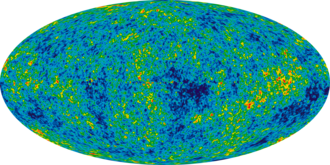
This model is currently the main way scientists explain the universe. It works well for explaining many things we observe, such as the cosmic microwave background, which is the leftover heat from the Big Bang, the way galaxies are spread out across the universe, and the amounts of different elements like hydrogen (including deuterium), helium, and lithium.
The ΛCDM model also helps explain why the universe seems to be expanding at an ever-faster rate, something we see when we look at light from faraway galaxies and supernovae. Scientists use general relativity to understand gravity in this model, and it has been very useful for explaining many observations over many years. However, there are still some puzzles that this model doesn’t fully answer, which leads scientists to explore other ideas.
Overview
The ΛCDM model explains how our universe began and evolved. It is based on three main ideas about space and time: the universe looks mostly the same everywhere and in every direction, it is expanding, and the rules of general relativity apply.
This model uses simple math to describe how the universe grows and changes. It includes different kinds of matter and energy, like ordinary matter (what we see in stars and planets) and mysterious dark matter that we cannot see but know exists because of its gravity. There is also dark energy, which makes the universe expand faster over time.
The model starts with the Big Bang, a sudden start of the universe filled with very hot radiation. After this, the universe expanded quickly in a period called cosmic inflation. Today, we can still see evidence of this early hot state as the cosmic microwave background, faint radiation spread all across the sky.
Cosmic expansion history
The universe is growing and changing over time. Scientists describe this growth using a simple idea called the "scale factor." Imagine the universe as a balloon being blown up — as it gets bigger, everything in it moves farther apart. This scale factor helps us understand how distances in space have changed since the beginning of the universe.
We also use a value called the Hubble parameter to describe how fast the universe is expanding right now. This helps us connect what we see in space — like how far away galaxies are and how quickly they are moving — with the overall shape and contents of the universe. By studying these changes, scientists can learn about the universe's history and what it might look like in the future.
Parameters
Different versions of the ΛCDM model use slightly different settings, or parameters, to match what we see in space.
The Planck version of the ΛCDM model uses six main parameters. These include the amount of ordinary matter, the amount of dark matter, and a few other important numbers that help explain how the universe looks. These six parameters are the smallest set needed to fit the observations well. Other possible parameters are set to common values. Scientists use computers to find the best values for these parameters, and from them, they can calculate other important numbers like how fast the universe is expanding.
| Description | Symbol | Value-2018 | |
|---|---|---|---|
Independent parameters | Baryon density today | Ωb h2 | 0.0224±0.0001 |
| Cold dark matter density today | Ωc h2 | 0.120±0.001 | |
| 100 × approximation to r∗/DA (CosmoMC) | 100 θ M C {\displaystyle \theta _{MC}} | 1.04089±0.00031 | |
| Reionization optical depth | τ | 0.054±0.007 | |
| Log power of the primordial curvature perturbations | ln ( 10 10 A s ) {\displaystyle \ln(10^{10}A_{s})} | 3.043±0.014 | |
| Scalar spectrum power-law index | ns | 0.965±0.004 | |
Fixed parameters | Total matter density today (including massive neutrinos) | Ωm h2 | 0.1428 ± 0.0011 |
| Equation of state of dark energy | w | w0 = −1 | |
| Tensor/scalar ratio | r | r0.002 | |
| Running of spectral index | d n s / d ln k {\displaystyle dn_{\text{s}}/d\ln k} | 0 | |
| Sum of three neutrino masses | ∑ m ν {\displaystyle \sum m_{\nu }} | 0.06 eV/c2 | |
| Effective number of relativistic degrees of freedom | Neff | 2.99±0.17 | |
Calculated Values | Hubble constant | H0 | 67.4±0.5 km⋅s−1⋅Mpc−1 |
| Age of the universe | t0 | (13.787±0.020)×109 years | |
| Dark energy density parameter | ΩΛ | 0.6847±0.0073 | |
| The present root-mean-square matter fluctuation, averaged over a sphere of radius 8h−1 Mpc | σ8 | 0.811±0.006 | |
| Redshift of reionization (with uniform prior) | zre | 7.68±0.79 |
Historical development
The discovery of the cosmic microwave background in 1964 showed that the universe began in a hot, dense state and has been expanding ever since. The speed of this expansion depends on the types of matter and energy in the universe.
In the 1970s, scientists studied models that only included ordinary matter, but these had trouble explaining how galaxies formed. In the 1980s, they found that adding cold dark matter helped solve this problem. By the mid-1990s, new discoveries led to the Lambda-CDM model becoming the leading idea. Observations in 1998 showed that the universe's expansion is actually speeding up, which supported this model. Later measurements from spacecraft like WMAP and Planck helped confirm the details of this model.
Successes
The ΛCDM model is the most successful way we have to explain how the universe works. It matches many important space observations very well. For example, it helps us understand the light from the early universe measured by the Planck mission and the Atacama Cosmology Telescope. It also explains the patterns in this ancient light.
The model even predicted things we later found, like a special pattern in the universe’s light discovered in 2005 and twists in space light seen in 2000. It also matches what we see in very distant stars and the amounts of certain elements made shortly after the Big Bang.
Challenges
The Lambda-CDM model works well with many observations, but scientists think it might be a simple version of something more complex.
Lack of detection
We still haven’t found particles of dark matter in experiments, and dark energy is very hard to study in labs. It is also very small compared to what theories predict.
Violations of the cosmological principle
The Lambda-CDM model assumes the universe looks the same in all directions and from every spot on large scales. But some observations suggest this might not be true.
Violations of isotropy
Data from galaxy clusters, bright objects called quasars, and certain exploding stars suggest differences in different directions on very large scales.
The European Space Agency found that maps of the cosmic microwave background show differences in temperature and density that are more than expected by chance.
Violations of homogeneity
The universe is thought to look mostly the same when looked at over very large areas. Studies of how galaxies are spread out support this idea when looking at very large distances.
Hubble tension
There is a big difference between the value of a key number, called the Hubble constant, measured from the very early universe and the value measured from nearby objects. This difference is a big puzzle for the Lambda-CDM model.
S8 tension
Another question mark for the Lambda-CDM model is called the “S8 tension.” This is about how much matter clumps together in the universe. Some measurements find less clumping than expected from the Lambda-CDM model, while others find agreement.
Axis of evil
Some people thought there was a strange match between the plane of our solar system and patterns in the cosmic microwave background. But newer studies did not find strong evidence for this.
Cosmological lithium problem
We find less lithium in the universe than the Lambda-CDM model expects. If all calculations are right, we might need changes to the model.
Shape of the universe
The Lambda-CDM model assumes the universe is flat. But some data suggest it might be curved instead.
Cold dark matter discrepancies
There are a few places where what the Lambda-CDM model predicts about dark matter doesn’t quite match what we see in galaxies.
Cuspy halo problem
In simulations, dark matter is more crowded in the centers of galaxies than what we actually observe.
Dwarf galaxy problem
Simulations predict many more small groups of dark matter than we see small galaxies around big ones like the Milky Way.
Satellite disk problem
Small galaxies around the Milky Way and Andromeda seem to line up in thin structures, but simulations say they should be spread out randomly.
High redshift galaxies
Some very bright objects found in the very early universe were at first thought to be too big and old for the Lambda-CDM model. But closer study showed many were brighter than they really are. The ones confirmed are less massive and fit better with the model.
Missing baryon problem
Early studies suggested we could not find all the ordinary matter (like stars and gas) that should exist based on the Lambda-CDM model. Later studies found that much of this missing matter exists in the space between galaxies, solving this problem.
Conventionalism
Some people argue that because the Lambda-CDM model can be changed to fit new data, it might not be possible to prove it wrong in the way scientists usually want.
Extended models
Extended models let scientists change one or more of the main settings in the basic Lambda-CDM model. These changes allow the model to include things like different space shapes or different types of dark energy. One idea is that dark energy might behave differently than we usually think. These models also consider tiny waves from the very early universe and the possibility of certain particles having more mass than we expect.
When scientists add these extra settings, it can make the results less certain and sometimes change the main values a little. As of 2015, there was no strong proof that any of these extra settings are different from the usual values. Some scientists think there might be changes in how the universe’s shape looks over time, but no clear evidence has been found yet. Theories suggest that a certain measure of these early universe waves should be between 0 and 0.3, and the newest results fit within this range.
| Description | Symbol | Value |
|---|---|---|
| Total density parameter | Ω tot {\displaystyle \Omega _{\text{tot}}} | 0.9993±0.0019 |
| Equation of state of dark energy | w {\displaystyle w} | −0.980±0.053 |
| Tensor-to-scalar ratio | r {\displaystyle r} | 0 = 0.002 Mpc−1 ( 2 σ {\displaystyle 2\sigma } ) |
| Running of the spectral index | d n s / d ln k {\displaystyle dn_{s}/d\ln k} | −0.022±0.020, k0 = 0.002 Mpc−1 |
| Sum of three neutrino masses | ∑ m ν {\displaystyle \sum m_{\nu }} | eV/c2 ( 2 σ {\displaystyle 2\sigma } ) |
| Physical neutrino density parameter | Ω ν h 2 {\displaystyle \Omega _{\nu }h^{2}} |
Images
Related articles


This article is a child-friendly adaptation of the Wikipedia article on Lambda-CDM model, available under CC BY-SA 4.0.
Images from Wikimedia Commons. Tap any image to view credits and license.