Macedonia (ancient kingdom)
Macedonia, also called Macedon, was an ancient kingdom on the edge of Archaic and Classical Greece. It later became the dominant state of Hellenistic Greece. The kingdom was founded and first ruled by the royal Argead dynasty, which was followed by the Antipatrid and Antigonid dynasties. Its people were the ancient Macedonians. The earliest kingdom was centred on the northeastern part of the Greek peninsula. It bordered Epirus to the southwest, Illyria to the northwest, Paeonia to the north, Thrace to the east, and Thessaly to the south.
Before the 4th century BC, Macedonia was a small kingdom centred in Aegae. It lay outside the area dominated by the city-states of Athens, Sparta, and Thebes, and was briefly subordinate to the Achaemenid Empire. During the reign of king Philip II (359–336 BC), Macedonia had its capital in Pella. Through conquest and diplomacy, it subdued mainland Greece, Paeonia, and the Thracian Odrysian kingdom. Philip II had a reformed army with phalanxes wielding the sarissa pike, and with it he defeated the old powers of Athens and Thebes at the Battle of Chaeronea in 338 BC.
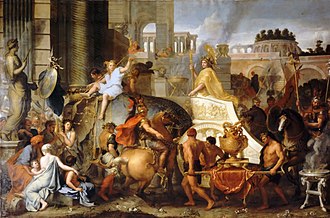
Philip II's son, Alexander the Great, became king of Macedon and leader of the League of Corinth that his father had founded. Alexander achieved the goal of commanding the whole of Greece when he destroyed Thebes after the city revolted. During his campaign of conquest, he overthrew the Achaemenid Empire and conquered land that stretched as far as the Indus River. For a brief period, his Macedonian Empire was the most powerful in the world. It was the definitive Hellenistic state and marked the start of a new period of Ancient Greek civilization. Greek arts and literature flourished in the new lands, and advances in philosophy, engineering, and science spread across the empire and beyond. Aristotle, who was Alexander's tutor, was especially important, and his writings became a keystone of Western philosophy.
After Alexander's death in 323 BC, there were the wars of the Diadochi, and his short-lived empire was divided up. Macedonia remained a Greek cultural and political centre in the Mediterranean region, alongside Ptolemaic Egypt, the Seleucid Empire, and the Attalid kingdom. Important cities included its capital Pella, Dion, Beroea, Pydna, and Amphipolis. New cities were also founded, such as Thessalonica, which the usurper Cassander founded and named after his wife Thessalonike of Macedon. Macedonia's decline began with the Second Macedonian War and the rise of Rome as the leading Mediterranean power. At the end of the Third Macedonian War in 168 BC, the Macedonian monarchy was abolished and replaced by Roman client states. A short-lived revival of the monarchy during the Fourth Macedonian War in 150–148 BC ended with the creation of the Roman province of Macedonia.
The Macedonian kings held absolute power and controlled state resources such as gold and silver. They supported mining so that currency could be minted, which paid for their armies and, by the reign of Philip II, a Macedonian navy. Unlike the other diadochi successor states, Macedonia never adopted the imperial cult that Alexander had fostered. Macedonian rulers still served as high priests of the kingdom and were leading supporters of local and international cults of the Hellenistic religion. The army theoretically limited the authority of Macedonian kings, while a few municipalities within the Macedonian commonwealth enjoyed a high degree of self-government and even had democratic governments with popular assemblies. Other uses of these names are listed at Macedonia (disambiguation) and Macedon (disambiguation).
Etymology
See also: Makedon (mythology) and Macedonia (terminology)
The name Macedonia (Greek: Μακεδονία, Makedonía) comes from the ethnonym Μακεδόνες (Makedónes). That word comes from the ancient Greek adjective μακεδνός (makednós), which means 'tall, slim'. It was also the name of a people related to the Dorians, as described by Herodotus, and it may describe the Ancient Macedonians themselves.
The name is most likely closely related to μακρός (makrós), which means 'long' or 'tall' in ancient Greek. It probably first meant 'highlanders', 'the tall ones', or 'high grown men'. The linguist Robert S. P. Beekes argues that both words come from a Pre-Greek substrate language and cannot be explained by Indo-European word-building, but Filip De Decker does not think Beekes's arguments are enough. The shorter English form, Macedon, developed in Middle English from the French form Macédoine.
History
Main article: History of Macedonia (ancient kingdom)
Legends said that the kings of the Argead dynasty descended from the hero Heracles and the god Zeus. Little is known about the early kingdom, which was centred in the northeast of the Greek peninsula and gradually grew larger. For a time, Macedonia was under the rule of the Achaemenid Empire of Persia, though it kept a large degree of independence. Later, Macedonian kings took part in conflicts with the Greek city-states, including Athens. Philip II of Macedon reformed the army and expanded the kingdom, winning the Battle of Chaeronea in 338 BC. His son Alexander the Great then built a large empire. After Alexander died in 323 BC, his generals fought for power, and Macedonia became part of the Hellenistic world of Greek-ruled kingdoms.
In the following centuries, Macedonia fought a series of wars with the Roman Republic, which had grown very powerful. In 168 BC, the Macedonian army was defeated at the Battle of Pydna, and the Romans ended the Macedonian monarchy. By 146 BC, Macedonia had come under Roman control, and it later became the Roman province of Macedonia.
Institutions
Main article: Government of Macedonia (ancient kingdom)
Further information: Ancient Greek law
The head of Macedonia's government was the king. From at least the time of Philip II, the king was helped by royal pages, bodyguards, companions, friends (philoi), an assembly that included members of the military, and, during the Hellenistic period, magistrates. It is not clear how much power these groups shared with the king. The earliest known government of ancient Macedonia was its monarchy, which lasted until 167 BC, when the Romans abolished it. Macedonian kings also led the army, acted as chief judge, and served as high priest. Companions and friends formed a council that advised the king, and an assembly could judge cases of high treason.
Further information: Synedrion
Antigonid kings relied on regional officials to run affairs of state. In ancient Athens, the Athenian democracy was restored three separate times after Antipater first conquered the city in 322 BC, but when Macedonia ruled it, the city was usually governed by an oligarchy. Other city-states were allowed more autonomy. Macedonia's army began as a force of farmers and shepherds, but Philip II turned it into a well-trained professional army. Its navy also grew, but after the 197 BC peace treaty that ended the Second Macedonian War with the Roman Republic, the navy was reduced to six vessels.
Main articles: Ancient Macedonian army and Antigonid Macedonian army
Further information: Hellenistic armies and Macedonian phalanx
Society and culture
Main article: Ancient Macedonians
Further information: Culture of ancient Greece
The ancient Macedonians shared many gods with the Greeks of the south, and their rulers were buried in tombs at Vergina with painted walls and rich grave goods. Their main work was herding animals, farming, and mining metals such as copper, iron, gold, and silver. Under Philip II, writers began to use Koine Greek, a common language of the time, and the native Macedonian language was most likely a form of Greek. Over time, the Macedonians became known for their metalwork, paintings, and mosaics.
Macedonians enjoyed theatre, music, sports, and feasts. Some famous thinkers visited their royal courts, including the philosopher Aristotle, who is said to have taught the young Alexander the Great. Scholars still disagree about whether the Macedonians were truly Greek or whether they were a separate people. Many experts believe that the differences between them and other Greeks were mainly political.
Technology and engineering
Further information: Ancient Greek technology, History of science in classical antiquity, Ancient Greek astronomy, Greek mathematics, and Medicine in ancient Greece
Further information: Architecture of ancient Greece
Further information: Greek and Roman artillery, Ancient Greek warfare, Lithobolos, and Siege ladder
Further information: Ancient Macedonian calendar
Macedonian buildings mixed forms and styles from the rest of Greece, so they were not a unique style of ancient Greek architecture. Macedonian builders liked the Ionic order among the classical orders, especially in the peristyle courtyards of private homes. Some ruins of Macedonian palaces survive, including a palace at Pella, a summer residence at Vergina, and a royal residence at Demetrias near Volos. At Vergina, three large banquet halls may show some of the earliest large triangular roof trusses, if they were built before the reign of Antigonus II Gonatas. Later Macedonian buildings also used arches and vaults. After winning the Battle of Chaeronea (338 BC), Philip II built a round memorial, the Philippeion, at Olympia. Its inside was decorated with statues of Philip, his parents Amyntas III of Macedon and Eurydice I of Macedon, his wife Olympias, and his son Alexander the Great.
By the Hellenistic period, Greek states often paid for stronger torsion siege engines, naval ships, and standard designs for arms and armour. Under Philip II and Alexander the Great, siege artillery improved, including ballistae and huge siege towers. The historians E. W. Marsden and M. Y. Treister argue that Antigonus I Monophthalmus and Demetrius I of Macedon had the most powerful siege artillery in the Hellenistic world at the end of the 4th century BC. Alexandria in Ptolemaic Egypt later became a centre for improving the catapult by the 3rd century BC, as shown in the writings of Philo of Alexandria. Macedonia may also have produced some other inventions, such as the rotary-operated olive press for making olive oil, though this may instead have come from another part of Greece, or from as far east as the Levant or Anatolia. Mould-pressed glass first appeared in Macedonia in the 4th century BC.
Currency, finances, and resources
Main article: Government of Macedonia (ancient kingdom)
Further information: Ancient Greek coinage and Economy of ancient Greece
The minting of silver coins began under Alexander I to pay for royal spending. Archelaus I raised the silver content of his coins and also made copper coins to help trade at home and abroad. Minting grew a great deal under Philip II and Alexander the Great, especially after the state gained more money from taking the Pangaion Hills. In the Hellenistic period, the royal houses of Macedonia, Ptolemaic Egypt, and the Attalid kingdom had full monopolistic control over mining, mostly to pay for their armies. By the end of the conquests of Alexander the Great, nearly thirty mints from Macedonia to Babylon made standard coins. The right to mint coins was shared by the central government and some local governments, such as the autonomous municipal governments of Thessaloniki, Pella, and Amphipolis within the Macedonian commonwealth. The Macedonians were also the first to issue different coins for internal and external circulation.
The state also raised money by collecting produce from arable lands, timber from forests, and taxes on imports and exports at harbours. The king ran some mines, groves, agricultural lands, and forests that belonged to the state, though these were often leased as assets or given as grants to members of the nobility, such as the hetairoi and philoi. Tariffs on goods moving through Macedonian seaports existed from at least the reign of Amyntas III, and Callistratus of Aphidnae (d. c. 350 BC) helped Perdiccas III double the kingdom's yearly profits from customs duties from 20 to 40 talents. After the defeat of Perseus at Pydna in 168 BC, the Roman Senate allowed iron and copper mines to reopen, but banned gold and silver mining by the four new client states that replaced the monarchy. This ban may have been meant to stop the Macedonians from paying for an armed rebellion, and the Romans may also have wanted to control inflation caused by a larger money supply from silver mining. The Macedonians kept minting silver coins from 167 to 148 BC, just before the Roman province of Macedonia was set up. When the Romans lifted the ban on silver mining in 158 BC, this may simply have reflected that the illegal mining had continued anyway.
Legacy
Further information: Hellenic studies, Hellenistic religion, Hellenistic Judaism, and Hellenism (neoclassicism)
The reigns of Philip II and Alexander the Great saw the end of Classical Greece and the start of Hellenistic civilization, as Greek culture spread to the Near East during and after Alexander's conquests. Macedonians then moved to Egypt and parts of Asia. However, the heavy colonization of foreign lands drained manpower from Macedonia itself, weakening the kingdom in its struggles with other Hellenistic powers and contributing to its downfall and conquest by the Romans. According to Errington, the spread of Greek culture and language through Alexander's conquests in West Asia and North Africa was a "precondition" for the later Roman expansion into these lands and formed the entire basis for the Byzantine Empire.
The Macedonian rulers of the Ptolemaic and Seleucid successor states welcomed men from across the Greek world as their hetairoi companions and did not build a national identity as the Antigonids did. Their cosmopolitan cities in Asia and northeastern Africa looked more like Macedonian cities than Spartan society, which stayed mostly insular, or Athens, which kept strict limitations on acquiring citizenship. These cities mixed natives, Greek and Macedonian colonists, and Greek-speaking Hellenized Easterners, many descended from intermarriage between Greeks and native peoples. The deification of Macedonian monarchs perhaps began with the death of Philip II, but Alexander the Great unambiguously claimed to be a living god. After visiting the oracle of Didyma in 334 BC, which suggested his divinity, he travelled to the Oracle of Zeus Ammon, the Greek equivalent of the Egyptian Amun-Ra, at the Siwa Oasis of the Libyan Desert in 332 BC to confirm his divine status. Although the Ptolemaic and Seleucid empires maintained ancestral cults and worshipped their rulers, kings were not worshipped in the Kingdom of Macedonia. Zeus Ammon was known to the Greeks before Alexander, especially at the Greek colony of Cyrene, Libya, but Alexander was the first Macedonian monarch to support Egyptian, Persian, and Babylonian priesthoods and deities, strengthening the mix of Near Eastern and Greek religious beliefs. After his reign, the cult of Isis gradually spread through the Hellenistic and Roman world, and the Egyptian god Sarapis was thoroughly Hellenized by the Ptolemaic rulers before his cult reached Macedonia and the Aegean region. The German historian Johann Gustav Droysen argued that Alexander's conquests and the creation of the Hellenistic world allowed for the growth and establishment of Christianity in the Roman era.

Quiz time!
5 questions about Macedonia (ancient kingdom)
Who was Alexander the Great's tutor?
Pictures
Keep exploring



This article is a child-friendly adaptation of the Wikipedia article on Macedonia (ancient kingdom), available under CC BY-SA 4.0.
Images from Wikimedia Commons. Tap any image to view credits and license.