Peatland
A peatland is a type of wetland whose soil is made of organic matter from decaying plants. Over time, this material forms layers of peat. Peatlands form when plant litter, usually from vegetation, does not fully decay. This happens because the land is water-logged and has little oxygen, which is called anoxia. Peatlands are unusual landforms. They form mostly through living processes rather than physical ones, and they can take on distinctive shapes and patterns on their surfaces.
The climate, including precipitation and temperature, mainly controls where peatlands form. The shape of the land also matters, because waterlogging happens more easily on flat ground and in basins. Peat formation usually begins in one of three ways. A forest on mineral soil can become waterlogged, which is called paludification. A lake can fill in and turn into peatland, which is called terrestrialisation. Or peat can begin forming on bare soil in areas that were once covered by glaciers. A peatland that is actively forming peat is called a mire. All mires are saturated with water, at least for part of the year, and each has its own ecosystem.
Peatlands are the largest natural carbon store on land. They cover around 3 million km² across the world. Each year, they absorb 0.37 gigatons (Gt) of carbon dioxide (CO2). Peat soils store over 600 Gt of carbon, which is more than all other vegetation types, including forests, store. In their natural state, peatlands provide many ecosystem services. They help reduce flood risk and erosion, clean water, and regulate climate.
Peatlands are under threat. They are harmed by commercial peat harvesting, drainage, and conversion for agriculture, especially palm oil production in the tropics. Fires also threaten them, and these are predicted to become more frequent with climate change. When peatlands are destroyed, the carbon they have stored is released into the air as greenhouse gases, which make climate change worse.
Several terms redirect here. For other uses, see Miring (ritual), Mire (disambiguation) and Quagmire (disambiguation).
See also: Floating mat (quagmire)
Types
Botanists and ecologists use the word "peatland" for any land covered by peat at least 30 cm (12 in) deep, even if it has been completely drained and is dry. A peatland that can still form new peat is called a mire. Drained peatlands may still have a peat layer, but they are not considered mires because new peat no longer forms.
There are two types of mire: bog and fen. A bog sits higher than the land around it and gets all its water from precipitation (ombrotrophic). Bogs are always acidic and poor in nutrients. A fen lies on a slope, on flat ground, or in a dip, and gets most of its water from the surrounding soil or groundwater (minerotrophic). Fens may be slightly acidic, neutral, or alkaline, and may be poor or rich in nutrients. All mires start as fens, and they may later turn into bogs once the peat layer rises above the land around it. A quagmire is a floating mire, bog, or peatland in a stage of hydrosere or hydrarch succession, and it shakes underfoot (floating mats).
Some swamps can also be peatlands, such as peat swamp forest, while marshes are generally not considered peatlands. Swamps are known for their forest canopy or for tall, dense plants like papyrus. Like fens, swamps usually have a higher pH and more nutrients than bogs. Some bogs and fens can support small shrubs or trees on hummocks. A marsh is a wetland where plants are rooted in mineral soil.
Global distribution
Peatlands are found all over the world, but they are most widespread at high latitudes in the Northern Hemisphere. They cover about 3% of the Earth's surface, though this is hard to measure exactly because countries survey their land in different ways. Mires form wherever conditions allow peat to build up, mostly where plant matter stays waterlogged. Where they form depends on topography, climate, parent material, biota and time, and the type of mire (bog, fen, marsh or swamp) depends on these factors too.
Most peatlands, about 64%, are in the cooler temperate, boreal and subarctic zones of the Northern Hemisphere, such as Canada, northern Europe and northern Russia. In polar regions they are usually shallow and often contain permafrost and palsas. In temperate areas they are more scattered, though blanket bog can cover large areas. Tropical mires, about 11% of peatlands, are often found under rainforest in places like Kalimantan, the Congo Basin and the Amazon basin. They can also form in coastal mangroves and in mountain areas, including Papua New Guinea. Indonesia has one of the largest peatlands in the world, but it faces threats from deforestation and forest fires. Many mires have been lost because of drainage for farming, forestry and peat harvesting.
Biochemical processes
Peatlands have unusual chemistry that affects the plants and animals living there and how water flows out of them. Peat holds a lot of material because it is rich in organic matter, giving it a very high cation-exchange capacity. Minerals such as Ca²⁺ are adsorbed onto the peat in exchange for H+ ions. As water passes through peat, it loses nutrients and its pH drops. So mires are usually poor in nutrients and acidic, unless a lot of groundwater flows in and brings extra minerals. Peat forms when more carbon enters the soil from dead material than leaves through decomposition. This happens because waterlogged peat has very little oxygen, which slows decomposition. Peat plants also break down slowly because they contain a lot of lignin and few nutrients. Topographically, peat that builds up raises the ground above its original level. Mires can grow well above the bedrock beneath them, with peat often more than 10 m deep in temperate regions and more than 25 m deep in tropical regions. A mire stops growing taller when peat decays at the same rate that new peat is added to its lower, water-saturated layer.
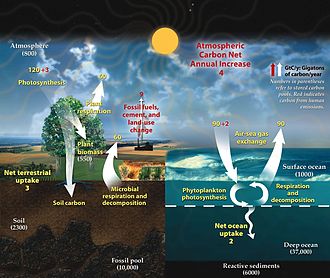
Peatlands cover just 3% of Earth's land surfaces, yet they hold between 500 and 700 billion tonnes of carbon. That is more than half the amount of carbon found in the atmosphere. Peatlands exchange carbon dioxide, methane and nitrous oxide with the air. In their natural state, mires take in a small amount of carbon dioxide through photosynthesis, which is more than the greenhouse gases they release. Most mires, however, release methane and nitrous oxide. The water table is the main control on how much carbon a peatland releases. When it rises after rain, the peat is covered by water, which limits oxygen and slows the release of carbon dioxide through respiration. When it falls, as in a drought, more oxygen reaches the microbes in the peat, which speeds up decomposition. Methane levels also change with the water table and temperature, because anaerobic microorganisms thrive when the water table is near the surface. Methanogens produce methane below the water table, and some of that methane is used up by methanotrophs above it. Peatlands also help scientists study past climate, since they can reveal isotopes, pollutants, macrofossils and pollen. Carbon-14 dating can show the age of the peat. Many kinds of microorganisms live in peatlands, including zoobenthos, and Sphagnum species are the most abundant. Peat contains a lot of humic acid, and humic materials can hold large amounts of water. If peatlands are dried out for farming, the water table drops and carbon is released into the air.
Use by humans
See also: Peat
Peatlands can hold clues about how people lived and what the environment was like in the past. These clues can be human objects, or records from plants and chemicals, such as palaeoecological and geochemical records. Today, the most common uses of peatlands are farming and forestry, which use about a quarter of the world's peatland. Farmers cut drainage ditches to lower the water table so that forests grow better or the land can be used for grazing animals or growing crops. Peat is also dug up for energy in Northern European countries, such as Russia, Sweden, Finland, Ireland and the Baltic states.
Tropical peatlands cover only 0.25% of Earth's land, but they store 3% of all soil and forest carbon. When people drain and harvest these peat forests, large amounts of carbon dioxide go into the air. Fires on dried peatland release even more. In Southeast Asia, peatlands are drained and cleared mostly by developing nations to make room for palm oil and timber, which are often exported. This releases carbon dioxide that the land had stored.
Tropical peatlands
Tropical peatlands are found mostly in Southeast Asia, where people have used them more for farming in recent decades. Large areas have been cleared and drained to grow food and cash crops such as palm oil. Draining these areas on a large scale often leads to subsidence, flooding, fires and poorer soil quality. The plants and the peat depend on each other, so changes to the water or the plants can harm the whole system. These lands are also cut down for logging and clear-cutting. Tropical peatland plants change with the climate, from mangrove woodlands near salty water to swamp forests further inland.
Tropical peatlands in Southeast Asia cover only a small part of Earth's land, but they give off a lot of carbon dioxide (CO2), especially when they are drained and burned. Fires in Indonesia have grown worse during drought years linked to ENSO-related weather, and the El Niño event of 1997–1998 caused huge losses of peatland. In 2015, wildfires released 11.3 Tg of CO2 per day in September and October. A large rice farming project called the Mega Rice Project, started in the 1990s, turned peatland into rice paddies but failed, and draining peatlands is one of the biggest long-term threats to them. Peatlands also release methane, which has a strong global warming potential.
Northern peatlands
Northern peatlands are linked to boreal and subarctic climates. Most were built up during the Holocene, after the Pleistocene glaciers pulled back. Tropical peatlands, in contrast, are much older. Total northern peat carbon stocks are estimated to be 1055 Gt C.
Of all the northern countries that surround the Arctic, Russia has the largest area of peatlands. It also contains the largest peatland in the world, the Great Vasyugan Mire. Nakaikemi Wetland in southwest Honshu, Japan, is more than 50,000 years old and has a depth of 45 m. The Philippi Peatland in Greece probably has one of the deepest peat layers, at 190 m.
Impacts on global climate
Wetlands and peatlands can help slow down climate change. The IPCC Sixth Assessment Report says that protecting and restoring them could cut greenhouse gas emissions and help with adapting to change and protecting wildlife. Wetlands store carbon in living plants, dead plants, and peat, though some of it is turned into carbon dioxide and methane. Wetlands store carbon well because they have high plant growth, high water levels, and slow decay. They need suitable meteorological and water conditions, and when their soil is fully soaked, anaerobic conditions form that store carbon but release methane. Wetlands cover about 5-8% of Earth's land but hold about 20-30% of the planet's 2500 Gt soil carbon. Peatlands hold more soil carbon than any other wetland type. Over the Holocene, the past 12,000 years, peatlands have acted as long-term carbon sinks and have cooled the climate. As the planet warms, wetlands could become major sources of carbon, and peatlands also help protect permafrost in cold regions.
Draining peatlands for farming and forestry releases large amounts of greenhouse gas emissions, mainly carbon dioxide and methane, because air enters the peat and it breaks down. Drained peatland carbon is hard to recover in time to help with climate goals. Drained peatlands are estimated to make up around 10% of all greenhouse gas emissions from farming and forestry. Palm oil is one of the world's largest crops and is considered efficient, but many plantations have replaced forested peatlands in Southeast Asia. These peatlands are drained and cleared to grow palm oil, which is used for vegetable oil and biofuel, and it is a popular cash crop in many countries. Draining causes fires, emissions, and lower biodiversity-related risks, and fires in dried peat release large amounts of carbon and harmful smoke that cause thousands of deaths every year. Some peatlands are also drying out because of climate change, and fires in these areas have increased sharply in recent years, especially in tropical regions. Fires are expected to become more frequent as the climate warms and dries, releasing more biomass and greenhouse gasses.
Management and rehabilitation
See also: Peatland restoration
The United Nations Convention on Biological Diversity highlights peatlands as key ecosystems that should be protected and cared for. The convention asks governments at all levels to present action plans for looking after wetland environments. Wetlands are also protected under the 1971 Ramsar Convention.
Restoration is often done by blocking the channels that drain water from a peatland, so natural plants can recover. In North America and Europe, rehabilitation projects usually focus on wetting peatlands again and replanting native plants. This helps reduce carbon release in the short term, until new plant growth provides fresh litter to build peat over the long term. UNEP is supporting peatland restoration in Indonesia. Peat extraction has been forbidden in Chile since April 2024.

Quiz time!
5 questions about Peatland
Why does plant material build up into peat instead of fully rotting away?
Pictures
Keep exploring




This article is a child-friendly adaptation of the Wikipedia article on Peatland, available under CC BY-SA 4.0.
Images from Wikimedia Commons. Tap any image to view credits and license.