 Safekipedia
Planck units
Adapted from Wikipedia · Discoverer experience
In particle physics and physical cosmology, Planck units are a special way to measure things. They use four important numbers from nature to define their measurements. These numbers are the speed of light, a constant for gravity, a constant for tiny particles, and a constant for heat energy. This system was first suggested in 1899 by a scientist named Max Planck.
The Planck scale is a very small size and a very short time. At this scale, normal physics rules might not work, and we need to think about how gravity works with tiny particles. This scale is similar to the conditions just after the Big Bang, when the universe was very young.
These units help scientists study big ideas like how gravity and tiny particles might work together. There are also different versions of Planck units, where some of these important numbers might have different values.
Introduction
In science, we often use special units to measure things, like meters for length or seconds for time. Planck units are a unique way to measure things using basic parts of nature. They come from four important constants in physics: the speed of light, a number that helps us understand gravity, a tiny amount of action in the quantum world, and a number that relates to temperature.
These units help scientists simplify equations. For example, one of Newton's laws about gravity can be written without one of the constants, making the math easier. But scientists must be careful when using these units to avoid losing important information.
History and definition
The idea of using natural units started in 1874 when George Johnstone Stoney noticed that electric charge comes in specific amounts. He created units named after him, called Stoney units, using constants like gravity, light speed, and electron charge.
In 1899, Max Planck introduced a new constant called the Planck constant. At the end of his paper, he suggested using special units based on nature itself, not on man-made objects. These units would work the same for everyone, no matter when or where they lived. Planck used important constants like gravity, light speed, and others to create units for measuring length, time, mass, and temperature.
| Name | Dimension | Expression | Value (SI units) |
|---|---|---|---|
| Planck length | length (L) | l P = ℏ G c 3 {\displaystyle l_{\text{P}}={\sqrt {\frac {\hbar G}{c^{3}}}}} | 1.616255(18)×10−35 m |
| Planck mass | mass (M) | m P = ℏ c G {\displaystyle m_{\text{P}}={\sqrt {\frac {\hbar c}{G}}}} | 2.176434(24)×10−8 kg |
| Planck time | time (T) | t P = ℏ G c 5 {\displaystyle t_{\text{P}}={\sqrt {\frac {\hbar G}{c^{5}}}}} | 5.391247(60)×10−44 s |
| Planck temperature | temperature (Θ) | T P = ℏ c 5 G k B 2 {\displaystyle T_{\text{P}}={\sqrt {\frac {\hbar c^{5}}{Gk_{\text{B}}^{2}}}}} | 1.416784(16)×1032 K |
Derived units
In any system of measurement, we can create units for many physical quantities from the basic units. Table 2 shows some of these derived Planck units, though many are rarely used. Like the basic units, these are mostly important for theoretical physics because they are often too large or too small to use in real experiments.
Some Planck units, like those for time and length, are either much too large or much too small to be useful in everyday life. Because of this, Planck units are mainly used in theoretical physics. For instance, our understanding of the Big Bang does not include the Planck epoch, which is when the universe was younger than one Planck time. To describe the universe during this time, we would need a theory of quantum gravity that connects quantum effects with general relativity. However, such a theory has not been discovered yet.
Some Planck units, like the Planck mass, are not extreme. The Planck mass is about 22 micrograms, which is large compared to tiny particles but small compared to living things. The related units of energy and momentum are also in a range we might see in everyday life.
| Derived unit of | Expression | Approximate SI equivalent |
|---|---|---|
| area (L2) | l P 2 = ℏ G c 3 {\displaystyle l_{\text{P}}^{2}={\frac {\hbar G}{c^{3}}}} | 2.6121×10−70 m2 |
| volume (L3) | l P 3 = ( ℏ G c 3 ) 3 2 = ( ℏ G ) 3 c 9 {\displaystyle l_{\text{P}}^{3}=\left({\frac {\hbar G}{c^{3}}}\right)^{\frac {3}{2}}={\sqrt {\frac {(\hbar G)^{3}}{c^{9}}}}} | 4.2217×10−105 m3 |
| momentum (LMT−1) | m P c = ℏ l P = ℏ c 3 G {\displaystyle m_{\text{P}}c={\frac {\hbar }{l_{\text{P}}}}={\sqrt {\frac {\hbar c^{3}}{G}}}} | 6.5249 kg⋅m/s |
| energy (L2MT−2) | E P = m P c 2 = ℏ t P = ℏ c 5 G {\displaystyle E_{\text{P}}=m_{\text{P}}c^{2}={\frac {\hbar }{t_{\text{P}}}}={\sqrt {\frac {\hbar c^{5}}{G}}}} | 1.9561×10⁹ J |
| force (LMT−2) | F P = E P l P = ℏ l P t P = c 4 G {\displaystyle F_{\text{P}}={\frac {E_{\text{P}}}{l_{\text{P}}}}={\frac {\hbar }{l_{\text{P}}t_{\text{P}}}}={\frac {c^{4}}{G}}} | 1.2103×1044 N |
| density (L−3M) | ρ P = m P l P 3 = ℏ t P l P 5 = c 5 ℏ G 2 {\displaystyle \rho _{\text{P}}={\frac {m_{\text{P}}}{l_{\text{P}}^{3}}}={\frac {\hbar t_{\text{P}}}{l_{\text{P}}^{5}}}={\frac {c^{5}}{\hbar G^{2}}}} | 5.1550×1096 kg/m3 |
| acceleration (LT−2) | a P = c t P = c 7 ℏ G {\displaystyle a_{\text{P}}={\frac {c}{t_{\text{P}}}}={\sqrt {\frac {c^{7}}{\hbar G}}}} | 5.5608×1051 m/s2 |
| frequency (T-1) | f P = 1 2 π c 5 ℏ G {\displaystyle f_{\text{P}}={\frac {1}{2\pi }}{\sqrt {\frac {c^{5}}{\hbar G}}}} | 2.9521×1042 Hz |
Significance
Planck units are special ways to measure things using basic parts of nature, not man-made rules. Unlike the metre or second, which were chosen for historical reasons, the Planck length and Planck time are connected to the very laws of physics. This helps scientists ask better questions. For example, instead of wondering why gravity is weak, they ask why particles like protons have such small mass.
When Max Planck first suggested these units in 1899, he wanted a universal way to measure things. Later, scientists thought that the Planck scale might show where our usual theories stop working, and space itself might behave strangely.
Planck scale
In particle physics and physical cosmology, the Planck scale is an energy scale where quantum effects of gravity become important. At this very high energy level, around 1.22×1028 eV, our usual theories about how tiny particles interact stop working well because gravity becomes hard to describe in these terms.
At the Planck length scale, gravity’s strength is thought to become similar to other forces, and scientists believe all forces might unite at this scale, though exactly how this happens is still a mystery. The Planck scale marks where we can no longer ignore quantum gravity effects, and our current ways of calculating break down. Some think it might be the lowest limit for forming a black hole by collapse.
Physicists understand other forces well at the quantum level, but gravity is tricky. It doesn’t fit into our usual theories at very high energies. For energies close to or above the Planck scale, we need a new theory of quantum gravity. Ideas for solving this include string theory, M-theory, loop quantum gravity, noncommutative geometry, and causal set theory.
In Big Bang cosmology, the Planck epoch is the very first stage of the universe, before time reached what we call the Planck time, about 10−43 seconds. We don’t have a good theory to describe such tiny times, and it’s unclear if the idea of time even makes sense at that level. During this time, quantum effects of gravity are thought to dominate. The universe was extremely hot and dense, and the forces we know today were likely united with gravity. This period was followed by the grand unification epoch, then the inflationary epoch, which ended after about 10−32 seconds.
The Planck length is about 10−20 times the size of a proton. It’s a scale where quantum gravity might change our ideas about distance. Some think the Planck length could be the shortest distance we can measure, because trying to look at smaller distances might just create black holes instead of showing smaller pieces.
The Planck time is so small that our current theories can’t describe what happened during that earliest moment of the Big Bang.
The Planck energy is roughly the energy in a car’s tank of fuel. In 1991, scientists observed a cosmic ray with energy about 2.5×10⁻⁸ times the Planck energy.
At the Planck temperature, the light from heat would have a wavelength about the Planck length. We don’t have theories to describe temperatures higher than this, and a quantum theory of gravity would be needed. At this temperature, black holes might form and disappear constantly, and adding more energy could actually lower the temperature by creating bigger black holes.
| Property of present-day observable universe | Approximate number of Planck units | Equivalents |
|---|---|---|
| Age | 8.08 × 1060 tP | 4.35 × 10¹⁷ s or 1.38 × 10¹⁰ years |
| Diameter | 5.4 × 1061 lP | 8.7 × 1026 m or 9.2 × 10¹⁰ light-years |
| Mass | approx. 1060 mP | 3 × 1052 kg or 1.5 × 10²² solar masses (only counting stars) 1080 protons (sometimes known as the Eddington number) |
| Density | 1.8 × 10−123 mP⋅lP−3 | 9.9 × 10⁻²⁷ kg⋅m−3 |
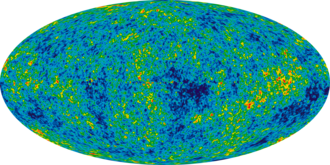
| Temperature | 1.9 × 10⁻³² TP | 2.725 K temperature of the cosmic microwave background radiation |
| Cosmological constant | ≈ 10−122 l −2 P | ≈ 10−52 m−2 |
| Hubble constant | ≈ 10−61 t −1 P | ≈ 10−18 s−1 ≈ 102 (km/s)/Mpc |
Nondimensionalized equations
In physics, different types of measurements like time and length can't be directly compared, even if their numbers look the same. However, in theoretical physics, scientists sometimes simplify things through a process called nondimensionalization. This makes many important physics equations easier by replacing certain constants with the number 1.
For example, the energy–momentum relation usually includes constants, but with this method, it becomes simpler. The Dirac equation, which describes how tiny particles behave, also looks simpler when constants are replaced by 1.
Alternative choices of normalization
Planck units are created by setting certain important numbers in nature to 1. But there are many ways to do this, and scientists sometimes choose different rules.
One common idea in physics is to use a number called 4π, which appears often when dealing with spheres. Some scientists think it makes more sense to set 4π times the gravitational constant to 1 instead of just the constant itself. This changes some math formulas but can make them look simpler and more like other important equations in physics. When they do this for both gravity and electromagnetism, they call the units "rationalized Planck units." In this system, five important numbers—c, 4π_G_, ħ, ε0, and kB—are all set to 1.
When designing these special units, scientists must decide whether to remove factors of 4π from the equations. If they set 4π_G_ to 1, it simplifies several important formulas, like Gauss's law for gravity and the Poisson equation. It also makes the equations that describe gravity in weak fields look just like the equations that describe electricity and magnetism.
Gravitational constant
The number G usually appears in physics equations multiplied by 4π or a small whole number. When creating natural units, scientists can choose to eliminate these 4π factors. If they set 4π_G_ to 1, it simplifies Gauss's law for gravity so it no longer has a 4π in it. It also removes 4π from the Poisson equation and from equations that mix gravity and electromagnetism. This choice also makes the impedance of gravitational waves in empty space equal to 1 and simplifies the formula for the entropy of a black hole.
Another option is to set 8π_G_ to 1. This removes 8π_G_ from the Einstein field equations, the Einstein–Hilbert action, and the Friedmann equations. When Planck units are changed this way, they are called "reduced Planck units." This also simplifies the formula for the entropy of a black hole.
| Expression | Value (SI units) |
|---|---|
| l P ′ = 4 π G ℏ c 3 {\displaystyle l_{\text{P}}^{\prime }={\sqrt {\frac {4\pi G\hbar }{c^{3}}}}} | 5.7295×10⁻³⁵ m |
| m P ′ = ℏ c 4 π G {\displaystyle m_{\text{P}}^{\prime }={\sqrt {\frac {\hbar c}{4\pi G}}}} | 6.1396×10⁻⁹ kg |
| t P ′ = 4 π G ℏ c 5 {\displaystyle t_{\text{P}}^{\prime }={\sqrt {\frac {4\pi G\hbar }{c^{5}}}}} | 1.9111×10−43 s |
| q P ′ = ε 0 ℏ c {\displaystyle q_{\text{P}}^{\prime }={\sqrt {\varepsilon _{0}\hbar c}}} | 5.2908×10⁻¹⁹ C |
| T P ′ = ℏ c 5 4 π G k B 2 {\displaystyle T_{\text{P}}^{\prime }={\sqrt {\frac {\hbar c^{5}}{4\pi Gk_{\text{B}}^{2}}}}} | 3.9967×1031 K |
Related articles


This article is a child-friendly adaptation of the Wikipedia article on Planck units, available under CC BY-SA 4.0.
Images from Wikimedia Commons. Tap any image to view credits and license.