 Safekipedia
Chronology of the universe
Adapted from Wikipedia · Discoverer experience
The chronology of the universe describes the history and future of the universe according to Big Bang cosmology. In this model, the history of the universe begins 13.787 billion years ago, when the universe was extremely dense and hot, before any matter formed.
The earliest stage is a vast expansion of space in a tiny fraction of a microsecond, followed by a slower expansion and the creation of matter and antimatter particles. These particles almost completely disappear, leaving energy and a small amount of matter in the form of a special kind of plasma. As the expansion continues, this plasma turns into a sea of protons and neutrons.
After just one second, the temperature drops enough that tiny particles called neutrinos stop reacting and continue moving across the universe today. After six seconds, the cooling from expansion allows the nuclei of the first elements to form, mainly hydrogen and helium, with a small amount of lithium.
After a few minutes, the universe cools for thousands of years until atoms become stable. The light from this time is still visible today as the background temperature of the universe. Later, gravity pulls hydrogen gas together, forming the first stars and eventually galaxies and larger structures we see today.
Background
Expansion
Main article: Expansion of the universe
The current way we understand the history of the universe is based on the idea of the Big Bang: the universe began very hot and crowded, then it grew bigger and cooler. As the universe grows, different tiny parts stop interacting with each other. This changes what the universe is like. Also, how fast the universe grows depends on what is inside it, linking together the study of the universe and the study of tiny parts of matter.
Time
Main article: Cosmic time
In the study of the universe, time and space are linked: as space grows, so does time. Time at any spot in space (like a galaxy) can be thought of as having its own imaginary clock. These clocks move along with their spot in space as the universe expands; they all match up to one moment long ago. Light from faraway galaxies was sent out long ago and moves at the speed of light: what we know about a faraway galaxy is only from one moment called the lookback time. As this light travels, the universe keeps growing, stretching the light’s wavelength, an effect called cosmological redshift. By measuring this redshift, we can find out how far away the galaxy is. This is how we learn about the timeline of the universe by watching distant light.
Overview
The story of the universe is divided into five main parts. The first part is called Inflation, a time when the universe grew very quickly. After that, particles called quark soup cooled and came together, and dark matter began to form. Next, in Big bang nucleosynthesis, small parts of atoms called nucleons joined to make the first atoms. Then, gravity builds cosmic structure as matter started to gather under gravity, forming stars, galaxies, and groups of galaxies. Finally, cosmic acceleration happened when the universe's expansion was pushed by dark energy, which became stronger than gravity.
Older models described these steps with different names or focuses. Modern science starts its timeline with inflation, which is the earliest period we have strong evidence for. Anything before that is still being studied and not yet confirmed.
| Article subsection | Cosmic time: 72 | Redshift | Temperature: 72 | Description |
|---|---|---|---|---|
| Inflation | unknown | not applicable | Cosmic inflation expands space by a factor of the order of 1026 over a time of the order of 10−36 to 10−32 seconds. | |
| Reheating | unknown | unknown | Converts the energy in the inflation field into a thermal bath of Standard Model particles, initiating the Hot Big Bang. Many mechanisms have been proposed. | |
| Baryogenesis | unknown | unknown | Matter and antimatter are created with one extra particle of matter for every 1010 pairs. The pairs annihilate producing photons and leaving the matter particles. Many mechanisms have been proposed but no observations select one.: 7 | |
| Electroweak phase transition | 20×10−12 s | 20×1015 | > 1015 K (150 GeV/kB) | The strong interaction becomes distinct from the electroweak interaction. Matter particles have mass.: 6 The sphere of space that will become the observable universe is approximately 300 light-seconds (~0.6 au) in radius at this time. |
| Quantum chromodynamics phase transition | 20×10−6 s | 1012 | 1015 K – 1012 K (150 GeV/kB – 150 MeV/kB) | The quark–gluon plasma of matter particles coalesce into hadrons: mostly protons, neutrons, and pions.: 6 |
| Neutrino decoupling | 1 s | 6×10⁹ | 1010 K (1 MeV/kB) | Neutrinos cease interacting with baryonic matter, and form cosmic neutrino background.: 6 The sphere of space that will become the observable universe is approximately 10 light-years in radius at this time. |
| Electron-positron annihilation | 6 s | 2×10⁹ | 1010 K – 109 K (1 MeV/kB – 100 keV/kB) | As the temperature falls, photons no longer have sufficient energy to produce electron/positron pairs. Electrons and positrons annihilate, leaving photons.: 87 |
| Big Bang nucleosynthesis | 10 s – 1000 s | 4×10⁸ | 109 K – 107 K (0.1 MeV/kB – 1 keV/kB) | Protons and neutrons are bound into primordial atomic nuclei: hydrogen and helium-4. Trace amounts of deuterium, helium-3, and lithium-7 also form. At the end of this epoch, the spherical volume of space which will become the observable universe is about 300 light-years in radius, baryonic matter density is on the order of 4 grams per m3 (about 0.3% of sea level air density)—however, most energy at this time is in electromagnetic radiation. |
| Recombination | 290 ka – 370 ka | 1090 – 1270 | 4000 K (0.4 eV/kB) | Electrons and atomic nuclei first become bound to form neutral atoms. Photons are no longer in thermal equilibrium with matter and the universe first becomes transparent. Recombination lasts for about 100 ka, during which the universe is becoming more and more transparent to photons. The photons of the cosmic microwave background radiation originate at this time. The spherical volume of space that will become the observable universe is 42 million light-years in radius at this time. The baryonic matter density at this time is about 500 million hydrogen and helium atoms per cubic metre, approximately a billion times higher than today. This density corresponds to pressure on the order of 10−17 atm. |
| Dark Ages | 370 ka – 150 Ma? (Only fully ends by about 1 Ga) | 1100 – 20 | 4000 K – 60 K | The time between recombination and the formation of the first stars. During this time, the only source of photons was hydrogen emitting radio waves at hydrogen line. Freely propagating CMB photons quickly (within about 3 million years) red-shifted to infrared, and the universe was devoid of visible light. |
| Star and galaxy formation and evolution | Earliest galaxies: from about 300–400 Ma? (first stars: similar or earlier) Modern galaxies: 1 Ga – 10 Ga (exact timings being researched) | From about 20 | From about 60 K | The earliest known galaxies existed by about 280 Ma. Galaxies coalesce into "proto-clusters" from about 1 Ga (redshift z = 6) and into galaxy clusters beginning at 3 Ga (z = 2.1), and into superclusters from about 5 Ga (z = 1.2). See: list of galaxy groups and clusters, list of superclusters. |
| Reionization | 200 Ma – 1 Ga (exact timings being researched) | 20 – 6 | 60 K – 19 K | The most distant astronomical objects observable with telescopes date to this period; as of June 2025, the most remote galaxy observed is MoM-z14, at a redshift of 14.44. The earliest "modern" Population I stars are formed in this period. |
| Present time | 13.8 Ga | 0 | 2.7 K | Farthest observable photons at this moment are CMB photons. They arrive from a sphere with a radius of 46 billion light-years. The spherical volume inside it is commonly referred to as the observable universe. |
| Alternative subdivisions of the chronology (overlapping several of the above periods) | ||||
| Radiation-dominated era | From inflation (~ 10−32 sec) – 47 ka | > 3600 | > 104 K | During this time, the energy density of massless and near-massless relativistic components such as photons and neutrinos, which move at or close to the speed of light, dominate both matter density and dark energy. |
| Matter-dominated era | 47 ka – 9.8 Ga: 96 | 3600 – 0.4 | 104 K – 4 K | During this time, the energy density of matter dominates both radiation density and dark energy, resulting in a decelerated expansion of the universe. |
| Dark-energy-dominated era | > 9.8 Ga: 96 | Matter density falls below dark energy density (vacuum energy), and expansion of space begins to accelerate. This time happens to correspond roughly to the time of the formation of the Solar System and the evolutionary history of life. | ||
| Stelliferous Era | 150 Ma – 100 Ta | 20 – −0.99 | 60 K – 0.03 K | The time between the first formation of Population III stars until the cessation of star formation, leaving all stars in the form of degenerate remnants. |
| Far future | > 100 Ta | The stelliferous era will end as stars eventually die and fewer are born to replace them, leading to a darkening universe. Various theories suggest a number of subsequent possibilities. Assuming proton decay, the matter may eventually evaporate into a Dark Era (heat death). Alternatively, the universe may collapse in a Big Crunch. Other suggested ends include a false vacuum catastrophe or a Big Rip as possible ends to the universe. | ||
Inflation
Main articles: Inflation (cosmology) and Expansion of the universe
Very early in the universe’s life, it expanded quickly. This happened just a tiny bit after the Big Bang, in less than a millionth of a millionth of a second. The universe grew huge during this time, from something very small to about the size of a ball.
This fast growth helped explain why we see groups of stars and galaxies today instead of everything spread out evenly. Tiny changes in the very early universe became big structures later on. We still don’t fully know what caused this quick expansion, but some ideas point to forces in nature changing and creating something called the inflaton field, which pushed everything apart very fast. This also spread out any old particles or problems from before this time.
Reheating
The exact time when the fast expansion of the universe stopped is not known, but it likely happened between 10−33 and 10−32 seconds after the Big Bang. During this fast expansion, particles spread out so thinly that they no longer had a temperature we can measure.
When the fast expansion ended, energy from a special field turned into many particles, making the universe fill up again with a dense, hot mix of basic particles. As the universe kept expanding, a small area that was once the size of a melon grew to become everything we can see today.
Main article: reheating
Main articles: elementary particles, Standard Model, observable universe
Hot Big Bang
The hot Big Bang model explains the history of the universe. It describes a time when the universe was extremely hot and dense. After this, the universe began to expand and is still expanding today. This model matches many observations of space and stars. Scientists call this the Lambda-CDM model. They do not know exactly what happened before the universe began to expand.
Baryogenesis
Main article: Baryogenesis
Baryons are tiny particles, such as protons and neutrons, made from three smaller parts called quarks. Scientists expect that when the universe began, baryons and their opposites, called antibaryons, would have been created in equal numbers. However, today we see almost no antibaryons. We do not fully understand why this is. To explain this, special conditions must have been met after a very fast expansion of the universe known as cosmological inflation. While current science suggests these conditions could happen, the differences are too small to fully explain what we see in the universe today.
Electroweak phase transition
Main article: Electroweak symmetry breaking
10−12 seconds after the Big Bang
As the universe cooled, something important happened. All the tiny particles that make up everything we see gained their weight. Before this, they had no weight at all. This change also made two forces — the weak nuclear force and the electromagnetic force — act very differently. Some particles that carry these forces suddenly became heavy and could only work over very tiny distances, like inside an atom. Other particles, like light, stayed light and could travel far.
Even after this change, the universe was still too hot for things like protons, neutrons, or atoms to stay together for long. Everything was moving and changing too fast.
Quantum chromodynamics phase transition
Between 10−12 seconds and 10−5 seconds after the Big Bang
Main article: Quark epoch
After a very fast expansion, the universe was filled with hot building blocks called quark–gluon plasma. During this time, scientists can study these conditions using special experiments.
The quark epoch began about 10−12 seconds after the Big Bang. During this time, the universe was very hot, so small particles called quarks could not stick together to form larger particles called hadrons. This period ended when the universe was about 10−5 seconds old.
Neutrino decoupling and cosmic neutrino background (CνB)
Main articles: Neutrino decoupling and Cosmic neutrino background
About 1 second after the Big Bang, tiny particles called neutrinos stopped interacting with other matter and started moving freely through space. Because neutrinos rarely bump into anything, these ancient neutrinos are still around today. They have very little energy—about 10−10 times the energy of neutrinos we can detect today. Because they are so hard to spot, scientists may not see this background of neutrinos clearly for many years.
Even though we haven’t seen them directly, there is strong evidence that these neutrinos exist. They are linked to the amount of helium created shortly after the Big Bang and to small patterns in the cosmic microwave background—the faint glow left over from the early universe. In 2015, scientists found clues in this glow that match what we would expect from these ancient neutrinos. The patterns suggest there are exactly three types of neutrinos, just as theories predict.
Electron-positron annihilation
Main article: Lepton epoch
Between 1 second and 10 seconds after the Big Bang, most particles called hadrons and their opposite particles, anti-hadrons, disappeared by crashing into each other. This left behind lighter particles called leptons, like electrons, muons, and some neutrinos, along with their opposite particles, antileptons. At first, these particles were made in pairs. As the universe cooled about 10 seconds after the Big Bang, it became too cold to make new pairs. The remaining leptons and antileptons then quickly crashed into each other, creating high-energy light called photons. After this, most of the mass and energy in the universe was in the form of these photons.
Nucleosynthesis of light elements
Main article: Big Bang nucleosynthesis
A few minutes after the Big Bang, the universe was hot and dense enough for tiny particles to combine. During this time, particles called protons and neutrons joined together to form new elements. Most of these combinations created deuterium, a type of hydrogen, and helium-4, a type of helium. Almost all the deuterium quickly turned into helium-4 because it is very stable.
Because the universe was expanding and cooling quickly, heavier elements like those made in stars didn’t form. Only small amounts of other elements, such as tritium and beryllium, were created, but these were unstable and broke apart soon after. The amounts of these light elements that we see in very old parts of the universe today match what we expect from this early time, which helps scientists understand how the universe began.
Matter-radiation equality
47,000 years after the Big Bang
Main articles: Matter-dominated era and Structure formation
For the first part of the universe's life, radiation—like light and energy—controlled how things changed. But after about 47,000 years, something new happened. Matter, which includes all the stuff we see around us, started to become more important than radiation. This shift allowed the universe to start forming larger structures.
As the universe cooled, matter began to gather together. There are two kinds of matter: ordinary matter, which makes up stars and planets, and a mysterious kind called dark matter, which we can't see but know is there because of its effects on gravity. Dark matter helped pull ordinary matter together to form the first clusters and clouds. These early gatherings eventually led to the formation of stars and galaxies.
Recombination, photon decoupling, and the cosmic microwave background (CMB)
Main articles: Recombination (cosmology) and decoupling (cosmology)
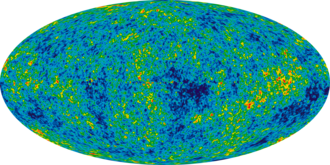
About 370,000 years after the Big Bang, an important change happened. The hot, glowing soup of particles in the early universe cooled enough for the first atoms to form. Before this, the universe was filled with a fog of charged particles that scattered light in all directions, making it impossible to see anything clearly.
As the universe cooled, electrons joined with protons to form neutral hydrogen atoms. When this happened, the light could finally travel freely without being scattered away. This moment is called photon decoupling, and the light released at this time is still around us today as the cosmic microwave background. It started out as visible light but, over billions of years, stretched into microwave radiation due to the expanding universe.
| The background of this box approximates the original 4000 K color of the photons released during decoupling, before they became redshifted to form the cosmic microwave background. The entire universe would have appeared as a brilliantly glowing fog of a color similar to this and a temperature of 4000 K, at the time. |
Gravity builds cosmic structure
370 thousand to about 1 billion years after the Big Bang
See also: Hydrogen line and List of the most distant astronomical objects
Even before light could travel freely, tiny bits of matter started to clump together because of gravity. Clouds of a gas called hydrogen slowly came together to form the first stars and galaxies.
Dark Ages
See also: 21 centimeter radiation
After light could travel freely, the universe had cooled down but still had no stars or galaxies to give off light. This time, called the Dark Ages, lasted from about 370,000 years after the Big Bang until the first stars formed. During this time, the universe was dark except for faint signals from hydrogen atoms.
The first stars, called Population III stars, appeared a few hundred million years after the Big Bang. These stars were the first to shine and helped end the Dark Ages. As more stars and galaxies formed, the universe began to look more like it does today.
Oldest observations of stars and galaxies
Main articles: Hubble Space Telescope, James Webb Space Telescope, and List of the most distant astronomical objects
Today, the oldest stars and galaxies we can see are from about 400 million years after the Big Bang. The James Webb Space Telescope, launched in December 2021, can see even farther back, to about 180 million years after the Big Bang, which might be when the first stars formed.
Earliest structures and stars emerge
Around 150 million to 1 billion years after the Big Bang
See also: Stellar formation, Dwarf galaxy, Baryon acoustic oscillations, Large-scale structure, Structure formation, and Stelliferous Era
Most of the matter in the universe is a mysterious type called dark matter, which slowly gathered into thin threads. Regular matter, made of atoms, followed these threads and formed clouds of hydrogen gas. These clouds eventually collapsed to form the first stars and galaxies. Where many galaxies formed, they grouped together into clusters and superclusters, while empty spaces called voids formed between them.
Reionization
See also: Reionization, Dwarf galaxy, and Quasar
As the first stars, small galaxies, and bright objects called quasars formed, their powerful light split hydrogen atoms apart, making the universe glow with energy again. This process, called reionization, changed the universe from a dark, foggy place to one where light could travel freely.
We study reionization by looking at light from distant quasars. This light shows patterns that tell us whether the hydrogen it passed through was split apart or still whole. By studying these patterns, scientists can figure out when reionization happened and how long it lasted.
Reionization likely started around 250 million years after the Big Bang and was mostly finished by about 500 million years. Some areas of neutral hydrogen still exist today, creating faint lines in the light from distant objects.
In August 2023, the James Webb Space Telescope shared images of black holes and other objects from the very early universe.
Galaxies, clusters and superclusters
See also: Galaxy formation and evolution
Over time, gravity continued to pull matter together to form galaxies. The stars from this time are called Population II stars, with newer stars called Population I stars forming later. Galaxies also grouped together into clusters and superclusters. Observations show small galaxies merging to form larger ones about 800 million years after the Big Bang.
Present and future
Further information: Timeline of natural history, Geologic time scale, Timeline of the evolutionary history of life, and Timeline of the far future
For about 12.8 billion years, the universe has looked much like it does today and will continue to look very similar for many more billions of years. The thin disk of the Milky Way began to form when the universe was about 5 billion years old. The Solar System formed about 9.2 billion years ago. The oldest organic matter that could support life dates back 4 billion years.
Dark energy is a mysterious force that makes the universe expand faster and faster. About 9.8 billion years after the Big Bang, the universe’s expansion began to speed up instead of slowing down. Scientists think dark energy makes up most of the universe. Unlike gravity, which pulls things together, dark energy pushes things apart, and its effect grows as the universe gets bigger. This means that far in the future, the universe may keep expanding at an ever-faster rate.
Beyond standard cosmology
Main articles: Cosmogenesis and Origin of the universe
Scientists use models to think about what happened very early in the universe, about 10-43 seconds after it began. These models help us understand the character and properties of the early universe.
Main article: Initial singularity
When we think about the very beginning, with infinite temperature and zero size, it goes beyond what our current physics can explain. It isn’t useful to guess about these conditions because they are outside our theories.
Main article: Grand unification epoch
Between 10-43 seconds and 10-36 seconds after the universe started, scientists think it could be described by theories that go beyond the usual particle physics models. These theories are called grand unified theories. Though many have been suggested, none have fully matched observations yet. During this time, as the universe cooled, it might have gone through a big change, similar to how water freezes, which could explain why there is more matter than antimatter today.
Main article: Electroweak epoch
Starting around 10-22 to 10-15 seconds after the universe began and lasting until about 10-12 seconds, particles interacted and reached a balance. Before this, at very high temperatures, forces and particles were different. This changed when the universe cooled enough, allowing forces and particles to behave as they do today.
Main articles: Ultimate fate of the universe and Timeline of the far future
Further information: Future of an expanding universe and Heat death of the universe
There are different ideas about what might happen to the universe in the very far future. What happens depends on things we don’t fully know yet, like certain constants of nature. If the universe keeps expanding, over trillions of years, most galaxies will move far away. Stars will stop being born, and even the longest-lived stars will eventually end. Everything will cool down and break apart into tiny particles.
The following scenarios have been proposed for the ultimate fate of the universe:
On extremely long timescales, rare events caused by quantum effects might happen. For example, over millions of trillions of years, black holes might seem to disappear quickly, and very unlikely events might occur many times.
| Scenario | Description | |
|---|---|---|
| Heat death | As expansion continues, the universe becomes larger, colder, and more dilute; in time, all structures eventually decompose to subatomic particles and photons. | In the case of indefinitely continuing cosmic expansion, the energy density in the universe will decrease until, after an estimated time of 101000 years, it reaches thermodynamic equilibrium and no more structure will be possible. This will happen only after an extremely long time because first, some (less than 0.1%) matter will collapse into black holes, which will then evaporate extremely slowly via Hawking radiation. The universe in this scenario will cease to be able to support life much earlier than this, after some 1014 years or so, when star formation ceases., §IID In some Grand Unified Theories, proton decay after at least 1034 years will convert the remaining interstellar gas and stellar remnants into leptons (such as positrons and electrons) and photons. Some positrons and electrons will then recombine into photons., §IV, §VF In this case, the universe has reached a high-entropy state consisting of a bath of particles and low-energy radiation. It is not known, however, whether it eventually achieves thermodynamic equilibrium., §VIB, VID The hypothesis of a universal heat death stems from the 1850s ideas of William Thomson (Lord Kelvin), who extrapolated the classical theory of heat and irreversibility (as embodied in the first two laws of thermodynamics) to the universe as a whole. |
| Big Rip | Expansion of space accelerates and at some point becomes so extreme that even subatomic particles and the fabric of spacetime are pulled apart and unable to exist. | For any value of the dark energy content of the universe where the negative pressure ratio is less than −1, the expansion rate of the universe will continue to increase without limit. Gravitationally bound systems, such as clusters of galaxies, galaxies, and ultimately the Solar System will be torn apart. Eventually the expansion will be so rapid as to overcome the electromagnetic forces holding molecules and atoms together. Even atomic nuclei will be torn apart. Finally, forces and interactions even on the Planck scale—the smallest size for which the notion of "space" currently has a meaning—will no longer be able to occur as the fabric of spacetime itself is pulled apart and the universe as it is known today will end in an unusual kind of singularity. |
| Big Crunch | Expansion eventually slows and halts, then reverses as all matter accelerates towards its common centre. Currently considered to be likely incorrect. | In the opposite of the "Big Rip" scenario, the expansion of the universe would at some point be reversed and the universe would contract towards a hot, dense state. This is a required element of oscillatory universe scenarios, such as the cyclic model, although a Big Crunch does not necessarily imply an oscillatory universe. Current observations suggest that this model of the universe is unlikely to be correct, and the expansion will continue or even accelerate. |
| Vacuum instability | Collapse of the quantum fields that underpin all forces, particles and structures, to a different form. | Cosmology traditionally has assumed a stable or at least metastable universe, but the possibility of a false vacuum in quantum field theory implies that the universe at any point in spacetime might spontaneously collapse into a lower-energy state (see Bubble nucleation), a more stable or "true vacuum", which would then expand outward from that point with the speed of light. |
Images
Related articles

This article is a child-friendly adaptation of the Wikipedia article on Chronology of the universe, available under CC BY-SA 4.0.
Images from Wikimedia Commons. Tap any image to view credits and license.