Visual arts
"Visual Arts" redirects here; not to be confused with Visual Arts (company).
The visual arts are art forms such as painting, drawing, printmaking, sculpture, ceramics, photography, video, image, filmmaking, design, crafts, and architecture. Many artistic disciplines such as performing arts, conceptual art, and textile arts, also involve aspects of the visual arts, as well as arts of other types. Within the visual arts, the applied arts, such as industrial design, graphic design, fashion design, interior design, and decorative art are also included.
Today, the term "visual arts" includes fine art as well as applied or decorative arts and crafts, but this was not always the case. Before the Arts and Crafts Movement in Britain and elsewhere at the turn of the 20th century, the term 'artist' had for some centuries often been limited to a person working in the fine arts, such as painting, sculpture, or printmaking, and not the decorative arts, crafts, or applied visual arts. Artists of the Arts and Crafts Movement emphasized this difference, and they valued folk art forms as much as high forms. Art schools also separated the fine arts from the crafts, holding that a craftsperson could not be considered a practitioner of the arts.
In both Western art and East Asian art, there was a growing tendency to place painting, and to a lesser degree sculpture, above other arts. Painting was seen as relying on the artist's imagination to the highest degree and as being the furthest removed from manual labour. In Chinese painting, the valued styles were "scholar-painting," which, at least in theory, was practiced by gentleman amateurs. The Western hierarchy of genres reflected similar attitudes.
Education and training
Visual arts education and training have changed over time, and they differ across the world and between cultures. Long ago, training in the visual arts began with apprentice and workshop systems, which usually lasted 2 to 6 years.
Different regions have followed different paths. In many European and North American countries, art academies grew into universities and institutes, and under the influence of industrialization, they focused more on applied arts than on fine arts. Several Sub-Saharan African countries have given less importance to art education in primary schools, choosing vocational or STEM subjects instead. In Asia, programs often followed the priorities of the state or nobility, though Singapore has focused on digital visual arts as part of its creative economy. In the Middle East, education moved away from 19th-century European models toward tourism and cultural heritage preservation. In several Latin American countries, art education that was once limited under colonial rule now focuses on contemporary art to build national identity, and Mexico's system has worked to bring together indigenous artistic heritage and Western academic structures. Museums and art galleries also teach people about art informally, offering historical context and aesthetic experiences.
Drawing
Main article: Drawing
Drawing is a way of making a 2D image, illustration, or graphic using many kinds of tools and techniques, both traditional and digital. Artists usually make marks on a surface by pressing a tool onto it or moving it across the surface. They use dry materials such as graphite pencils, pen and ink, inked brushes, wax color pencils, crayons, charcoals, pastels, and markers. Digital stylus pens can copy these effects. Common drawing methods include line drawing, hatching, crosshatching, random hatching, shading, scribbling, stippling, and blending. Chinese artists value the Four Treasures of the Study: the brush, ink, inkstone, and paper.
Drawing goes back tens of thousands of years and is found in cultures all over the world. Art of the Upper Paleolithic includes figurative art from at least 40,000 years ago. Even older are non-figurative cave paintings made of hand stencils and simple geometric shapes. Ancient cave representations of animals have been found in places such as Lascaux, France, Altamira, Spain, Maros, Sulawesi in Asia, and Gabarnmung in Australia. In ancient Egypt, people used ostraca, which were pieces of pottery and limestone, for ink drawings. Drawing on Greek vases began with geometric designs and later showed the human form in black-figure pottery during the 6th century BC. Indian palm-leaf manuscript drawings date back to the 5th and 6th centuries. With help from Islamic traders who traveled from China, drawing on paper spread in the Middle East and Europe in the 14th century. European artists such as Raphael, Michelangelo, and Leonardo da Vinci took up drawing and treated it as an art in its own right, not just a preparation for painting or sculpture.
Painting
Main article: Painting
Painting is the practice of applying pigments (color) mixed with a binding agent (a glue) to surfaces such as walls, canvas, or paper. Painters use drawing and composition to show their ideas and feelings. Painting has served many purposes, from body painting and religious icons to decorative and commercial arts, such as advertising. The earliest paintings used natural pigments made from ochre, chalk, and charcoal on stone. Tools for body painting are about 200,000 years old in regions like Zambia, and cave paintings made with twigs, fingers, feathers, and animal hair are at least 50,000 years old. As societies built buildings and pottery, painters developed fresco and frieze techniques in the Mediterranean and ancient India, and new binders such as tempera and encaustic appeared. Ink wash painting became a major tradition in East Asia.
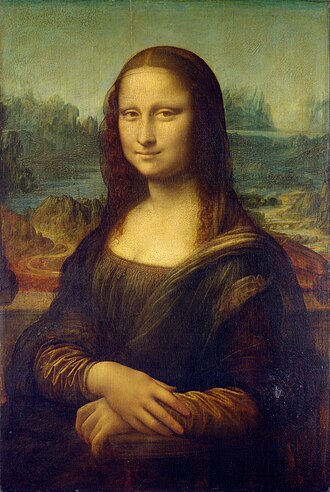
Artists later mixed pigments into drying oils to create more realistic representation. Wood panels were first favored, but stretched canvas became popular because it was easier to carry. The slow drying of oil paint allowed painters to use chiaroscuro, which shows three-dimensionality with light and shadow. In the 19th century, the box easel and paint tube let artists paint outdoors, called plein air painting, and allowed the use of synthetic colors. Watercolors were painted on paper, and gouache is used in commercial arts. In the 20th century, acrylic binders provided a fast-drying alternative to oil paint. Modern and contemporary artists used materials such as house paint, found objects, and newspaper collage. Later, digital painting allowed artists to use software programs to work with pixels instead of physical pigments.
Printmaking
Main article: Printmaking
Printmaking is creating an image for artistic purposes on a matrix. The image is then transferred to a flat surface using ink or another form of pigment. Except for a monotype, the same matrix can be used to make many copies of the print. The major techniques are woodcut, line engraving, etching, lithography, and screen printing, along with many others, including digital techniques. The image is usually transferred to paper or fabric, but other materials range from cloth and vellum to more modern materials.
Prints in the Western tradition made before about 1830 are known as old master prints. Main article: Old master print In Europe, woodcut was used for prints on paper from around 1400 AD, using printing methods developed in the Byzantine and Islamic worlds. Albrecht Dürer brought the Western woodcut to a level that has never been surpassed at the end of the century. In China, printmaking developed some 1,100 years ago as illustrations printed alongside text cut into woodblocks. Main article: Woodblock printing Over time, artists in the Song dynasty began to cut landscapes, and the technique was perfected during the Ming and Qing dynasties. In Japan, woodblock printing is best known for the ukiyo-e style, and it was widely used to print illustrated books during the Edo period. Main article: Woodblock printing in Japan Japanese woodblock printing, called mokuhanga, uses water-based inks, which allow for vivid colours and transparent glazes. In the early 20th century, shin-hanga, which blended ukiyo-e with Western painting techniques, became popular.
Photography
Main article: Photography
Photography is the process of making pictures using light. Light bounces off or is given off by objects and is recorded onto a sensitive surface or storage chip. This happens during a set amount of time, called an exposure. The process uses mechanical shutters, or electronically timed exposure of photons (tiny bits of light), which are then processed with chemicals or digitizing devices inside cameras.
The word comes from Greek words meaning "light" and "drawing" or "writing," so it literally means "drawing with light." The result of photography has traditionally been called a photograph. Many people call them a "photo" or "picture," and the word "image" is now used more and more.
Architecture
See also: Architecture
Architecture is the process and the product of planning, designing, and constructing buildings or other structures. Buildings are often seen as cultural symbols and works of art, and historical civilizations are often known by their surviving architectural achievements. Building first grew out of people's needs, such as shelter, security, and worship, and from the building materials and skills that were available. As cultures developed, building became a craft, and "architecture" is the name given to the most formal version of that craft.
The earliest surviving written work on architecture is De architectura, by the Roman architect Vitruvius, from the early 1st century AD. Vitruvius said a good building should have three qualities, often translated as firmness, commodity, and delight: durability (it should stand up well and stay in good condition), utility (it should suit its purpose), and beauty (it should be pleasing to look at).
Filmmaking
Main article: Filmmaking
Filmmaking is the process of making a motion picture. It starts with an idea and research, then moves on to writing the script, filming and recording, adding animation or special effects, editing, and working on sound and music. The last step is sharing the film with an audience. Filmmaking covers many kinds of films, including documentaries, theatre and literature on film, and poetic or experimental works. People also often use the word to describe video-based work.
Computer art
Main article: Computer art
See also: Digital art
Visual artists are no longer limited to traditional visual arts media. Computers have been used in the visual arts since the 1960s. They help artists capture or create images and forms, edit those images (including trying out many compositions), and make the final rendering or printing (including 3D printing). Many traditional art forms now use digital technology, so the lines between traditional artworks and new media works made with computers are blurred. Computer use has also blurred the lines between illustrators, photographers, photo editors, 3D modelers, and handicraft artists, and photographers may become digital artists.
Computer art is any art in which computers play a role in production or display. It can be an image, sound, animation, video, CD-ROM, DVD, video game, website, algorithm, performance or gallery installation. An artist may combine traditional painting with algorithmic art and other digital techniques, so defining computer art by its end product can be difficult. Computer art appears in art museum exhibits, but it can be seen more as a tool than a form, unlike painting. Some computer-based works belong to a new conceptual and postdigital strand, which treats the technologies, and their social impact, as a subject of study.
Plastic arts
Main article: Plastic arts
Plastic arts is a term for art forms that shape a plastic material by moulding or modelling, such as ceramics or sculpture. The term has also been used for all the visual arts, which are not writing or music. Materials that can be carved or shaped, such as stone, wood, concrete, or steel, are also included in the narrower meaning, because good tools can shape them. This use of "plastic" is different from the one used by Piet Mondrian and his movement, which he called "Neoplasticism."
Main article: Sculpture
Sculpture is three-dimensional artwork made by shaping or joining hard or plastic material, sound, text, or light. It is often made from stone (rock or marble), clay, metal, glass, or wood. Some sculptures are made by carving, while others are built together and fired, welded, molded, or cast. Sculptures are often painted. The earliest certain sculptures come from the Aurignacian culture, which lived in Europe and southwest Asia at the start of the Upper Paleolithic. This culture also made some of the earliest known cave art. Because sculpture uses materials that can be shaped, it is part of the plastic arts. Most public art is sculpture, and many sculptures together in a garden are called a sculpture garden. In the 20th century, many sculptors began to use art fabricators to make their works, since conceptual art became popular and technology improved. Sculptures can also be made with 3D printing. Some artists use the natural landscape itself, as in land art and hill figures. One example is the Litlington White Horse in East Sussex, England. It is a 20th-century shape made by removing grass to show the white chalk underneath, and it needs regular care to stay bright against the green hills.
US copyright definition of visual art
In the United States, the law that protects copyright for visual art uses a stricter definition of "visual art." A work of visual art is a painting, drawing, print, or sculpture that exists as a single copy, or in a limited edition of 200 copies or fewer that the artist signs and numbers in order. A still photo made only for exhibition also counts if it is a single signed copy or a signed, numbered limited edition of 200 or fewer.
Many things are not counted as visual art under this law. These include posters, maps, globes, charts, technical drawing, diagrams, models, applied art, films and other audiovisual works, books, magazines, newspapers, and similar publications. Merchandise, advertising, packaging, and parts of these items are also left out, as are any work made for hire and any work that is not protected by copyright under this law.

Quiz time!
5 questions about Visual arts
Why did painters start using stretched canvas instead of wood panels?
Pictures
Keep exploring




This article is a child-friendly adaptation of the Wikipedia article on Visual arts, available under CC BY-SA 4.0.
Images from Wikimedia Commons. Tap any image to view credits and license.