
Weimar
Weimar is a city in the German state of Thuringia, in Central Germany. It lies between Erfurt to the west and Jena to the east. It is about 80 km (50 mi) southwest of Leipzig, 170 km (106 mi) north of Nuremberg, and 170 km (106 mi) west of Dresden. Together with Erfurt and Jena, Weimar forms the central metropolitan area of Thuringia, which has about 500,000 people. The city itself has a population of 65,000. Weimar is well known for its cultural heritage and its importance in German history.
Weimar was a centre of the German Enlightenment and the home of the leading writers of Weimar Classicism, Johann Wolfgang von Goethe and Friedrich Schiller. In the 19th century, composers such as Franz Liszt made Weimar a centre of music. Later, artists and architects, including Henry van de Velde, Wassily Kandinsky, Paul Klee, Lyonel Feininger, and Walter Gropius, came to the city. They founded the Bauhaus movement, which became the most important German design school of the interwar period.
Weimar's political history in the 20th century was unsettled. It was the place where Germany's first democratic constitution was signed after the First World War. This gave its name to the Weimar Republic (1918–33), which existed between the end of World War I and the rise of the Nazis. The city was also one of the places later mythologized by Nazi propaganda.
Until 1948, Weimar was the capital of Thuringia. Many places in the city centre have been named UNESCO World Heritage Sites, either as part of the Classical Weimar complex, which holds monuments from the classical period of the 18th and 19th centuries, or the Bauhaus complex, which holds buildings linked to the Bauhaus art school. Heritage tourism is one of the leading economic sectors of Weimar. Notable institutions in the city include the Bauhaus University, the Liszt School of Music, the Duchess Anna Amalia Library, and two leading courts of Thuringia, the Supreme Administrative Court and the Constitutional Court. In 1999, Weimar was the European Capital of Culture.
History
Archaeological finds from the Thuringii epoch (3rd to 6th centuries) show that the Ilm valley around Weimar was settled early. The oldest records date to 899. Weimar was the seat of the County of Weimar, which united with the County of Orlamünde in 1062 and ended in the Thuringian Counts' War in 1346. Afterwards it fell to the Wettins, and the town grew. In 1552 Weimar became the residence of the Ernestine Wettins, and it stayed their capital until the end of the monarchy in 1918. The court brought wealth, and the city was home to many important figures. Johann Sebastian Bach worked there as the court's organist between 1708 and 1717.
Main article: Saxe-Weimar
Main article: Saxe-Weimar-Eisenach
Weimar's "golden" or "classical" age lasted from 1758 to 1832, a time of great culture. The city was home to Goethe, Schiller, Herder, Wieland, Bertuch and the pianist Hummel, and it became a place of pilgrimage for German thinkers. After Goethe's death, the city stayed an important cultural centre. Franz Liszt moved there in 1842, and the Weimar School of Music was founded in 1872. In 1919, Walter Gropius brought together schools to form the Bauhaus, which moved to Dessau in 1925. In 1919 the city hosted the constitution's drafting for the Weimar Republic, which lasted until 1933. After 1929 right-wing forces gained strength, and Weimar became an early centre of Nazism.
Under the Nazis, Weimar was important for its place in German history and high culture. Adolf Hitler visited it many times before 1933. In 1937 the Nazis built the Buchenwald concentration camp nearby, and some people held there were forced into slave labour. In 1945 the city centre was partly damaged by bombing, and US forces took the city before it came under the Soviet occupation zone of Germany. After German reunification in 1990, Weimar was restored with funding. It became a UNESCO World Heritage Site in 1996 and 1998, and was named European Capital of Culture for 1999. Today it is a popular home for people who work in Jena and Erfurt. In 2004 a fire damaged the Duchess Anna Amalia Library, which holds Goethe's Faust and an authentic Luther Bible from 1534. The library was reopened in 2007.
Geography and demographics
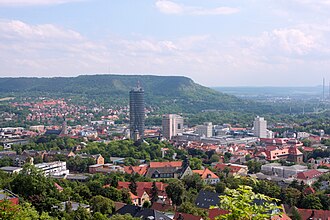
Weimar lies in the valley of the Ilm river, which flows into the Saale river. The city is on the southern edge of the Thuringian Basin, a fertile farming area between the Harz mountains to the north and the Thuringian Forest to the southwest. The land is hilly. To the north rises Ettersberg, the city's backyard mountain, and some southern hills are part of a Muschelkalk rock formation. Most of the eastern, central and western land is used for farming, while Ettersberg and some southern areas are covered in trees. Weimar has a humid continental climate or an oceanic climate, depending on the Köppen climate classification system. Summers are warm and sometimes humid, and winters are fairly cold. Snow falls mainly from December to February but seldom stays on the ground for long. Weimar borders the district of Weimarer Land, with neighbouring municipalities including Berlstedt, Ettersburg, Kleinobringen, Großobringen, Wohlsborn, Kromsdorf, Umpferstedt, Mellingen, Vollersroda, Buchfart, Hetschburg, Bad Berka, Troistedt, Nohra, Daasdorf am Berge, Hopfgarten and Ottstedt am Berge. The city itself has 10 inner urban and 11 suburban districts. The centre includes the old town (Altstadt) and Gründerzeit districts, while the Plattenbau settlements were built during the GDR period. The 11 suburban districts were once villages that joined the city during the 20th century, and most have stayed rural.
Over the centuries, Weimar was a small town of less than 5,000 inhabitants. When it became the capital of Saxe-Weimar in 1572, its population grew, and it reached 35,000 at the beginning of World War I. During the time between the world wars, the new capital of Thuringia saw a population boom, reaching 65,000 inhabitants in 1940. Since then, the population has stayed about the same. Like other eastern German cities, Weimar has a relatively small foreign population, and most of its people are not religious, because of the official atheism in the former GDR. Most of the newcomers come from rural parts of Thuringia, Saxony-Anhalt and Saxony, as well as from countries such as Poland, Russia, Ukraine, Hungary, Serbia, Romania and Bulgaria. The biggest migrant groups are Vietnamese people, Russians and Ukrainians. The city's economy has improved in recent years, and unemployment fell from 20% in 2005 to 5.1% in 2019.
Culture, sights and cityscape
Weimar has two World Heritage Sites. The Classical Weimar site has 11 places linked to Weimar as a European centre of the Enlightenment in the 1700s and early 1800s. The Bauhaus and its Sites in Weimar, Dessau and Bernau site includes two places in Weimar linked to the Bauhaus art school, which changed how people thought about architecture and design in the 20th century. The city has many museums. The Goethe-Nationalmuseum shows the life of Johann Wolfgang von Goethe, and Goethe's garden house in the Park an der Ilm shows his connection to nature. The Schiller-Museum shows the life of Friedrich Schiller. The Liszt-Haus shows the life of Franz Liszt, and the Nietzsche-Archiv shows the life of Friedrich Nietzsche. The Goethe- und Schiller-Archiv joined UNESCO's Memory of the World Programme in 2001. The Gedenkstätte Buchenwald is in the former Buchenwald concentration camp and remembers the victims of Nazi terror. Other places include the Bauhaus-Museum, the Duchess Anna Amalia Library, the Stadtmuseum, the Haus am Horn, the Fürstengruft, and the Deutsches Bienenmuseum, which hosts the only pure exhibition about bees and beekeeping in Germany.
The historic centre lies between the Ilm river and several streets and squares. Although it has medieval origins, few medieval buildings remain, because frequent fires destroyed many of them. Most buildings date from the 17th and 18th centuries. Weimar grew in many directions in the late 19th and early 20th centuries, and two Plattenbau settlements were built during the GDR period. The main church is the St. Peter and Paul church, where Johann Gottfried Herder was dean. The Catholic church was built in forms imitating Florence Cathedral, and the Russian Orthodox chapel was built for Grand Duchess Maria Pavlovna. The Gelmeroda church inspired many paintings by Lyonel Feininger. The city has large castles and palaces, such as the Stadtschloss, and ducal summer residences like Schloss Belvedere, Schloss Ettersburg, and Schloss Tiefurt. The Bauhaus University main buildings were designed by Henry van de Velde, and the German National Theatre was the place where the Weimar National Assembly developed the Weimar Constitution in 1919. The city's largest park, the Park an der Ilm, is an English landscape garden. Its famous memorial, the Goethe-Schiller-Denkmal, was made by Ernst Rietschel.
Each year since 1998, the festival Yiddish Summer Weimar celebrates klezmer music, Yiddish song, and Yiddish Language. The Onion Market, held in October, is Thuringia's largest festival. It has beer gardens, a Ferris wheel, and many stalls selling onion foods. Weimar has also had a student club in the city centre that hosts live music and disco nights.
Economy and infrastructure
Much of the land around Weimar is fertile, and 48% of the city's area is used for farming. The main crops are cereals, maize and rapeseed. Potatoes come from Heichelheim for Thuringian dumplings, including Knödel made from potatoes. Onions from Heldrungen and Oldisleben are sold at the Weimar Onion Market in October, and Saale-Unstrut wine comes from Bad Sulza. Industry has never been the main part of Weimar's economy, although several large factories operated until 1990. Most of them closed after reunification. Today, many small and medium-sized companies focus on electrical technology and engineering. The biggest producers are Bayer (medicines), Coca-Cola (drinks) and Hydrema (dump trucks). Tourism is the most important sector, and it is supported by government services, media, design and other creative work.
Weimar is connected by rail to Leipzig, Frankfurt/Kassel and other nearby towns, and it is served by the Thuringian Railway. Long-distance trains to Frankfurt and Dresden are available, but Weimar was removed from the German long-distance network after the Erfurt–Leipzig/Halle high-speed railway opened in 2015. Regional trains now connect the city with ICE stops in Erfurt, Halle and Leipzig. The city is also on the Bundesautobahn 4 motorway, and the Erfurt-Weimar Airport lies about 30 km (19 mi) west, though it has little air traffic. Bike routes such as the Ilm track and the Thuringian city string track are popular with visitors, and city buses serve the city and nearby villages. Weimar had trams from 1899 to 1937 and trolleybuses from 1948 to 1993.
After reunification, the education system was reorganised. The new Bauhaus University, founded in 1996, focuses on architecture, design and media. The Liszt School of Music is a music university founded in 1872. The city's archives include the Goethe- und Schiller-Archiv, which is part of UNESCO's Memory of the World Programme, and the Duchess Anna Amalia Library holds books and documents of German literary and cultural history.
Politics
Weimar has a mayor and a city council. Both were most recently elected on 26 May 2024. The city has had a lord mayor since 1838. The list of mayors goes back to 1793, and the years of office do not always match calendar years. Some of the mayors were Karl Pabst (1875–1910), Luitpold Steidle (1960–1969), and Gerhard Baumgärtel (1982–1989). Over time, mayors belonged to different political parties, including the NSDAP, the SED, and the LDP.
The current lord mayor is Peter Kleine, who has held the office since 1 July 2018. He is independent and runs for the CDU and the Weimarwerk Civic Alliance. He followed Stefan Wolf, a member of the SPD, who was mayor from 2006 to 2018.
Twin towns – sister cities
See also: List of twin towns and sister cities in Germany
Weimar is twinned with five cities: Blois in France, Hämeenlinna in Finland, Siena in Italy, Trier in Germany, and Zamość in Poland.
Friendly cities
Weimar also has friendly relations with Fulda in Germany, Jerusalem in Israel, Kamakura in Japan, and Shiraz in Iran.
Notable people
This section lists people connected with Weimar.
- Anna Amalia
- Johann Sebastian Bach
- Friedrich Baumbach
- Hector Berlioz
- Hans von Bülow
- Peter Cornelius
- Lucas Cranach the Elder
- Marlene Dietrich
- Johann Peter Eckermann
- Lyonel Feininger
- Paul Feyerabend
- Ute Freudenberg
- Caspar David Friedrich
- Uziel Gal
- Johann Wolfgang von Goethe
- Auguste Götze
- Walter Gropius
- Ulrike Grosse-Röthig
- Peter Gülke
- Nina Hagen
- Johann Gottfried Herder
- John Horrocks
- Johann Nepomuk Hummel
- Johannes Itten
- Joseph Joachim
- Wassily Kandinsky
- Andrey Kartapolov
- Harry Graf Kessler
- Paul Klee
- Serhiy Kulchytsky
- Christine Lieberknecht
- Ulrike Liedtke
- Franz Liszt
- Martin Luther
- László Moholy-Nagy
- Friedrich Nietzsche
- Andreas Oswald
- Jean Paul
- Friedrich Preller the Elder
- Friedrich Preller the Younger
- Joseph Joachim Raff
- Friedrich Schiller
- Baldur von Schirach
- Oskar Schlemmer
- Arthur Schopenhauer
- Frédéric Soret
- Rudolf Steiner
- Richard Strauss
- Harry Thürk
- Marcus Urban
- Henry van de Velde
- Christiane Vulpius
- Eberhard Wagner
- Richard Wagner
- Dorothea Juliana Wallich
- Johann Gottfried Walther
- Christoph Martin Wieland
- Carl Zeiss
Pictures
Keep exploring


This article is a child-friendly adaptation of the Wikipedia article on Weimar, available under CC BY-SA 4.0.
Images from Wikimedia Commons. Tap any image to view credits and license.