Safekipedia

Nazi Germany

Explorer · ages 7 and underAdapted from Wikipedia
Leaders of the Nazi Party at a 1934 rally in Nuremberg, Germany. Adolf Hitler stands in the center, flanked by SA leader Viktor Lutze and SS leader Heinrich Himmler. The Nazi regime used such rallies for propaganda, and this photo is kept as a historical record of that period.

Who Were the Nazis?

Nazi Germany was a time when Germany was run by Adolf Hitler and the Nazi Party. It was a German state from 1933 to 1945. During this time, one group held all the power in the country. It was a totalitarian dictatorship.

The Nazis called their country the "Third Reich," which means "Third Empire." They said it followed the Holy Roman Empire and the German Empire. They also hoped it would last a very long time, but it lasted only 12 years.

Life in the Country

After Hitler became Chancellor of Germany in 1933, many people had no work. This was a hard time called the Great Depression. The government built new roads called the Autobahnen, which are motorways. As more people found jobs, many people liked the government more.

In 1938, Germany joined Austria to its land. Many families also heard about a special car. Ferdinand Porsche designed it as part of the Strength Through Joy plan. After the war, the car was renamed the Volkswagen, which means "people's car."

Remembering This Time

This was a difficult time when countries did not get along. In May 1945, the Allies helped bring an end to World War II in Europe. Many leaders were later put on trial at the Nuremberg trials.

After the war, the Allies began a process called denazification. It meant removing Nazi ideas and people from the government. Today, many people think Nazi ideas and actions were deeply wrong.

Pictures

Adolf Hitler speaking to a crowd at Heldenplatz in Vienna on 15 March 1938, days after German troops entered Austria and annexed the country. The original photo caption uses Nazi propaganda language, which does not reflect historical fact.
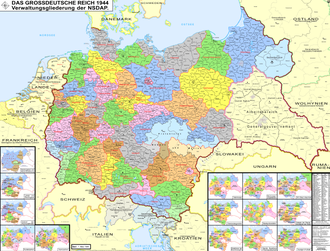
A 1944 map made by the Nazi Party showing how the Greater German Reich was divided into regions, districts, and administrative areas. It shows how the regime organized its territory during World War II.
A 17th-century map of Germany and the Holy Roman Empire, designed by Julius Reichelt and published by Nicolaes Visscher II.
A 1938 portrait photograph of Adolf Hitler, the leader of Nazi Germany at the time.
German military vehicles drive into the town of Saaz (now Žatec) in the Sudetenland in October 1938. Nazi flags hang from the buildings, marking the start of German occupation of this region of Czechoslovakia.
An animated map showing how the borders and territories of Europe changed during the Second World War.
German soldiers marching in a victory parade on Avenue Foch in Paris in June 1940, after German forces occupied the city during World War II. This photo is from the German Federal Archive.
Scottish soldiers watch as German refugees walk back through the village of Bedburg, near Kleve, in February 1945, during the final months of the Second World War in north-west Europe.
A 1941 map from a German military atlas showing the borders of the Greater German Reich during World War II.
A chart from 1935 showing how the Nazi Nuremberg Laws sorted people by their grandparents' background. These laws were unjust and based on false ideas about race, and they caused great harm to Jewish people and others in Germany.
Four men stand together at a ceremony in Berlin in August 1942, when Otto Georg Thierack became Reich Minister of Justice in Nazi Germany. The men pictured include Roland Freisler, who led the People's Court, which the Nazi regime used to punish opponents.
Joseph Goebbels, a leader of the Nazi Party, photographed in 1933. He served as Germany's Minister of Propaganda.
Hitler, Göring, Goebbels, and Rudolf Hess during a military parade in 1933
IG Farben synthetic oil plant under construction at Buna Werke (1941). This plant was part of the complex at Auschwitz concentration camp.
(from left) Hitler; Robert Ley, head of the German Labour Front; Ferdinand Porsche, armaments manufacturer; and Hermann Göring, head of the Four Year Plan (1942)
Nazi boycott of Jewish businesses, April 1933. The posters say "Germans! Defend yourselves! Don't buy from Jews!"
Poster from the Nazi Party's Office of Racial Policy: "60 000 RM is what this person with hereditary illness costs the community in his lifetime. Fellow citizen, that is your money too."
The Nazi salute in school (1934): children were indoctrinated at an early age.
Young women of the Bund Deutscher Mädel (League of German Girls) practising gymnastics in 1941
A Nazi book burning on 10 May 1933 in Berlin, as books by Jewish and leftist authors are burnt
Defendants in the dock at the Nuremberg trials

Keep exploring

This article is a child-friendly adaptation of the Wikipedia article on Nazi Germany, available under CC BY-SA 4.0.

Images from Wikimedia Commons. Tap any image to view credits and license.