Safekipedia

Shunzhi Emperor

Explorer · ages 7 and underAdapted from Wikipedia
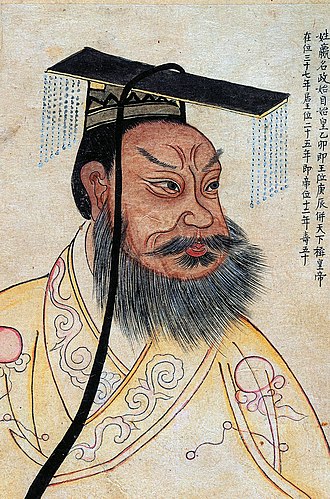
A portrait of the Shunzhi Emperor, the first Qing emperor to rule China, shown in formal court robes.

Who Was He?

The Qing dynasty had a second emperor named the Shunzhi Emperor. His personal name was Fulin. He was born in 1638 and passed away when he was 22 years old.

He was the first Qing emperor to rule over China proper. His father was Hong Taiji. When his father passed away, a group of Manchu princes chose Fulin to be the next emperor. He was only five years old.

A Young Emperor and His Helpers

Because Fulin was so young, two helpers, Dorgon and Jirgalang, helped him rule. Both were from the Aisin-Gioro clan. Dorgon was a son of Nurhaci, and Jirgalang was one of Nurhaci's nephews.

In 1644, the young emperor was crowned as the emperor of China in Beijing. For several years, the prince regent Dorgon held most of the power. Under his leadership, the Qing took over much of the land of the former Ming dynasty.

Remembered Today

When Dorgon passed away at the end of 1650, the young emperor began to rule on his own. He worked to make the government fair, and he had mixed success.

The Shunzhi Emperor was followed by his third son, the Kangxi Emperor, who ruled for sixty years. Fewer records survive from the Shunzhi time than from later periods of the Qing dynasty. So this time is not very well known today.

Quiz time!

3 questions about Shunzhi Emperor

Question 1 of 3

In which city was the young emperor crowned?

Pictures

A painting of Dorgon, Prince Rui, a 17th-century Qing Dynasty prince and military leader who was the son of Nurhaci.
The Circular Mound Altar, a round stone terrace at the Temple of Heaven in Beijing, where emperors once performed rituals to honour heaven.
The Examination Hall in Peking (Beijing), China, photographed in 1899. Imperial-era halls like this were where students took the difficult civil service exams.
Shang Kexi, the powerful 'Old Viceroy' of Guangdong, as drawn by Dutch visitors to Guangzhou around 1655.
Portrait of Ni Yuanlu, a Chinese calligrapher and painter who lived during the Ming Dynasty.
An engraving from 1656 by Johan Nieuhof showing a diplomatic embassy seen by Dutch visitors in Beijing. Historians later suggested the envoys may have come from Turfan rather than from India.
Qiongdao Island in Beihai Park, Beijing, topped by the famous White Pagoda.
A hand-colored engraving portrait of Johann Adam Schall von Bell, a German Jesuit missionary who worked in China during the Ming and Qing dynasties.
A microscope image showing smallpox viruses, greatly magnified. Smallpox was a serious disease that was wiped out worldwide thanks to vaccination.
A portrait of Oboi, a regent who helped govern China during the early reign of the Kangxi Emperor in the Qing Dynasty.
A Ming-dynasty woodblock print showing a Jurchen tribesman, made during the 1368–1644 period in China.
An elderly Chinese American man with a queue, the long braided hairstyle once required of Chinese men under Manchu rule, photographed in San Francisco in the early 1900s.
A portrait of the Shunzhi Emperor, who ruled China during the early Qing dynasty in the 1600s.
The Kangxi Emperor's three "southern tours" in the Jiangnan region—1684, 1689 (here depicted), and 1699—asserted the prestige and confidence of the newly solidified Qing dynasty a few years after it defeated the Three Feudatories.
Empress Dowager Zhaosheng, who was an influential political figure during the reigns of both her son Shunzhi and her grandson Kangxi

Keep exploring

This article is a child-friendly adaptation of the Wikipedia article on Shunzhi Emperor, available under CC BY-SA 4.0.

Images from Wikimedia Commons. Tap any image to view credits and license.