 Safekipedia
Lucknow
Adapted from Wikipedia · Adventurer experience
Lucknow is the capital and largest city of the Indian state of Uttar Pradesh. It is an important place for learning, business, culture, and visiting. Along with Agra and Varanasi, Lucknow helps form the Uttar Pradesh Heritage Arc.
The city's history goes back a very long time. It became important under leaders called the Nawabs of Lucknow. Later, it was part of big changes in India's history.
Today, Lucknow is known for its technology and car industries. It has important schools and research centers, like IIM Lucknow and the Central Drug Research Institute. The city is famous for its tasty food traditions and is recognized by UNESCO as a City of Gastronomy.
Toponymy
Lucknow is the English name for the local name "Lakhnau." There are many stories about how the city got its name. One story says it is named after Lakshmana, a hero from the ancient story Ramayana. It is said that Lakshmana had a palace there, called Lakshmanapuri, meaning "Lakshmana's city." Over time, the name changed to Lakhanpur, and later to Lucknow.
Other stories say the city may have been called Lakshmanavati, meaning "fortunate," after Lakshmana. The name slowly changed over many years. Some believe the city was named after Lakshmi, the goddess of wealth. Yet another story says it was named after an important architect named Lakhna Ahir, who built a famous fort called Qila Lakhna.
History
See also: Awadh, Kosala, and Oudh State
Lucknow has a rich history. Long ago, it was part of the land of Kosala, an important area in ancient India.
Over time, Lucknow was ruled by many groups. These included the Delhi Sultanate, the Sharqi Sultanate, the Mughal Empire, and the Nawabs of Awadh. The Nawabs made Lucknow famous for its art, music, and lovely buildings like the Bara Imambara, the Chota Imambara, and the Rumi Darwaza.
Lucknow was important in India’s fight for freedom. During a big uprising in 1857, people from Lucknow showed bravery against British rule. The city was also important for leaders like Mahatma Gandhi and Jawaharlal Nehru.
The city has been a mix of different cultures. Persian, Arabic, and British influences can be seen in its buildings, language, and traditions.
Lucknow was a key place during India’s struggle for independence. Many important events happened there, including meetings of leaders and brave actions against British rule.
Geography
Further information: Cis-Gomti area
The Gomti River is the main feature of Lucknow and flows through the city, dividing it into two parts. Lucknow is in the middle of the Indus-Gangetic Plain and is surrounded by many towns and villages such as Malihabad, Kakori, Gosainganj, and Itaunja. The city is near Barabanki to the east, Unnao to the west, and Raebareli to the south, with Sitapur and Hardoi to the north. Lucknow sits at an elevation of about 123 metres above sea level.
Lucknow used to cover an area of 402 square kilometres but grew to 631 square kilometres in 2019 when more villages were included. The city has three main areas: a busy downtown part, a middle area with concrete houses, and an outer area with villages.
Climate
See also: Floods in Lucknow
Lucknow has cool, dry winters from November to February and very hot, dry summers from March to June. Most of the rain falls between July and October, brought by winds from the southwest. Winter temperatures usually stay between 3°C and 25°C, while summer temperatures can reach 40°C to 45°C. Fog is common in the winter months.
Flora and fauna
Lucknow has about 5.66 per cent of forest cover. Some native trees in the area include shisham, dhak, mahuamm, babul, neem, peepal, ashok, khajur, mango, and gular.
The city is known for growing many kinds of mangoes, especially Dasheri, in nearby Malihabad and parts of the Lucknow district. Farmers grow crops like wheat, paddy, sugarcane, mustard, potatoes, and vegetables such as cauliflower, cabbage, tomato, and brinjal. Flowers like sunflowers, roses, and marigolds are also grown over large areas. You can also find monkeys in some forest patches around the city, like in Musa Bagh.
The Lucknow Zoo, started in 1921, is one of the oldest zoos in India. It has animals from Asia and other places, and visitors can enjoy toy train rides there. The city also has a beautiful botanical garden with many different plants. There is a Uttar Pradesh State Museum that shows old sculptures from the 3rd century AD.
Economy
Lucknow is an important city in India with many jobs and industries. It has factories that make airplanes, cars, and machines. The city is known for making clothes with special designs called Chikan embroidery that many people enjoy.
Lucknow is growing and has many technology companies. It is also a place where people study new ways to make medicines and grow plants. The city has big plans to build more places for technology jobs and to help people in many different work areas.
Administration
Lucknow is managed by important leaders and groups. The Lucknow division includes six districts and is led by a Divisional Commissioner. This commissioner looks after local government, buildings, and safety. The District Magistrate of Lucknow helps with tasks like property records and elections.
The Lucknow Municipal Corporation takes care of the city's daily needs. It started in 1862 and has had mayors and leaders over time. The corporation is led by a mayor, but daily work is done by a municipal commissioner. The most recent mayor was the first woman to hold the position.
The police in Lucknow are led by a Police Commissioner, with help from other officers. The city uses cameras and technology to keep watch and help people. There is a special phone service to support people in need.
Judicial institutions
Lucknow has a branch of the Allahabad High Court. The city also has a District & Sessions Court, five special courts, one family court, and two railway courts. The High Court branch and many other courts are in an area called Qaiser Bagh, while the railway courts are in Charbagh.
People in western Uttar Pradesh have asked for a new High Court branch to be set up closer to them, in a city called Meerut. This is because many court cases come from western Uttar Pradesh, but people have to travel far to reach the current High Court in Allahabad. Having a closer court would help people get justice more easily.
Central government offices
Since May 1, 1963, Lucknow has been an important place for the Central Command of the Indian Army. Before that, it was the base for the Eastern Command.
Lucknow also has an office of the National Investigation Agency. This group works to keep India safe. It watches over five states: Bihar, Madhya Pradesh, Uttarakhand, Jharkhand, and Chhattisgarh.
The Commission of Railway Safety of India, which is part of the Ministry of Civil Aviation, used to have its main office in Lucknow.
Infrastructure
The Lucknow Development Authority takes care of building and planning in the city. It is part of the Uttar Pradesh government. The Divisional Commissioner of Lucknow is the main leader of this group, and a special government officer handles everyday work. The city has a plan for growth until 2031.
Politics
As the main city of Uttar Pradesh, Lucknow is home to many important government offices. This includes the Uttar Pradesh Vidhan Sabha and a branch of the Allahabad High Court. Rajnath Singh, the Union Defense Minister, represents Lucknow in Parliament. There are also several areas in Lucknow that have their own representatives in the state government.
Public utilities
In Lucknow, electricity comes from the Madhyanchal Power Distribution Corporation Limited. This group works for the Uttar Pradesh Power Corporation Ltd.
Fire safety is looked after by the Uttar Pradesh Fire Service. Jal Nigam looks after the water supply, sewers, and drains. Jal Sansthan gives water to homes and connects them to water and sewer services. The Lucknow Municipal Corporation collects and manages solid waste in the city.
Transport
Roads
See also: Purvanchal Expressway, Agra–Lucknow Expressway, Awadh Expressway, and Lucknow Outer Ring Road
Lucknow has two big highways that meet at the Hazratganj intersection: NH-30 going north to Shahjahanpur through Sitapur, and NH-30 going south to Allahabad through Raebareli. There are also NH-27 to Kanpur and Porbandar through Jhansi and Silchar through Gorakhpur. Lucknow has many ways to get around, like metro trains, taxis, city buses, cycle rickshaws, auto rickshaws, and compressed natural gas (CNG) buses with or without air-conditioning. CNG was introduced to help keep the air clean.
The Lucknow Outer Ring Road is a long highway that helps traffic move better around Lucknow and makes it easier to travel to nearby areas. It connects to several roads, including Sultanpur Road, Rae Bareli Road, Hardoi Road, Kanpur Road, Ayodhya Road, and Sitapur Road.
Further information on the road and street: Subhash Marg and Mahatma Gandhi Marg
Bus
City buses
See also: Lucknow City Transport Services Limited
Lucknow has city buses run by Lucknow City Transport Services Limited (LCTSL), a public bus company. Bus stops are in places like Gudamba, Viraj Khand, Alambagh, Scooter India, Institute of Engineering and Technology, Babu Banarasi Das University, Safedabad, Pasi qila, Charbagh, Andhe Ki Chowki, Jankipuram, Gomti Nagar Railway Station, Budheshwar Intersection, Faizabad Road and Qaiserbagh.
Inter-state buses
See also: Kanpur Lucknow Roadways Service and Lucknow Upnagariya Parivahan Sewa
The main inter-state bus station is in Alambagh. There is a smaller station at Qaiserbagh. Kanpur Lucknow Roadways Service helps people travel daily for work or school. Main cities served are Allahabad, Varanasi, Jaipur, Jhansi, Agra, Delhi, Gorakhpur.
Railways
Lucknow has many train stations. The main station is Lucknow Railway Station at Charbagh, built in 1923. Next is Lucknow Junction railway station. The city links to big cities like New Delhi, Mumbai, Hyderabad, Kolkata, Chandigarh, Nashik, Amritsar, Jammu, Kota jn., Chennai, Bangalore, Ahmedabad, Pune, Indore, Bhopal, Jhansi, Jabalpur, Jaipur, Raipur and Siwan.
Lucknow has fourteen train stations, all connected by buses and roads. Trains between Lucknow and Kanpur started in 1867.
Air transport
See also: Chaudhary Charan Singh International Airport and Lucknow Air Force Station
Lucknow's airport is Chaudhary Charan Singh International Airport. It is one of the best small airports in the world. The airport can handle all types of weather and has space for up to 14 planes. It covers 480 hectares (4.80 km2; 1,187 acres), with Terminal 1 for international flights and Terminal 2 for domestic flights. It can handle planes like Boeing 767 to Boeing 747-400. International flights go to places like Dubai, Muscat, Sharjah, Riyadh, Bangkok, Dammam and Jeddah.
The airport is being expanded to allow bigger planes like Airbus A380 to land. A new terminal is being built.
Metro
See also: Lucknow Metro
Lucknow Metro started on 6 September 2017. It was built very quickly and is one of the most affordable fast public transport systems in India. Lucknow has the third largest metro network in the state after Noida, Meerut and Ghaziabad.
In February, the Chief Minister approved a metro system for the capital. It has two lines: one north-south from Munshipulia to CCS International Airport and one east-west from Charbagh Railway Station to Vasant Kunj.
Cycling
Lucknow is one of the friendliest cities for bicycles in Uttar Pradesh. There are special paths for bikes near the chief minister's home. The path is about four-and-a-half kilometres long. The bike path is separate from sidewalks and roads. Inspired by Amsterdam, new bike paths are being built. There will also be bike rentals.
Demographics
Lucknow's population has grown over the years. In 2011, about 2.8 million people lived there, and there were more men than women. Most people speak Hindi, and some speak Urdu. Many people in the city can read and write.
The number of working women in Lucknow is lower than the number of working men.
| Year | Pop. | ±% |
|---|---|---|
| 1865 | 300,000 | — |
| 1871 | 284,800 | −5.1% |
| 1881 | 261,300 | −8.3% |
| 1891 | 273,000 | +4.5% |
| 1901 | 264,000 | −3.3% |
| 1911 | 259,800 | −1.6% |
| 1921 | 240,600 | −7.4% |
| 1931 | 274,700 | +14.2% |
| 1941 | 387,177 | +40.9% |
| 1951 | 496,900 | +28.3% |
| 1961 | 595,400 | +19.8% |
| 1968 | 763,600 | +28.2% |
| 1971 | 814,000 | +6.6% |
| 1981 | 1,007,604 | +23.8% |
| 1991 | 1,669,204 | +65.7% |
| 2001 | 2,245,509 | +34.5% |
| 2011 | 2,902,601 | +29.3% |
| Source: | ||
Architecture
Main article: Architecture of Lucknow
Lucknow has many beautiful buildings from British and Mughal times. Most of these special buildings are in the old part of the city. The Uttar Pradesh Tourism Department offers tours called "Heritage Walks" to show visitors these important places. You can see religious buildings like Imambaras, mosques, and other Islamic shrines, as well as gardens, baradaris, and palace areas.
Bara Imambara in Hussainabad is a large building made in 1784 by the Nawab of Lucknow, Asaf-ud-Daula. It was built to help people during a difficult time that year. It is the largest hall in Asia without using wood, iron, or stone beams for support. Thousands of workers helped build it.
The Rumi Darwaza is a tall gate built in 1784 by Nawab Asaf-ud-daula. It was the main entrance to Lucknow and is also called the Turkish Gateway. It leads to the Great Imambara and has beautiful decorations.
Lucknow has many different architectural styles. The University of Lucknow looks very European, while the Uttar Pradesh Vidhan Sabha building and Charbagh Railway station mix Indian and Saracenic styles. Dilkusha Kothi is a palace built by a British leader around 1800, showing English Baroque style. It was used by the Nawab of Awadhs for hunting and as a summer home.
The Chattar Manzil was a palace for the rulers of Awadh and their families, with a dome shaped like an umbrella. Next to it is the 'Lal Baradari,' built by Nawab Saadat Ali Khan I between 1789 and 1814. It was used for important royal events and now serves as a museum with portraits of key leaders from the past.
La Martiniere College mixes Indian and European styles. It was built by Major-General Claude Martin, who was born in Lyon and passed away in Lucknow in 1800. The college has domed ceilings without wooden beams and also shows Gothic architecture.
Lucknow's Asafi Imambara has special vaulted halls. The Bara Imambara, Chhota Imambara, and Rumi Darwaza show a mix of Mughlai and Turkish styles, while La Martiniere College shows an Indo-European style. Even newer buildings use domes and pillars, and at night, these lit-up monuments attract many visitors.
Around Hazratganj, Lucknow's main shopping area, you can see a mix of old and new buildings. It has a multi-level parking lot where an old police station used to be, with pathways, green spaces, and lamp-posts reminding visitors of the Victorian era.
Culture
Lucknow is a city where many cultures come together. The city has a rich mix of traditions from Hindu and Muslim history. People in Lucknow are known for speaking politely and with style. They call themselves Lucknowites or Lakhnavi.
Lucknow has special clothing called ghararas. These are loose trousers worn with a kurta (shirt) and a dupatta (veil). The outfit is decorated with zari, zardozi, and gota patti lace.
The city speaks Hindi and Hindustani, but Urdu is also important, especially in poetry. Lucknow has been a center for Muslim culture and poetry.
Lucknow is famous for its Awadhi cuisine, which includes dishes like biryanis, kebabs, and special breads. The city also enjoys street foods, sweets, and drinks like kulfi and paan.
The city celebrates many festivals, including Diwali, Eid, Holi, and the Lucknow Mahotsav, a yearly event showcasing local art and culture.
Lucknow is the home of Kathak dance and many musicians. The city is also known for its embroidery, especially chikankari, a delicate white-thread embroidery on cotton clothes.
Lucknow was named India's second-happiest city in a survey, ranking above bigger cities like New Delhi, Bangalore, and Chennai.
Education
See also: List of educational institutions in Lucknow
Lucknow is a special place for learning. It has many important schools and research centers. Some well-known schools include Indian Institute of Management Lucknow and Indian Institute of Information Technology, Lucknow. There are also big universities like the University of Lucknow and King George's Medical University.
One famous school is City Montessori School. It has many branches and is one of the largest schools in the world. Lucknow also has many other schools, including La Martiniere Lucknow, one of the oldest schools in India.
There are also special schools for different groups of people, such as Integral University and Maulana Azad National Urdu University's satellite campus.
Media
Lucknow is important in India's film industry. Many movies are filmed in Lucknow. Some of these films are Umrao Jaan, Shatranj ke khiladi, and Vikram Vedha. The city has several news channels and newspapers, like Bharat Samachar and The Pioneer.
Lucknow has many FM radio stations, such as Radio City, Red FM 93.5, and Radio Mirchi. In 2015, a mobile app named "My Lucknow My Pride" was made to help protect the city's culture and bring in more visitors.
Sports
Cricket, association football, badminton, golf, and hockey are very popular sports in Lucknow.
The main sports center is the K. D. Singh Babu Stadium, which has a swimming pool and space for indoor games. There are plans to improve this stadium. Other important sports places include Dhyan Chand Astroturf Stadium, Mohammed Shahid Synthetic Hockey Stadium, and several others near Integral University.
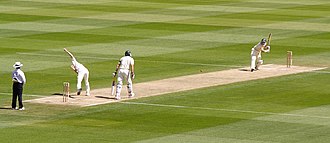
In September 2017, Ekana International Cricket Stadium opened and hosted a big cricket event. In November 2018, it held its first T20 international match between the Indian national cricket team and the West Indies cricket team. It is one of the largest cricket stadiums in India.
Lucknow is important for badminton, being the headquarters of the Badminton Association of India. The city has produced many famous sports players, including cricketers like Mohammad Kaif, Piyush Chawla, and Suresh Raina, as well as hockey players and a tennis player who reached a major tournament at Wimbledon.
In October 2021, a new cricket team called the Lucknow Super Giants was formed and will play at BRSABV Ekana Cricket Stadium.
Parks and recreation
Main article: List of tourist attractions in Lucknow
Lucknow has many beautiful parks and places to play. They are managed by the Lucknow Development Authority. Popular spots include Kukrail Reserve Forest, Qaisar Bagh, Gomti Riverfront Park, Dr. Ram Manohar Lohia Park, Eco Park, Ambedkar Memorial Park, and Janeshwar Mishra park, which is the largest park in Asia. These parks have green spaces, a large lake, paths for cycling and walking, and many kinds of plants. There are also plans to build a big Ferris wheel with great views of the city. Near Lucknow is Kukrail Picnic Spot. It has many crocodiles, a small zoo, and lots of open space to explore.
Sister cities
Lucknow has a sister city named Brisbane. Brisbane is in Queensland, which is part of Australia.
Notable individuals
Main article: List of people from Lucknow
Lucknow has been home to many famous people. They come from different fields and have helped society in many ways. The city is still a place where talented people live and grow.
Historical places
Lucknow has many special old buildings and places that people visit to learn about its history. Some of these places include Bara Imambara, Chhota Imambara, Imambara Ghufran Ma'ab, Aminabad, La Martiniere Lucknow, Isabella Thoburn College, Qaisar Bagh, Rumi Darwaza, Shah Najaf Imambara, Dargah of Hazrat Abbas, Dilkusha Kothi, Karbala of Dayanat-ud-Daulah, Tomb of Mir Babar Ali Anis, Imambara Sibtainabad (Maqbara of Amjad Ali Shah), Rauza Kazmain, Residency, Usman Enclave, All Saints Garrison Church, Lucknow, Alambagh, and Begum Hazrat Mahal Park.
Images
Related articles



This article is a child-friendly adaptation of the Wikipedia article on Lucknow, available under CC BY-SA 4.0.
Images from Wikimedia Commons. Tap any image to view credits and license.