Tiergarten (park)
The Tiergarten is a well-known park in the inner-city area of Berlin. Its name means "Animal Garden" in English. It lies completely within the district of the same name and is one of the most popular parks in the city.
At 210 hectares (520 acres), the Tiergarten is among the largest urban gardens in Germany. Only the Tempelhofer Park, which used to be Berlin's Tempelhof airport, and Munich's Englischer Garten are larger.
Its formal German name is Großer Tiergarten, which means "Greater Animal Garden." It is also known as a deer park or game hunting park.
History
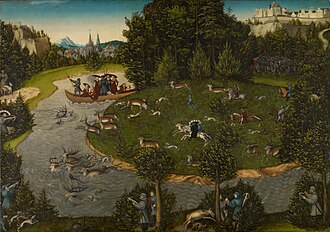
The Tiergarten began in 1527 as a hunting area for the Elector of Brandenburg. It lay west of the Cölln city wall, the sister town of Old Berlin, near the City Palace. Its forests were good for hunting deer and other wild animals, and the electors of Brandenburg used it as their main hunting ground. Over time, hunting faded as Berlin grew. Frederick Wilhelm I built many structures, and he connected his castle to the new Charlottenburg Palace with Unter den Linden. Der Große Stern and the Kurfürstenplatz were added, with boulevards. In 1740, Frederick II (Frederick the Great) opened the park's first public gardens. In 1742 he had Georg Wenzeslaus von Knobelsdorff tear down the fences, turning the park into a pleasure garden for the people of Berlin. It was decorated in the baroque style with flowerbeds, borders, espaliers and mazes. Refugees, Huguenots, were allowed to sell refreshments there. In 1786, Prince Augustus Ferdinand of Prussia moved into Bellevue Palace. A pheasant house later became the core of the Zoological Garden, a zoo founded in 1844. During the revolutions of 1848, the park hosted the first assembly demanding the end of national censors.
In the 1800s, Peter Joseph Lenné, who worked at Sanssouci in Potsdam, made a plan for a people's park. Frederick William III first rejected it, but a modified version was built between 1833 and 1840, modeled on English gardens. The park was owned by the monarchy until 1881, when it became open to the public. Nationalistic memorials were added from 1849 under Eduard Niede and Hermann Geitner, including the Siegesallee and the Königsplatz, later known as Platz der Republik. Statues by Friedrich Drake of Queen Louise, Johann Wolfgang von Goethe, Gotthold Ephraim Lessing, Theodor Fontane, Richard Wagner and Albert Lortzing were also placed in the park. After the Nazi Party took power in 1933, Adolf Hitler planned a new city called Welthauptstadt Germania, with the Tiergarten at its centre. The Straße des 17. Juni was widened, and the Berlin Victory Column was moved to the Großer Stern. The Second World War caused major damage, and some statues were buried near Bellevue Palace to protect them. After the war, the park lay in the British Occupation sector of West Berlin, and many trees were cut down for firewood. In 1945, shortly after the fall of Berlin, the occupying Soviets built the Soviet War Memorial (Tiergarten) for the Red Army near the Reichstag. The park was replanted between 1949 and 1959, with help from Berlin University, Ernst Reuter, a linden, and young trees sent during the Berlin Blockade. Later, the Haus der Kulturen der Welt was started in 1956 with Eleanor Dulles as part of the Interbau exhibition.
After the fall of the Berlin Wall in 1990, the edges of the park changed a great deal. New buildings such as the German Chancellery were built on its northern border, and open lawns replaced areas once used for picnics and football. The Tiergartentunnel allows trams and S-Bahn trains to pass under the park. Two memorials stand near the eastern end of the park: the Memorial to Homosexuals Persecuted Under Nazism, built in 2008, and the Memorial to the Sinti and Roma Victims of National Socialism, built in 2012. On 25 July 2026, the Berlin Pride van attack took place in the park.
Facilities and attractions
The park has a Berlin zoo and monuments, including the Soviet War Memorial. It also has Gaslaternen-Freilichtmuseum Berlin, a permanent exhibition of historical gas lanterns, and English gardens.
Visitors can enjoy picnics, barbecues, jogging, cycling, and field sports such as soccer. You can rent pedal taxis, and a large playground sits on the park's southeastern corner, near Potsdamer Platz. During cold winters, some of the small ponds may be used for ice-skating.
Geography
The park lies on the northern and central side of the Tiergarten area. It is bordered on the north by the river Spree. The small quarter Hansaviertel borders it on the north-west, and the Zoological Garden is on the south-west side. The main road is the Straße des 17. Juni, which ends at the Brandenburg Gate to the east. Other main roads are the Altonaer Straße, Spreeweg and Helmut-Kohl-Allee. In the middle of the park is the square called Großer Stern ("Great Star"), with the Siegessäule (Victory Column) in its centre.
Other notable places near the park include the Soviet War Memorial, the Reichstag (seat of the Bundestag) and Federal Chancellery (seat of the Chancellor of Germany) on the eastern edge, the new central railway station to the north, and on the south-eastern edge the Memorial to the Murdered Jews of Europe, the Memorial to the Sinti and Roma victims of National Socialism and the central square of Potsdamer Platz. The park covers about 210 hectares (520 acres). In the northern neighbouring quarter of Moabit, a much smaller park has the same name, so the two are called Großer and Kleiner Tiergarten.
Transport
The park is mainly served by the S-Bahn at two rail stops: Berlin Tiergarten, at the western entrance on Straße des 17. Juni, and Berlin Bellevue (lines S3, S5, S7 and S9). The N9 bus also serves the park.
In Art and Culture
Robert Walser wrote a short prose piece about the Tiergarten. It is included in Berlin Stories, a collection published in English in 2012.

Quiz time!
5 questions about Tiergarten (park)
What does the name Tiergarten mean in English?
Pictures
Keep exploring



This article is a child-friendly adaptation of the Wikipedia article on Tiergarten (park), available under CC BY-SA 4.0.
Images from Wikimedia Commons. Tap any image to view credits and license.