 Safekipedia
Pan-Germanism
Adapted from Wikipedia · Discoverer experience
Pan-Germanism is a political idea that wanted to bring all ethnic Germans, German-speaking people, or people of Germanic descent together into one nation called Greater Germany. This idea was very important in the 19th century when Germany was becoming a unified country. However, when the German Empire was officially created in 1871, some places like Switzerland, Austria-Hungary, Luxembourg, and Liechtenstein were not included.
By the late 1800s, many Pan-German thinkers began to support unfair treatments of other groups and harmful beliefs. These ideas later influenced the policies of Nazi Germany, especially the plan called Heim ins Reich, which helped lead to World War II under Adolf Hitler.
The Nazis also tried to create something called the Greater Germanic Reich, aiming to unite all Germanic peoples under one rule. After World War II, people turned against these ideas, and today Pan-Germanism is mostly supported by a few nationalist groups on the political right in Germany and Austria.
Etymology
The word pan comes from Greek, meaning "all" or "every". The term "German" comes from the Latin word "Germani", which Julius Caesar used to describe tribes in Gaul. Over time, it came to mean people who spoke Germanic languages, including those who spoke early forms of modern German.
In German, there are different words for Pan-Germanism, such as "alldeutsch" or "gesamtdeutsch", which mean wanting all German-speaking people to be in one country. The word "Pangermanismus" can also mean bringing together all people who speak Germanic languages. The term "Pan-German" was first used in English in 1892.
Origins (before 1860)
Further information: 18th-century history of Germany, German Confederation, and Vormärz
The idea of Pan-Germanism started during the time of the Napoleonic Wars, influenced by strong feelings of national pride. Many Germans at that time were not united and had been separate for a long time, since the days of the Holy Roman Empire.
People who supported uniting all German-speaking people wanted to bring together many different groups under one country. Famous thinkers and writers talked about how Germany should grow and include more lands where German people lived. They believed this would help Germany become stronger and more important in Europe.
The German Question
Main articles: German Question and Unification of Germany
In the 1860s, two powerful states, Prussia and Austria, both wanted to grow their influence. Prussia, led by Otto von Bismarck, worked to bring together many German-speaking lands. After some wars, including the German war of 1866, Prussia helped form the German Empire in 1871. This new empire included many German-speaking people but left out others, like those in Austria.
Later, during Adolf Hitler's rise to power, ideas about uniting all German-speaking people grew stronger. Groups like the Pan-German League supported these ideas, wanting to bring together people from many places into one big nation. These ideas influenced events during World War I.
Austria
Main article: German nationalism in Austria
In the early 1900s, a man named Georg Ritter von Schönerer became a big voice for people in Austria who wanted all German-speaking areas to join together under one country. After some big changes and wars, many Germans in Austria felt strongly about being part of a larger German nation instead of their own separate Austrian identity.
Later, during World War II, Austria did join with Germany. But after the war ended in 1945, people in Austria started to see themselves as their own nation again, moving away from the idea of joining with Germany.
Scandinavia
Some people in the past thought that groups who spoke similar languages, like those in Germany and Scandinavia, should join together into one big country. This idea was called Pan-Germanism. One famous writer, Jacob Grimm, believed that parts of Denmark, called Jutland, should belong to Germany because Germans lived there long ago. But others disagreed, saying we can't really know what language ancient people spoke.
Later, in the 1900s, a group in Germany wanted to create a large empire including many Germanic-speaking peoples, such as those in Denmark, the Netherlands, Sweden, Norway, and Flanders. This idea did not sit well with people in Scandinavia, especially during the time of Nazi Germany, leading to strong feelings against such plans.
1918 to 1945
Further information: Areas annexed by Nazi Germany, Völkisch movement, Heim ins Reich, and Generalplan Ost
World War I marked the first real attempt to put the idea of Pan-Germanism into action. The Pan-German movement pushed hard for expanding the empire.
After losing World War I, Germany's influence over Central and Eastern Europe dropped sharply. The Treaty of Versailles reduced Germany in size. Alsace-Lorraine became part of France again. Austria-Hungary broke apart. A small part called "German Austria" hoped to join Germany, but this was forbidden by the Treaty of St. Germain.
During the Weimar Republic, Adolf Hitler, who was born in Austria, began to support strong German national ideas. He met Heinrich Class in 1918, who helped him during the 1923 Beer Hall Putsch. Hitler and his followers shared many goals with the Pan-German League, but they had different ways of achieving them. The German Workers Party of Bohemia left the pan-German movement and joined the German Workers' Party led by Anton Drexler, which later became the Nazi Party under Adolf Hitler.
Nazi messages used the phrase Ein Volk, ein Reich, ein Führer to encourage people in Austria to support joining Germany, called an "Anschluss".
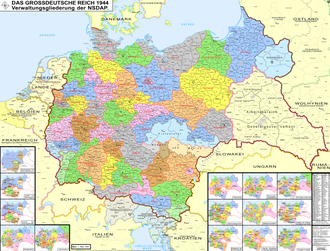
The Nazis wanted to create a new big empire called the Greater Germanic Reich. They wanted to bring in areas like the Netherlands, Belgium, parts of France, Denmark, Norway, Sweden, Iceland, parts of Switzerland, and Liechtenstein. They also looked east for more land, thinking they needed space to survive.
History since 1945
See also: Expulsion of Germans after World War II, Former eastern territories of Germany, and Reunification of Germany
After World War II, the idea of uniting all German-speaking people faded away. Germany was badly damaged and split into different zones controlled by the Soviet Union, France, America, and Britain. Later, it became two separate countries: West Germany and East Germany. Austria was also separated from Germany. After the war, Germany lost more land than before, with parts taken by the Soviet Union and Poland. Because these ideas were linked to harmful beliefs by the Nazi party, talking about uniting all German-speaking people became something people avoided. The joining of East and West Germany in 1990 brought back discussions about these old ideas.
Images
Related articles




This article is a child-friendly adaptation of the Wikipedia article on Pan-Germanism, available under CC BY-SA 4.0.
Images from Wikimedia Commons. Tap any image to view credits and license.