Safekipedia

Lion's mane jellyfish

Explorer · ages 7 and underAdapted from Wikipedia
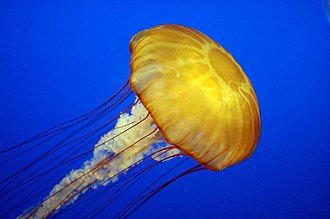
A lion's mane jellyfish (Cyanea capillata) drifting in the clear waters of the Gullmarn fjord in Sweden. Its long, trailing tentacles can reach several dozen centimetres.

What Is It?

The lion's mane jellyfish (Cyanea capillata) is one of the largest known species of jellyfish. It got its name from its long, flowing tentacles, which look like a lion's mane. Its bell has eight parts, so it looks a little like a star.

Young lion's mane jellyfish are light orange or tan. As they grow older, they turn darker red and purple.

Where Does It Live?

This jellyfish likes cold water. You can find it in the Arctic, the northern Atlantic, and the northern Pacific Oceans. It is common in the English Channel, the Irish Sea, and the North Sea.

Sometimes these jellyfish drift to new places when the water gets warmer. Some have even reached the Baltic Sea. Similar jellyfish also live near Australia and New Zealand.

Why People Know About It

The biggest lion's mane jellyfish ever measured was found off the coast of Massachusetts in 1865. Its tentacles were about 36.6 meters (120 feet) long. That is longer than a blue whale! Some scientists are not sure this record is correct.

Its tentacles can sting, so it is best to enjoy this amazing animal from a safe distance.

Quiz time!

3 questions about Lion's mane jellyfish

Question 1 of 3

Why is it called a lion's mane jellyfish?

Pictures

A lion's mane jellyfish drifting in the Gullmarn fjord near Sämstad, Sweden. This jellyfish is about 10–12 cm wide, with long tentacles that can reach 60–80 cm.
A young lion's mane jellyfish has caught a moon jellyfish with one of its tentacles, while the two small jellies drift in the waters of a Swedish fjord.
A lion's mane jellyfish swimming in the sea at Holma Marina in Sweden, seen from the side.
Three moon jellyfish are caught by a larger lion's mane jellyfish in a Swedish fjord. In spring, young lion's mane jellyfish grow quickly and often feed on moon jellyfish, sometimes attaching to their undersides.
A lion's mane jellyfish (Cyanea capillata), the largest known jellyfish, photographed in Newfoundland, Canada.
A lion's mane jellyfish (Cyanea capillata) photographed in a marina in Sweden. This one is small, about 20 cm across, and is shown in its contracted shape.
A lion's mane jellyfish (Cyanea capillata) photographed in the Holma Marina in Sweden. This small specimen is about 20 cm across.
A lion's mane jellyfish (Cyanea capillata) seen from below, photographed in the Holma Marina off the coast of Sweden.
Models of a lion's mane jellyfish and a thresher shark on display in the Sant Hall of Oceans at the Smithsonian National Museum of Natural History in Washington, D.C.
A lion's mane jellyfish (genus Cyanea) washed up on a beach in Parksville, British Columbia, Canada.

Keep exploring

This article is a child-friendly adaptation of the Wikipedia article on Lion's mane jellyfish, available under CC BY-SA 4.0.

Images from Wikimedia Commons. Tap any image to view credits and license.